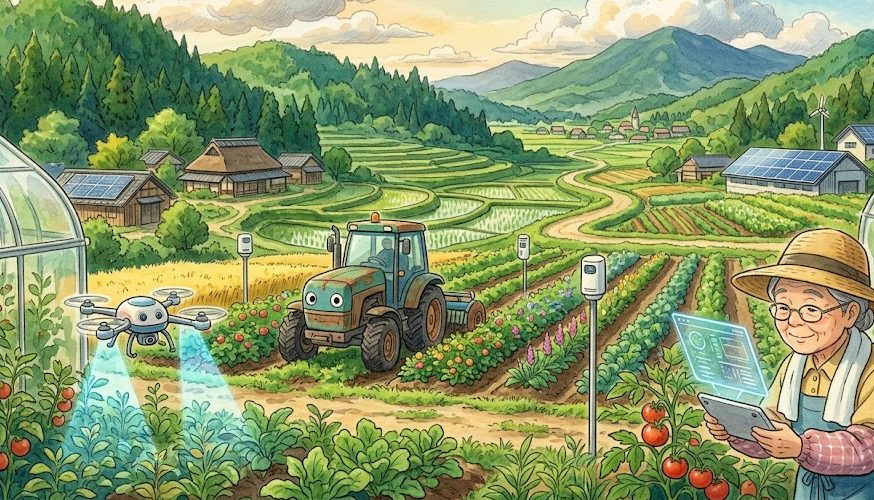
Agriculture has always been a field where timing, observation, and practical experience matter. Farmers make decisions about planting, irrigation, crop protection, harvesting, and equipment based on conditions that can change from one day to the next. As farms become more connected, artificial intelligence and automation are adding another layer to this decision-making process.
Smart farming technology combines agricultural knowledge with digital systems that can collect information, analyze conditions, and assist with repetitive tasks. Artificial intelligence can examine large amounts of data and identify patterns, while automated equipment can carry out certain operations with less manual intervention.
These technologies are not changing agriculture overnight. Instead, they are gradually becoming part of everyday farming through tools such as automated irrigation controllers, crop-monitoring cameras, GPS-guided machinery, robotic equipment, weather systems, and farm-management software.
The most useful applications are often the ones that solve practical problems. A system that helps detect a problem earlier, reduces unnecessary machine movement, improves irrigation timing, or makes farm records easier to manage can provide value without requiring an entirely automated farm.
Understanding AI and Automation in Agriculture
Artificial intelligence and automation are related, but they are not exactly the same thing.
AI refers to computer systems that can analyze information, recognize patterns, generate predictions, or assist with decisions. In agriculture, this can involve analyzing images of crops, processing weather information, identifying plant conditions, or studying historical farm data.
Automation focuses more on allowing a machine or system to perform a task with limited human intervention.
For example, a soil sensor may detect changing moisture conditions. An AI or decision-support system could analyze that information, while an automated irrigation controller could activate a pump or valve according to predefined conditions.
When these technologies work together, farming systems can become more responsive.
However, automation does not mean that farmers disappear from the process. Human oversight remains important because agricultural conditions can be unpredictable and technology can make mistakes.
AI Can Turn Farm Data Into Useful Information
Modern farms can generate large amounts of information.
Data may come from soil sensors, weather stations, satellites, drones, tractors, irrigation equipment, cameras, and mobile applications.
Individually, these measurements may not tell the whole story. AI systems can help organize and analyze them to identify patterns.
For example, a farm-management platform may combine information about weather, soil moisture, crop growth, and previous field operations. An analytical system could then highlight areas that deserve attention.
The value comes from connecting different pieces of information.
Instead of looking at a single measurement in isolation, farmers can potentially develop a broader picture of field conditions.
This does not guarantee a correct decision every time. Agricultural data can be incomplete, sensors can fail, and conditions can change quickly. AI is therefore most useful when its recommendations are reviewed alongside real-world observations.
Computer Vision Is Helping Monitor Crops
One of the most interesting agricultural applications of AI is computer vision.
Cameras can capture images of crops, leaves, soil, fruits, weeds, and other objects. AI models can then analyze those images to identify patterns.
In some systems, computer vision can help distinguish crops from weeds. In others, it may assist with detecting visible signs of stress or identifying fruit that is ready for harvesting.
This can be particularly useful when large fields make manual inspection difficult.
Instead of checking every plant individually, a camera-based system can scan a larger area and highlight locations that may require closer examination.
The farmer can then investigate those areas directly.
Computer vision is especially useful when combined with drones or agricultural machinery because cameras can collect images while equipment moves through the field.
Automated Irrigation Can Improve Daily Farm Management
Irrigation is one of the areas where automation can have an immediate practical role.
Traditional irrigation may depend on fixed schedules or manual decisions. Automated systems can use timers, soil moisture sensors, weather information, or predefined thresholds to control irrigation.
For example, a system may monitor soil moisture and activate irrigation when the measured level falls below a selected range.
This can reduce the need for constant manual switching of pumps and valves.
More advanced systems can divide a field into irrigation zones and manage each area separately.
This is useful when different parts of a field have different soil characteristics or water requirements.
Automation does not eliminate the need for monitoring. Farmers still need to check equipment, confirm sensor accuracy, and adjust settings as crop conditions change.
Smart Machinery Is Becoming More Connected
Agricultural machinery is also becoming increasingly digital.
Modern tractors and other farm machines can use GPS-based positioning, onboard computers, sensors, and software to improve navigation and record field operations.
GPS guidance can help equipment follow planned paths across fields.
This can be useful for planting, cultivation, spraying, and harvesting because consistent machine movement can reduce unnecessary overlaps and improve field coverage.
Connected machinery can also record information about fuel use, operating hours, field locations, and other activities.
Over time, these records can help farmers understand how equipment is being used and where operational improvements may be possible.
The technology is particularly useful for large operations where manually tracking every machine movement would be difficult.
Robots Are Taking On Repetitive Agricultural Tasks
Agricultural robots are being developed for tasks that can be repetitive, physically demanding, or difficult to perform efficiently at large scale.
Depending on their design, robots can assist with weeding, crop monitoring, harvesting, transportation, or other specialized operations.
A field robot may use cameras and sensors to move between crop rows and identify specific plants or objects.
Some systems are designed to remove weeds mechanically, while others may assist workers by transporting harvested produce.
The biggest opportunity for robotics is not necessarily replacing every agricultural worker. Instead, robots can potentially handle selected repetitive tasks while people focus on activities that require judgment, supervision, maintenance, or specialized skills.
The technology is still developing, and its practicality varies significantly between crops and farming environments.
AI-Based Crop Monitoring Can Detect Changes Earlier
Walking through a field and visually inspecting crops remains important, but technology can help monitor large areas more frequently.
Satellite imagery, drones, cameras, and sensor networks can collect information about crop conditions.
AI systems can compare images over time and identify areas where vegetation appears to be changing.
A section of a field showing unusual growth may indicate several possible causes, including water stress, nutrient differences, pest activity, disease, or physical damage.
The technology cannot always identify the exact cause automatically.
Instead, it can act as an early-warning system.
Farmers can investigate the highlighted area and determine what is actually happening.
This combination of automated detection and human verification can make monitoring more efficient.
Predictive Tools Can Support Farm Planning
Agriculture involves uncertainty.
Weather can change, crop development can vary, and market conditions can shift.
AI-based analytical tools can use historical and current information to support planning.
For example, models may analyze weather patterns, crop-development information, soil measurements, and historical farm records.
Depending on the system, the output may include estimates or recommendations related to irrigation, crop monitoring, equipment maintenance, or harvest planning.
These predictions should not be treated as guarantees.
A forecast is based on available data and assumptions. Unexpected weather or field conditions can change the outcome.
The best use of predictive technology is to provide another source of information that can be considered alongside local knowledge and direct observation.
Automated Weed Detection Can Reduce Unnecessary Work
Weeds compete with crops for resources and can increase farm-management costs.
Traditional weed control may involve treating large areas because it is difficult to identify every individual weed.
Computer vision offers another approach.
A camera mounted on agricultural equipment can capture images while the machine moves through the field. Software can analyze the images and distinguish between crop plants and unwanted vegetation.
In systems designed for targeted treatment, equipment may then apply control measures only where weeds are detected.
The concept is sometimes called precision weed management.
Reducing unnecessary treatment can potentially improve resource efficiency, although performance depends on crop type, weed species, camera quality, field conditions, and the accuracy of the detection system.
Automated Greenhouses Create Controlled Environments
AI and automation are also useful in protected agriculture.
Greenhouses can contain sensors that monitor temperature, humidity, light, carbon dioxide levels, moisture, and other environmental conditions.
Automated systems can respond by adjusting ventilation, irrigation, heating, cooling, or lighting.
For example, if the greenhouse becomes too warm, an automated ventilation system may activate according to programmed conditions.
If growing media becomes too dry, an irrigation system may respond to sensor readings.
This creates a more controlled growing environment.
AI can add another layer by analyzing historical environmental data and identifying relationships between conditions and crop performance.
The result can be a system that continuously monitors the growing environment instead of relying entirely on occasional manual checks.
Automation Can Improve Equipment Maintenance
Farm equipment is expensive, and unexpected breakdowns can cause significant disruption during important parts of the agricultural season.
Connected machinery can collect information about operating conditions, engine performance, usage hours, temperatures, and other indicators.
Some systems can use this information to identify unusual patterns that may indicate a maintenance issue.
This approach is sometimes referred to as predictive maintenance.
Instead of waiting for a machine to fail completely, operators may receive an indication that a component requires inspection.
Predictive maintenance is not perfect, but early warnings can potentially reduce unexpected downtime and help farmers organize maintenance more efficiently.
Farm Management Platforms Are Becoming Central Hubs
AI and automation become more useful when information from different systems can be managed together.
Farm-management platforms can act as digital hubs where farmers track fields, crops, equipment, tasks, expenses, weather information, and production records.
Some systems can connect with sensors and machinery.
This can reduce the need to maintain separate records for every activity.
A farmer may be able to review irrigation information, field maps, equipment records, and crop observations through a single digital platform.
The exact capabilities vary widely between software products, but the overall trend is toward greater connectivity.
Small Farms Can Adopt Technology Gradually
Smart farming is not limited to huge agricultural operations.
Smaller farms can also introduce technology gradually.
Instead of purchasing a fully automated system, a farmer might begin with a soil moisture sensor, digital weather station, mobile farm-management application, automated irrigation timer, or GPS-based mapping tool.
The important question is not how advanced the technology looks.
The better question is whether it solves a real problem.
If irrigation takes too much manual effort, automation may be useful. If crop monitoring is difficult because the farm is large, aerial imagery may help. If records are difficult to organize, farm-management software may be a better investment.
Starting with a specific need can make technology adoption more practical.
Connectivity Is an Important Part of Smart Farming
Many agricultural technologies depend on connectivity.
Sensors need to communicate with software. Machines may transmit operational data. Mobile applications may require internet access to synchronize information.
This can create challenges in rural areas where network coverage is inconsistent.
Some systems can store information locally and synchronize it later, while others require continuous connectivity.
Farmers considering connected technologies should therefore evaluate not only the device itself but also the communication infrastructure required to operate it reliably.
A technically advanced tool is less useful if the surrounding infrastructure cannot support it.
Data Security and Ownership Also Matter
As farms become more digital, agricultural data becomes increasingly important.
Information about field locations, crop performance, equipment use, production practices, and farm operations may be stored digitally.
Farmers should understand where their data is stored, who can access it, and how it can be exported or used.
Software providers may have different terms regarding data ownership and sharing.
Before adopting a digital farming platform, it is useful to review its privacy and data-management policies.
Technology should make farming more efficient without creating unnecessary uncertainty about important farm information.
The Human Role Remains Essential
One of the biggest misconceptions about agricultural automation is that technology can make every farming decision automatically.
Real farms are too complex for that approach.
Weather conditions can change unexpectedly. Machines can malfunction. Sensors can provide inaccurate readings. A crop may behave differently from historical patterns.
Farmers understand local conditions that may not appear in a dataset.
For this reason, AI and automation work best as support tools.
A system can identify an unusual area in a field, but the farmer can inspect it. A weather model can provide a forecast, but the farmer can consider local observations. An automated irrigation system can follow sensor readings, but the farmer can adjust the settings when circumstances change.
Human judgment remains an important part of the system.
What the Future Could Look Like
Agricultural technology is moving toward greater integration.
Instead of separate systems for irrigation, machinery, crop monitoring, weather, and record keeping, future platforms may connect many of these functions.
A field could contain sensors collecting soil information while satellites and drones provide crop imagery. Farm software could combine those datasets with weather information and equipment records.
AI systems could analyze the information and highlight areas requiring attention.
Automated machinery could then perform selected tasks based on approved instructions.
This does not mean every farm will become completely autonomous. Different crops, climates, budgets, and farming methods require different solutions.
The more realistic future is likely to involve different levels of automation depending on the needs of each operation.
Making Smart Technology Work in the Real World
The success of smart farming depends on more than purchasing advanced equipment.
Farmers need reliable information, suitable infrastructure, training, maintenance, and clear goals.
A technology project should begin with a practical question.
What problem needs to be solved?
Is water management difficult? Is crop monitoring taking too much time? Is equipment maintenance unpredictable? Are field records disorganized?
Once the problem is identified, the appropriate technology becomes easier to evaluate.
This approach can prevent farmers from investing in complicated systems simply because they are technologically impressive.
Conclusion
Artificial intelligence and automation are creating new possibilities for modern agriculture.
AI can analyze agricultural data, recognize patterns, support crop monitoring, and assist with planning. Automation can control irrigation, guide machinery, monitor greenhouse conditions, support equipment maintenance, and perform selected repetitive tasks.
Together, these technologies can make certain agricultural operations more connected and information-driven.
However, smart farming is not about removing people from agriculture. Technology works best when it supports the knowledge and experience of farmers.
The future of agriculture will likely combine human decision-making with increasingly capable digital tools. Farmers who understand their own challenges and adopt technology where it provides genuine value can gradually build more efficient and better-organized farming systems.
Smart agriculture is ultimately not defined by how many machines or sensors a farm owns. It is defined by how effectively technology is used to understand conditions, manage resources, and support better everyday agricultural decisions.