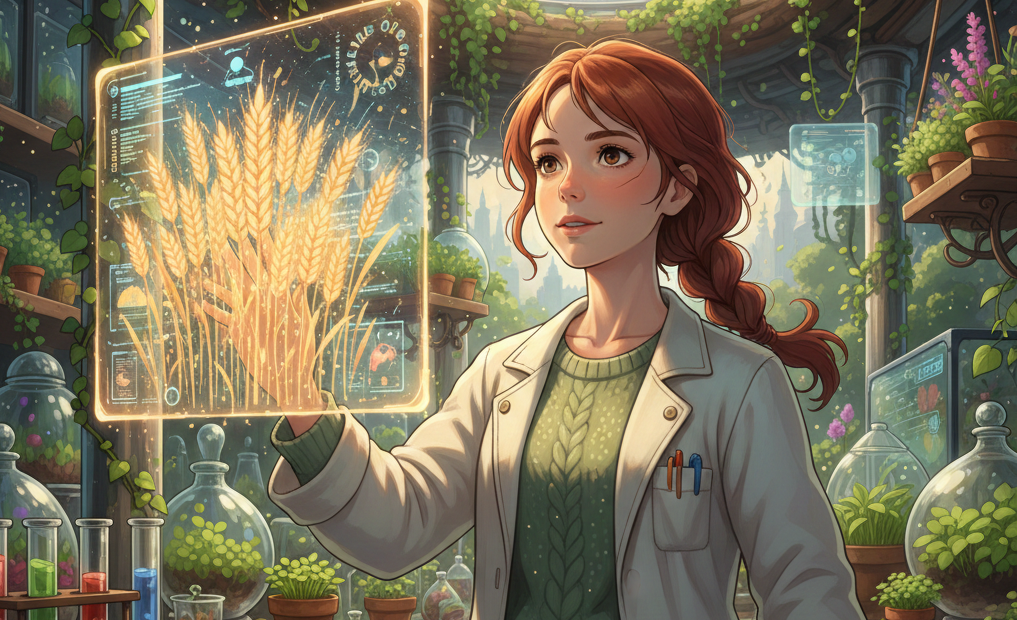
Did you know that by the year 2050, global food demand is expected to increase by 70%, yet nearly 30% of potential crop yields are lost annually due to unpredictable weather and pests? For centuries, farmers have looked at the sky and the soil, making educated guesses about their harvest. But in an era of rapid climate change and resource scarcity, “guessing” is no longer enough. The stakes are too high for the modern farmer to rely on luck.
The challenge is clear: how do we feed a growing population while dealing with erratic rainfall, degrading soil health, and rising costs? The answer lies in the digital palm of our hands—Artificial Intelligence (AI). By transforming raw data into actionable insights, AI is moving agriculture from a game of chance to a high-precision science. This article explores how AI-driven yield prediction is revolutionizing the industry, the immense benefits it brings, and how you can begin integrating these smart solutions into your own farming practices.
💡 Understanding AI in Crop Yield Prediction: Key Concepts and Importance
At its core, Artificial Intelligence in agriculture is about using machines to simulate human intelligence to solve complex problems. When we talk about predicting crop yields, AI acts like a “super-expert” that can look at thousands of variables simultaneously. Unlike traditional methods that might only consider last year’s performance, AI looks at the bigger picture.
Key Components:
- Machine Learning (ML): These are algorithms that learn from historical data—such as past weather patterns, soil types, and seed varieties—to identify trends that are invisible to the human eye.
- Satellite Imagery & Computer Vision: AI “sees” the farm through high-resolution satellite or drone images. It can detect changes in leaf color or plant height to estimate how much grain or fruit will be produced months before harvest.
The Analogy: Think of AI as a GPS for your farm. Just as a GPS calculates traffic, road conditions, and speed to tell you exactly when you will arrive at your destination, AI calculates soil moisture, heat units, and pest cycles to tell you exactly how much harvest you will achieve.
✨ Why It Matters: The Top Benefits of AI Yield Prediction
The integration of AI isn’t just a trend; it is a fundamental shift that offers tangible rewards for both small-scale organic growers and large commercial farmers.
- Economic Stability: Precision leads to profit. When a farmer knows their expected yield, they can negotiate better prices with buyers in advance and reduce the waste of expensive seeds and fertilizers.
- Environmental Sustainability: AI-driven insights allow for “Variable Rate Application.” This means farmers only apply water or nutrients where the AI predicts a need, preventing chemical runoff into local water supplies and protecting the soil microbiome.
- Enhanced Risk Management: AI provides an early warning system. If a heatwave or a specific pest outbreak is predicted to lower yields, farmers can take preventive action—like early harvesting or applying organic biopesticides—to mitigate the damage.
- Global Food Security: By stabilizing yields and reducing crop failure, AI ensures a more consistent food supply for local communities and the global market.
Pro Fact: Studies show that farms using AI-based predictive analytics can increase their resource efficiency by up to 25%, significantly lowering the cost per acre.
🌱 How to Get Started: A Practical Guide for Beginners
Transitioning to smart farming doesn’t require a degree in computer science. You can start small and scale up as you see the results.
- Step 1: Digitize Your Records: Start keeping digital logs of your planting dates, fertilizer types, and harvest weights. This data is the “fuel” that AI needs to learn about your specific land.
- Step 2: Leverage Free Agri-Apps: Use mobile applications like Plantix or Google’s specialized tools. These apps use AI to identify plant diseases from a simple smartphone photo and provide yield estimates based on your region.
- Step 3: Invest in Basic Soil Sensors: Affordable IoT (Internet of Things) sensors can now measure soil pH, moisture, and temperature. Connect these to a central app to get real-time health reports of your field.
- Step 4: Monitor Localized Weather Data: Move beyond general news reports. Use AI-powered weather services that provide hyper-local forecasts tailored specifically to your farm’s coordinates.
- Step 5: Consult with Agri-Tech Experts: Many startups now offer “Prediction as a Service.” For a small fee, they can analyze your farm’s satellite data and provide a detailed yield forecast report.
Beginner’s Tip: Don’t try to automate the whole farm at once. Choose one specific crop or one section of your field to test AI tools. Compare the results with your traditional sections to see the difference in accuracy.
🚀 Overcoming Challenges and Looking into the Future
While the potential is enormous, there are hurdles to consider. The initial cost of high-end sensors and the technical learning curve can be intimidating for traditional farmers. Furthermore, in many rural areas, limited internet connectivity remains a barrier to real-time data syncing.
However, the future is incredibly bright. We are moving toward an era of “Autonomous Agriculture.” In the next decade, we expect to see AI models that not only predict yields but also automatically trigger drones to release beneficial insects or adjust irrigation pivots without any human intervention. The convergence of AI with regenerative organic practices will ensure that we don’t just grow more food, but better food that heals the earth.
✅ Conclusion
Artificial Intelligence is no longer a luxury reserved for tech giants; it is becoming the backbone of resilient, sustainable farming. By accurately predicting crop yields, we empower farmers to make smarter decisions, protect our natural resources, and secure our global food future. The journey toward a smarter farm starts with a single data point. Embrace the technology today to ensure a bountiful harvest tomorrow.
Next Step: Take a look at your current farm records. Are they ready for the AI revolution? Start by downloading a basic crop monitoring app today and see the power of data in action.
❓ Frequently Asked Questions (FAQs)
1. Is AI expensive for small farmers? While some systems are costly, many mobile-based AI tools are free or very low-cost, making them accessible even for small-scale home gardeners.
2. Does AI yield prediction work for organic farming? Absolutely. In fact, AI is perfect for organic farming because it helps you manage soil health and pests naturally by providing precise data before problems arise.
3. How accurate are AI predictions? Depending on the quality of the data provided, modern AI models can achieve over 90% accuracy in predicting harvest volumes.
4. Do I need a drone to use AI? No. While drones are helpful, most AI prediction models can work using only satellite data and soil sensor inputs.
Bhai, ye article kaisa laga? Agar aapko aise hi baaki 19 articles chahiye, toh bas title bhejte jao! Would you like me to write the next one on “Regenerative Agriculture”?