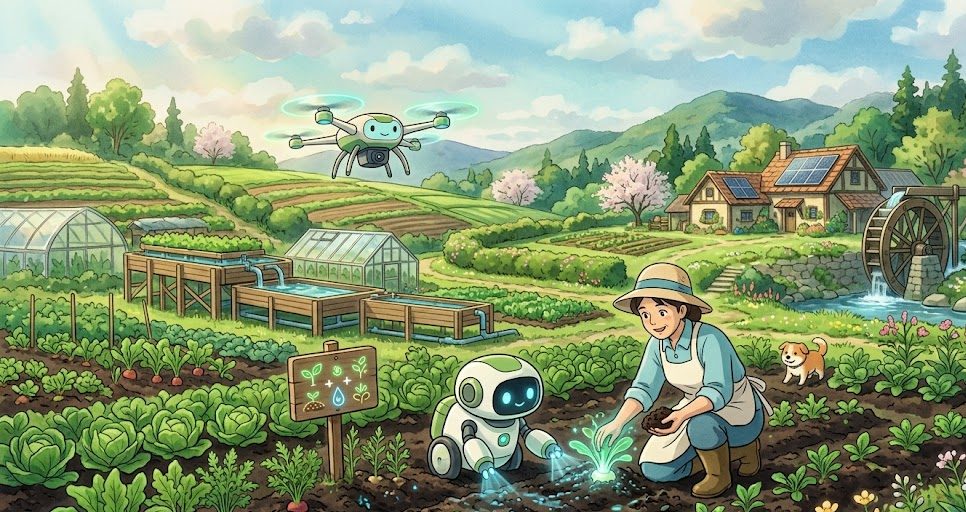
The global agricultural landscape is standing at a critical crossroads. As traditional industrial methods face the limits of chemical dependency and soil depletion, a new movement is emerging—one that combines AgriTech & Innovation with deep-rooted biological wisdom. For the modern farmer and the digital entrepreneur, the goal is no longer just about volume; it is about “Smart Farming” that ensures long-term profitability and ecological health.
The New Frontier: AI and Smart Technology
The “Digital Revolution” in farming isn’t just a buzzword; it’s a fundamental shift in how we produce food. By utilizing AI and Smart Technology, farmers can now move from broad, generalized practices to precision-based management.
- Precision Agriculture: Using AI to analyze data helps in applying water, fertilizers, and pesticides only where and when they are needed.
- Data-Driven Decisions: Smart farming tools allow for the monitoring of crop health and environmental conditions in real-time.
- Real-Time Monitoring: Sensors and data analytics can monitor moisture levels and nutrient requirements in real-time, reducing waste.
- Efficiency and Waste Reduction: These innovations reduce resource waste, which is essential for “Sustainable Farming”.
The Heart of the Revolution: Healing the Soil Naturally
At the center of Agriculture 2.0 is a return to soil health. Modern agriculture is moving toward Climate & Soil Management that treats the soil as a living ecosystem rather than just a medium for plants.
- Natural Soil Healing: Instead of relying on synthetic inputs, the focus is on natural restoration and soil science to enhance microbial health.
- Restoring Nutrient Cycles: Focusing on soil science—such as organic matter enrichment and microbial health—ensures the ground remains productive for generations.
- Microbial Synergy: Understanding soil science helps in fostering the beneficial bacteria and fungi that naturally feed and protect crops.
- Carbon Sequestration: Healthy soil management doesn’t just improve yields; it helps combat climate change by trapping carbon in the ground.
Implementing Smart Farming Solutions
To achieve maximum yields, farmers are implementing a variety of practical and innovative “Smart Farming” solutions.
- Water Saving Farming: Automated irrigation and sensors ensure “Water Saving Farming” becomes a reality, which is vital for survival in drought-prone areas.
- Smart Crop Farming: Selecting the right crops for the right soil through “Smart Crop Farming” minimizes risk and maximizes output.
- Climate Adaptation: Advanced “Climate & Soil Management” allows farmers to prepare for and adapt to unpredictable weather patterns.
- Smart Planning: Before planting a single seed, successful modern farming requires a strategic “Blueprint” that integrates innovation with traditional wisdom.
Diversification and High-Value Growth
The digital revolution encourages the diversification of the farm into a “Farming Innovation Hub”. This approach creates multiple revenue streams while improving the farm’s overall health.
1. High-Value Cash Crops
Focusing on “Exotic Vegetable Farming” or “Herbal & Medicinal Plants” can lead to higher profit margins.
- Hydroponics: A soil-less method that allows for “Smart Crop Farming” in controlled environments, ensuring year-round production.
- Mushroom Farming: This requires minimal land and can be a highly profitable “Sustainable Farming” venture.
2. The Livestock & Dairy Hub
Integrating a “Livestock & Dairy Hub” with traditional crop farming creates a closed-loop system.
- Closed-Loop Nutrients: Animals provide manure for “Natural Soil Healing,” while the farm provides feed.
- Animal Health: Maintaining high standards of “Animal Health” ensures that livestock side-businesses contribute effectively to the overall “Sustainable Business” model.
3. Fish & Aqua Farming
Adding “Fish & Aqua Farming” into the mix provides nutrient-rich water for crops and a secondary source of protein, further diversifying the business.
Conclusion: The Future of the Green Revolution
The future of farming lies in the balance between the precision of AgriTech & Innovation and the foundational principles of soil science. By mastering these “Smart Farming” techniques, we can ensure that our harvests are not only bountiful today but sustainable for generations to come.
Whether you are an established farmer or a digital entrepreneur building an “Innovation Hub,” Agriculture 2.0 offers the tools needed for a “Digital Wealth Blueprint” in the sector. The era of smart, sustainable, and high-yield farming has arrived.