Ten years ago, my farm was a battlefield. I was constantly fighting fires. If the soil was dry, I pumped water until the pump broke. If I saw a weed, I sprayed it until my chemical bill put me in the red. If a crop failed, I just blamed the weather and tried the exact same thing the next year. I was treating my farm like a collection of broken parts rather than a living, breathing machine.
It took years of exhaustion and razor-thin profit margins for me to realize that modern farming isn’t just about working harder. It is about working smarter by connecting the dots.
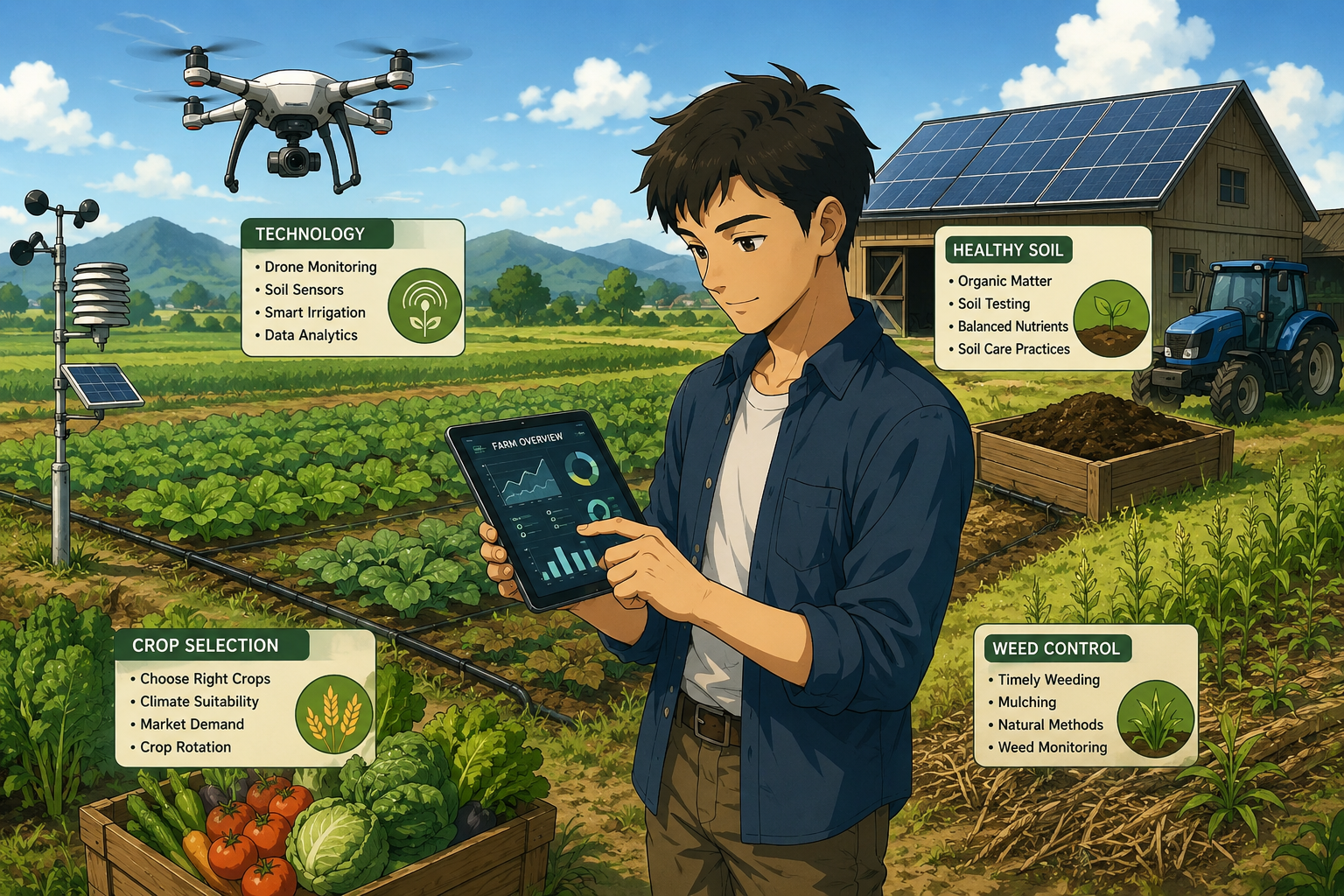
You cannot separate your soil health from your weed control. You cannot separate your crop selection from your technology. They are all gears in the exact same engine. Today, I want to walk you through how these four pillars—Soil Health, Crop Selection, Weed Control, and Smart Technology—actually work together to create a farm that practically runs itself.
Pillar 1: Soil Health (The Foundation)
Everything starts in the dirt. If your soil is dead, no amount of expensive technology or premium seeds will save your harvest. Ten years ago, I thought “good soil” just meant dirt that had a lot of synthetic fertilizer dumped on it.
Today, I know that real soil health is about biological life. A handful of healthy, dark loam contains billions of microscopic workers—mycorrhizal fungi, nematodes, and aerobic bacteria.
- The Sponge Effect: When you build up organic matter (using compost and cover crops), your soil turns into a massive underground sponge. It holds onto water during a drought and drains properly during a flood.
- Natural Immunity: A thriving soil food web literally attaches itself to the roots of your crops. It acts as an underground highway, delivering specific minerals to the plants and boosting their natural immune system against pests.
You don’t build soil; you heal it. Once the soil is healed, it stops being a medium you have to constantly feed, and it starts becoming an active partner in your farm’s success.
Pillar 2: Crop Selection (The Engine)
Choosing what to plant used to be a guessing game for me. I would see a trendy crop online, buy the seeds, and hope my local climate would cooperate. It was an expensive gamble.
In a modern, integrated farm, crop selection is a highly strategic decision that directly influences your soil health and your weed pressure.
The Crop Rotation Strategy:
You cannot plant corn in the same field for five years straight and expect good results. Heavy feeders like corn drain the soil of nitrogen. By rotating your crops, you naturally balance the ecosystem.
- Year 1: Plant a heavy feeder (like tomatoes or corn) that requires rich, deep soil.
- Year 2: Follow it with a legume (like beans or peas). Legumes are nitrogen fixers; they literally pull nitrogen out of the air and push it back into the soil, repairing the damage from Year 1.
- Year 3: Plant a deep-rooted crop (like carrots or radishes) to naturally aerate the soil and break up any compaction.
When you select the right crops in the right order, they do the tilling and fertilizing for you.
Pillar 3: Weed Control (The Defense)
Weeds are the ultimate opportunists. If you leave a patch of bare dirt, nature will immediately send a weed to cover it up. For my first three years, I tried to beat weeds with heavy rototilling. All I did was churn up thousands of dormant weed seeds from deep in the earth and bring them to the surface to germinate.
Responsible weed control in a modern system isn’t about poisoning the land; it is about outsmarting the seed bank.
The “Canopy and Smother” Method:
- Stale Seedbed: Weeks before I plant my real crops, I water the bare dirt. The weeds think it’s spring, so they sprout. I immediately terminate them with a flame weeder or a shallow stirrup hoe. By the time my cash crop goes in, the top layer of weed seeds is already gone.
- Living Armor: The moment my cash crop is harvested, I broadcast cover crop seeds (like winter rye). This creates a dense, impenetrable canopy. Any remaining weed seeds are completely starved of sunlight and simply die off in the shade.
Pillar 4: Farm Technology (The Brain)
This is where the magic happens. A decade ago, I thought “AgriTech” was just for massive corporate farms. But today, smart technology is what ties the soil, the crops, and the weed control together into one manageable system.
Technology doesn’t replace the farmer; it acts as an extension of the farmer’s eyes and ears.
- IoT Soil Sensors: I don’t guess when to water anymore. Wi-Fi-enabled moisture probes buried in my fields tell my phone exactly when the roots are dry. This prevents over-watering, which protects my soil structure and keeps fungal diseases away.
- Drone Scouting: I fly a small drone with an NDVI camera over my fields once a week. It reads the photosynthesis levels of the plants. If a patch of weeds is starting to break through the canopy, the drone spots it from the air before I can see it from the ground.
- Farm Management Software: I log my crop rotations, my cover crop dates, and my harvest yields into a cloud app. When I sit down in the winter to plan next year, the software tells me exactly which fields need a nitrogen-fixing crop and which ones have the highest weed pressure.
The Synthesis: How the System Works Together
Reading about these four pillars separately is one thing, but the real profitability comes when you lock them all together. Let’s look at exactly how they interact in a real-world scenario.
Imagine you are fighting a massive outbreak of broadleaf weeds in a specific pasture.
- The Tech: Your drone maps the field and identifies the specific GPS coordinates of the heaviest weed pressure. You log this into your farm app.
- The Crop Selection: Knowing that field has a weed problem, you don’t plant a delicate, slow-growing crop there next spring. Instead, you select a fast-growing, aggressive crop (like forage sorghum or a dense cover crop mixture) that will rapidly establish a canopy.
- The Weed Control: Because you chose an aggressive crop, it out-competes the broadleaf weeds for sunlight. The weeds are naturally smothered without you having to spray a single drop of chemical herbicide.
- The Soil Health: As the aggressive cover crop dies back in the winter, its massive root system decays, feeding the soil biology and adding a thick layer of organic matter to the topsoil, preparing the ground perfectly for a high-value cash crop the following year.
To help visualize this interconnected web, I use a system simulation. Play with the interactive tool below to see how changing one variable impacts the entire farm.
The Master Blueprint
If you want to transition your land into a modern, highly efficient operation, here is a quick cheat sheet on how to align your practices:
| Farm Pillar | The Old Way (Reactive) | The Modern Way (Proactive & Integrated) |
| Soil Health | Dumping synthetic NPK fertilizer based on guesswork. | Building organic matter; using IoT sensors to prevent over-watering. |
| Crop Selection | Planting the same cash crop in the same dirt every year. | Strategic crop rotation to naturally balance soil nutrients. |
| Weed Control | Deep tilling that churns up new seeds; heavy spraying. | Using the Stale Seedbed method and dense cover crop canopies. |
| Technology | Pen and paper; repairing things only after they break. | Drone scouting for early detection; cloud software for rotation planning. |
Final Thoughts from the Field
Farming is an incredibly demanding profession, but it shouldn’t feel like you are at war with the earth. When you treat your farm as a single, connected ecosystem—where the technology monitors the soil, the soil feeds the crops, and the crops suppress the weeds—the heavy lifting is finally taken off your shoulders.
Start small. This season, download one farm management app to track your yields. Plant one field with a nitrogen-fixing cover crop. Try the stale seedbed technique on just a quarter of an acre. Once you see how these systems naturally support each other, you’ll never go back to fighting the dirt.
Let the technology give you the data, let the biology do the work, and finally enjoy the harvest you’ve earned.