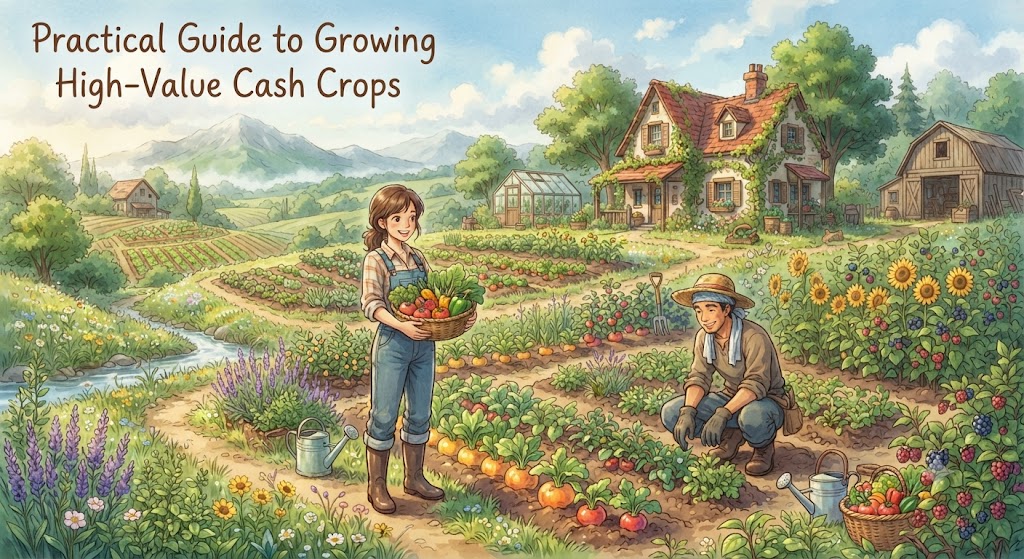
Growing a high-value cash crop can be an attractive option for farmers who want to generate more income from a relatively small area of land. Unlike staple crops that are often produced in large volumes with relatively narrow profit margins, high-value crops can earn considerably more per acre or hectare when quality, timing, and market access are managed well.
Examples include specialty vegetables, herbs, berries, greenhouse crops, cut flowers, culinary plants, and certain specialty grains or seeds. However, a crop is not automatically profitable simply because it sells for a high price. Production costs, labor requirements, storage, transportation, weather, and local demand can all determine whether a crop actually makes financial sense.
The most successful approach is to treat cash-crop production as both a farming activity and a small business.
Start With the Market, Not the Seed Packet
One of the most common mistakes new growers make is choosing a crop first and looking for buyers later.
A better approach is to reverse the process.
Before planting, investigate:
- Who is likely to buy the crop?
- How much do they normally purchase?
- What quality standards do they expect?
- What price range is realistic?
- When is demand highest?
- How quickly must the crop reach the buyer?
- Are there established competitors nearby?
Potential markets include farmers’ markets, restaurants, farm shops, grocery stores, wholesalers, food processors, cooperatives, community-supported agriculture programs, and direct online sales.
For example, a grower near a large city may have opportunities to supply restaurants with fresh herbs or specialty vegetables. A rural grower with limited access to direct customers may need to work with wholesalers or local distributors.
The important point is that market access should influence crop selection.
Choosing the Right High-Value Crop
There is no single crop that is most profitable everywhere. Climate, soil, water availability, labor costs, infrastructure, and consumer demand vary significantly between regions.
Some categories worth investigating include:
| Crop category | Examples | Potential advantage |
|---|---|---|
| Specialty vegetables | Baby carrots, specialty tomatoes, salad greens | Shorter production cycles |
| Culinary herbs | Basil, coriander, mint, parsley | Strong demand and repeat harvesting |
| Berries | Strawberries, raspberries, blueberries | High retail value |
| Specialty mushrooms | Oyster and other culinary varieties | Can be grown in controlled environments |
| Cut flowers | Seasonal flowers, specialty varieties | Direct-to-consumer opportunities |
| Greenhouse crops | Tomatoes, peppers, cucumbers | Extended growing season |
| Specialty seeds | Herb, flower, vegetable seeds | Potentially high value per unit |
| Medicinal or aromatic plants | Selected legal herbs and botanicals | Niche-market opportunities |
The best choice is usually the crop that fits both the farm and the market.
A crop requiring intensive irrigation may not be appropriate for a farm with limited water. Similarly, a highly perishable crop may be difficult to sell profitably if buyers are several hours away.
Calculate Profit Before Planting
High selling prices can be misleading.
Imagine a crop sells for $5 per unit while another sells for only $1.50. The first crop may appear more attractive, but if it requires three times as much labor, expensive infrastructure, specialized packaging, and rapid transportation, its final profit could be lower.
A simple planning equation is:
Estimated profit = expected revenue − total production costs
Production costs should include more than seeds and fertilizer.
Consider:
- Seeds or planting material
- Soil preparation
- Fertilizer and amendments
- Irrigation
- Pest management
- Labor
- Machinery
- Greenhouse or protected structures
- Packaging
- Refrigeration
- Transportation
- Market fees
- Insurance
- Land costs
- Equipment maintenance
- Crop losses
It is also wise to calculate a conservative scenario.
For example:
Expected yield × realistic selling price = potential gross revenue
Then subtract all expected expenses.
Do the same calculation using a lower selling price and a lower yield. This helps reveal whether the business can survive an average or difficult season.
Small-Scale Trials Can Prevent Expensive Mistakes
Instead of immediately planting an entire field with a new crop, consider starting with a trial area.
A small trial can answer practical questions such as:
- Does the crop perform well in the local soil?
- How much labor does it actually require?
- What pests appear?
- How much irrigation is needed?
- What percentage of the harvest reaches marketable quality?
- Can local buyers sell it at the expected price?
For a first season, the objective does not have to be maximum production.
The objective can be learning at a controlled cost.
Once production methods and market demand are better understood, the grower can gradually expand.
Soil and Water Come First
High-value crops often have relatively demanding quality requirements. Poor soil fertility, drainage problems, or inconsistent irrigation can quickly reduce marketable yield.
A soil test is therefore one of the simplest starting points.
Testing can provide information about:
- Soil pH
- Major nutrients
- Organic matter
- Salinity in some situations
- Other characteristics relevant to crop selection
The results can then guide nutrient management rather than relying on guesswork.
Water management is equally important.
Both drought and excessive moisture can damage crops. Drip irrigation, mulching, moisture monitoring, rainwater management, and well-designed drainage can help improve consistency where appropriate.
For growers in parts of the UK, excessive rainfall and poor drainage may be a bigger concern than irrigation. In many parts of the United States, particularly warmer or drier regions, irrigation planning may be a central part of the production system.
Quality Can Be More Important Than Maximum Yield
A high-value crop is often sold based on quality rather than simply weight.
Buyers may care about:
- Appearance
- Size
- Color
- Freshness
- Uniformity
- Flavor
- Shelf life
- Cleanliness
- Packaging
- Harvest timing
Producing 10,000 kilograms of a crop does not necessarily create a good business if a significant portion cannot be sold at the target price.
Instead, growers should think about marketable yield.
Marketable yield is the portion of the harvest that actually meets the buyer’s requirements and can be sold.
This changes how a farmer evaluates production. A smaller harvest with excellent quality may sometimes generate more useful revenue than a larger harvest with substantial waste.
Timing Can Create a Major Advantage
Markets frequently experience periods when supply is limited and prices are stronger.
This creates an opportunity for growers who can produce crops during those windows.
Protected cultivation, succession planting, early-season production, late-season production, storage, and careful variety selection can sometimes help extend the marketing period.
For example, rather than planting an entire field on one date, a grower may divide production into several planting dates. This can spread harvests over a longer period and reduce the risk of having the entire crop ready simultaneously.
However, timing should be based on actual local market information rather than assumptions about price.
Direct Sales Can Change the Economics
Selling directly to consumers can sometimes provide a higher price than selling through a wholesale channel, but it also requires additional work.
Direct-market options include:
- Farmers’ markets
- Farm stands
- Community-supported agriculture
- Local delivery
- Online farm stores
- Restaurant relationships
- Subscription boxes
The higher selling price must be compared with the additional costs of marketing, customer communication, packaging, transportation, and sales time.
A farmer should therefore calculate net return per hour of work, not just price per kilogram or pound.
Labor Is Often the Hidden Cost
Some high-value crops require substantial manual work.
Planting, pruning, harvesting, sorting, washing, packing, and delivering produce can consume more time than expected.
Before expanding production, estimate the labor required for every stage.
A useful question is:
If the crop succeeds exactly as planned, do I have enough people and time to harvest and sell it?
This is particularly important with highly perishable crops. A mature crop cannot always wait several days for labor to become available.
Reduce Risk Through Crop Diversification
Putting the entire farm into one high-value crop can create substantial financial exposure.
Weather events, disease, changing prices, buyer problems, or transportation disruptions can affect a single crop severely.
Diversification can reduce some of this risk.
A farm might combine:
- One fast-growing crop
- One longer-season crop
- One perennial crop
- A protected-culture crop
- A direct-market crop
The exact combination depends on the farm’s resources.
Diversification does not eliminate risk, but it can prevent one problem from affecting the entire business.
Consider Value-Added Products
Sometimes the greatest opportunity is not selling the raw crop.
Depending on local regulations and food-safety requirements, growers may explore products such as:
- Dried herbs
- Packaged salad mixes
- Preserved produce
- Specialty sauces
- Flower arrangements
- Seed packets
- Farm gift boxes
Value-added products can potentially extend shelf life or increase the value of the original harvest.
However, processing and selling food can involve additional licensing, labeling, food-safety, insurance, and facility requirements. These rules vary considerably between jurisdictions, so growers should check their local requirements before starting.
Keep Detailed Farm Records
Professional records can reveal opportunities that are difficult to see from memory.
Track:
Production
- Planting date
- Variety
- Area planted
- Fertilizer applications
- Irrigation
- Pest issues
- Harvest quantity
Financial
- Input costs
- Labor hours
- Packaging
- Transportation
- Sales revenue
- Unsold product
Market
- Buyer
- Selling price
- Order quantity
- Customer feedback
- Repeat purchases
After the season, compare the results.
You may discover that a crop with a lower selling price generated a better return because it required less labor and had fewer losses.
A Practical First-Year Strategy
For someone entering high-value crop production, a cautious first-year plan might look like this:
Step 1 — Research local demand
Talk to potential buyers before planting.
Step 2 — Select two or three potential crops
Compare their climate requirements, production costs, labor demands, and market opportunities.
Step 3 — Test the soil
Use the results to identify potential limitations.
Step 4 — Run a small trial
Avoid committing the entire farm to an untested crop.
Step 5 — Track every cost
Record even small expenses.
Step 6 — Measure marketable yield
Separate sellable produce from damaged, undersized, or otherwise unmarketable produce.
Step 7 — Review customer feedback
Find out what buyers actually value.
Step 8 — Expand carefully
Increase production only after the first trial demonstrates that the crop can be produced and sold successfully.
Think Beyond One Good Season
A profitable cash-crop operation should be built for repeatability.
One unusually high market price can make a season look successful even when the underlying business model is weak. Conversely, one poor season does not necessarily mean a crop is unsuitable.
Look at several factors together:
Yield + quality + selling price + labor + input costs + losses + market access = real business performance
Over time, records can help identify which crops consistently provide attractive returns under the farm’s actual conditions.
The goal is not simply to grow an expensive crop. The goal is to develop a reliable production system that turns land, water, labor, and management into sustainable revenue.
Final Takeaway
High-value cash crops can create interesting opportunities for both small and larger farms, particularly when growers can reach specialized markets or sell directly to customers. But profitability comes from careful planning rather than simply choosing a crop with a high retail price.
Start with the market, understand the production requirements, calculate realistic costs, test crops on a manageable scale, protect soil and water resources, and keep accurate records.
Most importantly, treat the first season as both a production season and a learning opportunity. The information gathered from a small, well-managed trial can be far more valuable than committing a large area to a crop before its economics and market potential are understood.
With careful crop selection and disciplined business planning, high-value agriculture can become a practical part of a diversified farm operation.