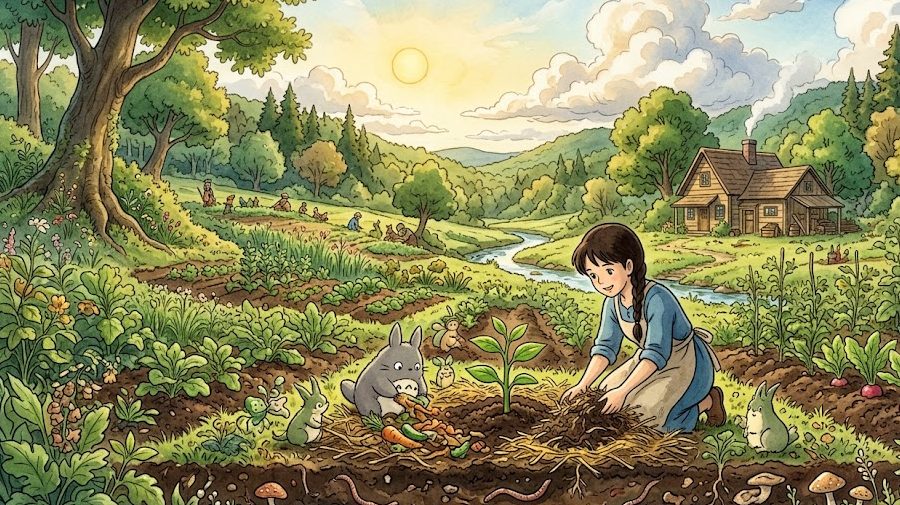
Healthy soil is one of the most important assets on a farm, yet it is easy to overlook. Farmers see the crops growing above the ground, but much of the work that supports those crops happens underneath the surface. Soil stores water, provides nutrients, supports roots, contains living organisms, and creates the physical environment in which plants develop.
Over time, however, soil can lose some of its natural quality. Continuous cropping, erosion, excessive disturbance, poor water management, compaction, and the removal of organic material can gradually affect soil structure and fertility.
Natural soil restoration focuses on rebuilding these functions through practices that work with natural soil processes. Rather than depending on one quick treatment, restoration is usually a gradual process involving organic matter, plant roots, soil cover, crop diversity, careful water management, and reduced disturbance.
The exact approach depends on the soil, climate, crops, and farming system. Still, several practical principles can help farmers move toward healthier and more fertile soil.
What Does Natural Soil Restoration Mean?
Natural soil restoration is the process of improving degraded or weakened soil by encouraging natural biological and physical processes.
It does not necessarily mean avoiding every modern agricultural input. Instead, the emphasis is on strengthening the soil system itself.
A restored soil should ideally have better structure, useful biological activity, improved water management, and sufficient nutrients to support plant growth.
This process can take time.
A field that has been heavily degraded over many years may not return to better condition after a single season. Soil restoration is more similar to rebuilding a long-term system than applying a quick fix.
The best results usually come from combining several compatible practices.
Start by Finding Out Why the Soil Is Struggling
Before trying to restore soil, it is important to understand the problem.
Poor crop growth can have many causes.
The soil may have low organic matter, nutrient deficiencies, excessive salinity, unsuitable pH, compaction, poor drainage, erosion, or inadequate moisture. Sometimes several problems occur together.
A soil test is a useful starting point because it can provide information about nutrient levels and pH.
Field observations are equally valuable.
Look for areas where water collects after rain or irrigation. Check whether roots are developing normally. Notice whether the soil becomes extremely hard when dry or sticky when wet.
Also observe whether some areas consistently produce weaker crops than others.
Understanding the cause helps prevent unnecessary treatments.
Rebuild Organic Matter
Organic matter is central to natural soil restoration.
Leaves, roots, crop residues, compost, manure, and other biological materials eventually contribute organic material to the soil.
As these materials decompose, they interact with the soil and support biological activity.
Organic matter can also influence soil structure and water-holding characteristics.
One of the simplest restoration strategies is therefore to return more plant material to the soil whenever practical.
Instead of removing every crop residue from a field, farmers may leave suitable residues on the surface or incorporate them according to the requirements of the farming system.
Compost and properly managed organic amendments can also contribute to this process.
The key is regular input rather than a one-time application.
Keep Living Roots in the Soil
Plants do more than produce crops.
Their roots interact directly with the soil environment. Living roots provide organic inputs and create pathways through the soil as they grow and eventually decompose.
This is one reason cover crops can be useful for soil restoration.
A cover crop occupies the soil during periods when the main crop is not growing. Its roots keep biological activity connected to the soil and its above-ground growth provides additional plant material.
Different plants develop different root systems.
Some have fine, dense roots, while others develop deeper or stronger root structures. A diverse combination can therefore create different interactions with the soil.
Choosing suitable cover crops depends on climate, water availability, crop rotation, and local farming conditions.
Protect the Soil Surface
Healthy soil should not remain exposed unnecessarily.
Bare soil can be vulnerable to wind and water erosion. Heavy rainfall can remove fine particles, while strong winds can carry away dry topsoil.
Vegetation and crop residues provide a protective layer.
Cover crops can protect soil during otherwise empty periods, while mulch can shield the surface around garden and field crops.
Even simple plant residue management can make a difference.
Keeping suitable organic material on the soil surface reduces direct exposure and allows the material to gradually break down.
Protecting soil from erosion is particularly important because the formation of new topsoil is a very slow natural process.
Reduce Unnecessary Tillage
Soil needs to be disturbed for some agricultural operations, but excessive disturbance can interfere with natural soil structure.
Repeated intensive tillage can break soil aggregates and expose organic material to faster decomposition. It can also disturb organisms living within the soil.
Reduced-tillage and conservation approaches aim to limit unnecessary disturbance.
This does not mean that every farm should immediately stop tillage.
Different soils and crops require different approaches. Weed pressure, residue levels, equipment, climate, and planting requirements all need to be considered.
A practical restoration goal is to use only the amount of disturbance necessary for the farming operation.
Use Crop Rotation to Increase Diversity
Growing the same crop repeatedly can create a narrow biological system.
Different crops interact with soil in different ways.
Their roots reach different depths, their residues decompose differently, and their nutrient requirements vary.
Crop rotation introduces greater diversity.
A rotation might include cereals, legumes, vegetables, forage crops, or other locally suitable plants.
Legume crops can be particularly useful in some rotations because of their relationship with nitrogen-fixing bacteria. However, their benefits depend on species, soil conditions, management, and the overall cropping system.
A good rotation should also make economic sense.
Farmers need crops that fit both soil-management goals and actual production needs.
Consider Cover Crops Between Main Crops
Cover crops are particularly useful when there is a period between commercial crops.
Instead of leaving the field empty, a suitable cover crop can keep roots in the soil and provide surface biomass.
Cover crops can serve several purposes.
They may help protect against erosion, improve soil structure, contribute organic material, support biological activity, and reduce opportunities for weeds to establish.
Some cover crops are selected for their root systems, while others are chosen because they produce substantial biomass.
The right species depends heavily on local conditions.
A cover crop should not create new problems by consuming excessive water, becoming difficult to control, or interfering with the following crop.
Planning is therefore important.
Improve Water Movement Naturally
Water is essential for soil life and crop growth, but its movement through soil needs to be balanced.
Poorly structured soil may allow water to run off rather than enter the root zone. Compacted layers can restrict infiltration and root development.
Organic matter, plant roots, and reduced disturbance can gradually contribute to better soil structure.
Vegetative cover also protects the surface from the impact of rainfall.
On sloped land, suitable erosion-control practices can further reduce rapid runoff.
The objective is not simply to make soil hold as much water as possible. It is to create a system where water can enter, move, and remain available to plants without causing prolonged waterlogging.
Encourage Earthworms and Other Soil Organisms
A healthy soil contains a diverse community of organisms.
Earthworms are among the most visible, but they are only one part of a much larger biological system.
Bacteria, fungi, insects, microscopic organisms, and other soil life contribute to decomposition and nutrient cycling.
Practices that provide organic material and reduce unnecessary disturbance can create better conditions for these organisms.
Earthworms, for example, can create channels as they move through soil, contributing to soil structure and water movement.
Their presence should be viewed as one indicator rather than a complete measurement of soil health.
The broader goal is to maintain an environment where many useful biological processes can occur.
Use Compost Carefully
Compost can be a useful source of organic material.
Well-managed compost contains decomposed organic materials that can be incorporated into soil or used as a surface amendment depending on the production system.
However, more compost is not automatically better.
The material should be properly prepared and appropriate for the intended use. Excessive applications can create nutrient imbalances or other problems.
Compost should therefore be considered part of a larger soil-management strategy.
Where possible, farmers and gardeners should understand the material’s composition and apply it according to soil conditions and crop requirements.
Manage Manure Responsibly
Animal manure has traditionally been used to return nutrients and organic material to agricultural soils.
When properly managed, it can contribute to soil fertility and organic matter.
However, fresh or improperly handled manure can create problems, including nutrient losses, unpleasant odors, contamination risks, and crop damage.
Proper storage, composting where appropriate, and correct application timing are important.
The amount applied should also match the needs of the soil and crop.
Organic does not automatically mean unlimited or risk-free.
Good management remains essential.
Avoid Soil Compaction
Compaction can slow down restoration because it restricts the physical space available for roots, water, and air.
Heavy machinery operating repeatedly over the same area can increase compaction, especially when soil is wet.
Farmers can reduce this risk by planning machinery movement, avoiding unnecessary traffic, and staying off fields when conditions are unsuitable.
Permanent or controlled traffic patterns may also be useful in some agricultural systems.
Deep-rooted plants can sometimes help improve certain compacted soils, but their effectiveness depends on the severity and depth of compaction.
Severe compaction may require additional intervention.
Restore Soil Nutrients Thoughtfully
Natural restoration does not mean ignoring nutrient requirements.
Plants remove nutrients from the soil when crops are harvested.
Those nutrients need to be replaced through appropriate sources.
Soil testing can help identify which nutrients are limited.
Instead of applying nutrients based solely on habit, farmers can use test results and crop requirements to develop a more balanced fertility program.
Organic materials may contribute nutrients, but their nutrient content varies.
Commercial fertilizers can also be part of a responsible soil-management system when applied according to crop needs and local recommendations.
The goal is balanced fertility rather than simply increasing nutrient levels.
Pay Attention to Soil pH
Soil pH influences nutrient availability and the suitability of soil for different crops.
If pH is too high or too low for a particular crop, plants may have difficulty accessing certain nutrients even when those nutrients are physically present.
Testing provides a better starting point than guessing.
If an amendment is needed to adjust pH, the appropriate material and application rate should be based on test results and local recommendations.
Large changes should be made carefully because soil chemistry can respond differently depending on soil type.
Reduce Erosion on Sloped Land
Erosion can undo years of soil-building work.
On sloped fields, rainfall can move soil downhill, carrying away valuable topsoil and organic material.
Vegetation can help hold soil in place.
Depending on the landscape, farmers may use contour-based farming, grassed areas, terraces, buffer strips, or other erosion-control methods.
The most appropriate method depends on slope, rainfall, soil type, field layout, and farming practices.
The main principle is to slow water movement and keep soil protected.
Give Restoration Time to Work
One of the most important lessons in natural soil restoration is patience.
Soil changes gradually.
Adding organic material can begin improving conditions, but building significant organic matter reserves may take years.
A cover crop may protect soil during one season, while the full effects of repeated rotations become clearer over a longer period.
Farmers should therefore measure progress using several indicators.
Crop performance, soil-test results, water infiltration, erosion, soil structure, organic matter, and biological activity can all provide useful information.
There may also be setbacks.
A drought, flood, extreme heat, or poor crop season can temporarily affect soil conditions.
Long-term trends are usually more meaningful than one year’s result.
Combine Practices Instead of Searching for One Solution
Natural soil restoration works best as a system.
For example, a farmer might combine:
- Crop rotation
- Cover crops
- Crop-residue management
- Compost or other suitable organic inputs
- Reduced soil disturbance
- Improved irrigation
- Erosion control
- Soil testing
- Better traffic management
Each practice addresses a different part of the soil system.
Together, they can reinforce one another.
Plant roots support soil structure. Organic matter provides biological resources. Soil cover reduces erosion. Reduced disturbance protects soil structure. Better water management reduces stress.
The combined effect can be greater than relying on one practice alone.
A Practical Restoration Plan
Farmers who want to begin restoring soil can start with a simple process.
First, test and observe.
Collect soil-test information and identify visible problems.
Second, protect the surface.
Reduce unnecessary bare-soil periods and manage residues appropriately.
Third, increase organic inputs.
Use suitable crop residues, compost, manure, or other locally appropriate materials.
Fourth, introduce diversity.
Use crop rotation and cover crops where practical.
Fifth, reduce unnecessary disturbance.
Review tillage and machinery practices.
Sixth, manage water carefully.
Improve irrigation and reduce runoff where possible.
Finally, measure progress.
Repeat appropriate soil tests and compare crop performance over time.
This gradual approach makes restoration more manageable.
Final Thoughts
Natural soil restoration is not about finding a single product that can transform a field immediately. It is about rebuilding the conditions that allow soil to function as a healthy, living system.
Organic matter, plant roots, crop diversity, soil cover, careful water management, reduced disturbance, responsible nutrient use, and erosion control can all contribute to that process.
The best strategy will differ from one farm to another. Soil type, climate, crops, available resources, and production goals all influence what is practical.
What matters most is consistency.
A farmer who protects the soil surface this season, introduces suitable crops into the rotation, returns organic material, manages water carefully, and monitors changes over several years can gradually build a stronger foundation for crop production.
Healthy soil is not created in a single season. It is built through repeated decisions that protect its structure, biology, and fertility. By working with natural soil processes rather than constantly correcting problems after they appear, farmers can create growing conditions that are more resilient and productive over the long term.