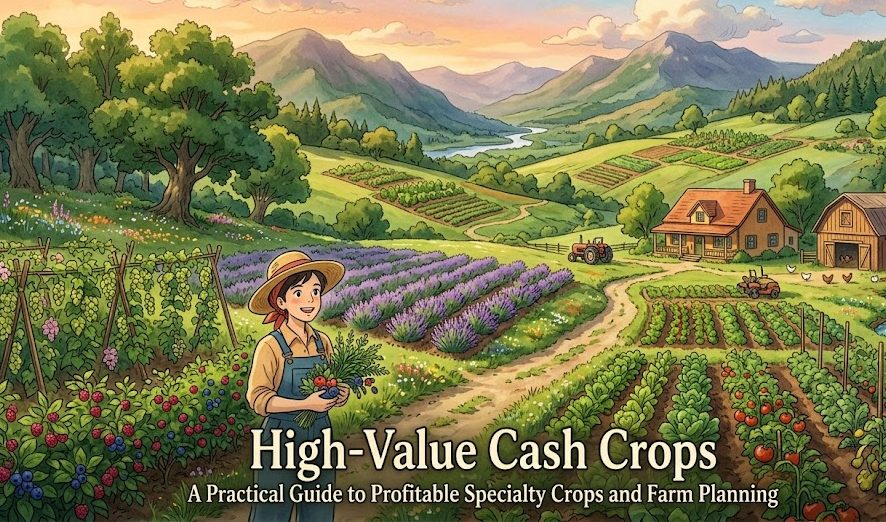
Choosing what to grow is one of the most important decisions a farmer makes. The right crop can fit the local climate, available land, labor, water supply, storage facilities, and market opportunities. The wrong crop can create high costs, difficult management, or produce that is hard to sell at a suitable price.
High-value cash crops are often associated with specialty agricultural products that can generate greater revenue per unit of land than some traditional field crops. Examples may include herbs, spices, certain vegetables, flowers, specialty fruits, seeds, medicinal or aromatic plants, and other crops with specific market demand.
However, a high selling price does not automatically mean high profit.
Production costs, crop losses, transportation, labor, processing, storage, market fluctuations, and quality requirements can significantly affect the final result. Successful specialty-crop farming therefore begins with planning rather than simply choosing the crop with the highest advertised price.
A practical approach is to evaluate the complete production and marketing system before putting significant land or money into a new crop.
What Makes a Crop “High-Value”?
A high-value crop generally has the potential to generate substantial revenue from a relatively small growing area compared with lower-value commodity crops.
The value can come from several factors.
Some crops have strong consumer demand. Others are valuable because they are difficult to produce, require particular growing conditions, have specialized uses, or are sold into premium markets.
Fresh herbs, specialty vegetables, flowers, certain fruits, spices, and high-quality seeds are examples of products that may receive higher prices under suitable market conditions.
But the word “high-value” should always be considered in context.
A crop that sells for a high price may also require intensive labor, expensive inputs, careful harvesting, specialized packaging, or rapid transportation.
The real question is not simply, “How much does this crop sell for?”
It is:
How much can remain after the complete cost of producing and selling it?
Start With the Market, Not the Seed
One of the biggest mistakes in specialty farming is planting first and searching for buyers later.
Before selecting a crop, investigate the potential market.
Find out who purchases the product and what quality they expect.
Potential buyers may include local wholesalers, retailers, restaurants, food processors, exporters, specialty stores, farmers’ markets, cooperatives, or direct consumers.
Each market can have different requirements.
A restaurant may want consistent weekly deliveries. A processor may require a specific variety or quality grade. A wholesaler may focus heavily on price and volume.
Understanding the buyer helps determine whether a particular crop makes sense.
Farmers should also consider how far the product needs to travel. Highly perishable crops may require fast transportation or cold storage, while dried products may have greater flexibility.
Consider Specialty Vegetables
Specialty vegetables can provide opportunities for farmers who have access to nearby urban or premium food markets.
Examples can include unusual varieties of tomatoes, peppers, leafy greens, baby vegetables, specialty beans, Asian vegetables, and other crops with specific consumer demand.
The advantage of specialty vegetables is that they may target customers who are willing to pay for particular characteristics such as freshness, variety, appearance, or local production.
However, these crops often require careful timing.
Fresh produce has a limited shelf life, and quality can decline quickly after harvest.
Farmers therefore need to coordinate production with expected demand rather than simply maximizing the number of plants.
Herbs Can Offer Multiple Market Opportunities
Fresh and dried herbs are another category worth considering.
Depending on local conditions and market access, farmers may grow culinary herbs, aromatic plants, or other specialty herbs.
Some herbs can be sold fresh, while others may be dried, processed, or packaged.
This creates the possibility of multiple product formats.
However, processing introduces additional requirements.
Drying must be handled carefully, and storage conditions need to protect product quality.
Farmers considering herbs should investigate the exact requirements of their target market before planting large quantities.
Spices Can Be Attractive Specialty Crops
Spices have long been important agricultural products in many parts of the world.
Depending on the region, farmers may grow crops such as turmeric, ginger, chili, coriander, cumin, or other locally suitable spices.
Spice farming can involve opportunities beyond fresh produce because many products can be dried, stored, processed, or sold in different forms.
But quality matters significantly.
Color, moisture, cleanliness, variety, maturity, and processing methods can influence market acceptance.
Farmers should therefore understand the standards expected by buyers.
A good crop with poor post-harvest handling may lose much of its market value.
Flowers Can Be High-Value but Time-Sensitive
Flowers represent another specialty agricultural category.
Cut flowers, ornamental plants, seasonal flowers, and nursery products can serve local and regional markets.
Demand can increase around weddings, festivals, holidays, events, and other occasions.
The challenge is that many flower products are highly perishable.
Harvest timing, handling, packaging, transportation, and temperature management can all affect quality.
A flower farm therefore needs more than good growing conditions. It also needs a reliable sales and distribution system.
Farmers should investigate local demand before investing in specialized infrastructure.
Specialty Fruits Require Long-Term Planning
Certain fruits can command attractive prices, particularly when they have desirable varieties, strong local demand, or access to premium markets.
However, fruit farming usually requires more patience than many annual crops.
Trees and perennial plants may take time before reaching meaningful production.
Farmers must consider land availability, irrigation, pollination, pruning, pest management, harvesting, and long-term maintenance.
The financial planning should therefore cover multiple years rather than focusing only on the first harvest.
Specialty fruit production can be rewarding, but it requires a longer planning horizon.
Aromatic and Essential-Oil Crops
Some farmers explore aromatic plants because their products can be sold as raw agricultural material or processed into oils and other products.
Examples can include crops grown for aromatic leaves, flowers, or plant material.
The opportunity depends heavily on processing and buyer access.
If a farm produces a crop that requires distillation or specialized extraction, the farmer needs to know who will perform the processing and what costs are involved.
Growing the plant is only one part of the business.
A complete plan should include harvesting, transportation, processing, storage, packaging, and final sales.
Nursery Plants Can Create Different Revenue Streams
Plant nurseries represent another specialty agricultural business.
Instead of selling mature field crops, nursery operators can sell seedlings, saplings, ornamental plants, fruit plants, herbs, or other planting materials.
The advantage is that products can be sold at different stages of growth.
However, nursery production requires careful attention to plant quality, watering, disease management, containers, growing media, and customer demand.
A nursery can also serve local gardeners, landscapers, farmers, and commercial growers.
Location can therefore be particularly important.
A nursery close to a population center may have different opportunities from one operating in a remote agricultural area.
Evaluate Climate Before Choosing a Crop
Market demand means little if the crop cannot perform well in the local environment.
Temperature, rainfall, humidity, soil type, water availability, sunlight, and seasonal patterns all affect crop suitability.
A crop that performs well in one region may require expensive infrastructure in another.
Before making a major investment, compare the crop’s environmental requirements with the actual conditions on the farm.
Local agricultural recommendations can be valuable because they are more relevant than generic information from another climate.
If possible, a small trial plot can provide useful information before the farmer expands production.
Calculate the Complete Cost
High-value crops can also have high production costs.
A realistic budget should include:
- Seeds or planting material
- Soil preparation
- Fertilizers and amendments
- Irrigation
- Pest and disease management
- Labor
- Equipment
- Harvesting
- Packaging
- Transportation
- Storage
- Processing
- Market fees
- Land or infrastructure costs
Some costs are easy to see, while others are hidden.
For example, a crop may require frequent harvesting. The selling price may look attractive, but high labor requirements can significantly reduce the final margin.
A complete budget helps reveal whether the crop is actually suitable for the farm.
Calculate Revenue Conservatively
Expected revenue should not be based only on the highest market price.
Prices can change between seasons and even within the same season.
Yield can also vary because of weather, pests, diseases, irrigation problems, or other conditions.
A better approach is to create several scenarios.
For example:
Conservative scenario: lower yield and lower selling price.
Expected scenario: realistic yield and average expected price.
Strong scenario: favorable yield and stronger market conditions.
This approach gives farmers a better understanding of the range of possible outcomes.
It also reduces the risk of making decisions based entirely on an optimistic estimate.
Start With a Trial Plot
When introducing an unfamiliar crop, a small trial can be extremely useful.
Instead of planting the entire farm immediately, allocate a manageable area to test the crop.
Track germination, growth, water requirements, labor, pest pressure, harvest quantity, quality, and selling opportunities.
The trial should also test the business side.
Can the crop actually be sold?
Do buyers accept the quality?
How much time does harvesting require?
How quickly does the product need to reach the customer?
These answers can be more valuable than theoretical production estimates.
Post-Harvest Handling Can Protect Crop Value
Producing a high-quality crop is only half the job.
Post-harvest handling can determine how much of that quality reaches the customer.
Fresh vegetables, herbs, flowers, and fruits may need rapid cooling, careful sorting, suitable packaging, and fast transportation.
Dried crops may require proper drying and moisture control.
Spices and seeds may need cleaning and grading.
Poor handling can lead to spoilage, contamination, physical damage, or reduced appearance.
Farmers should therefore plan the post-harvest process before expanding production.
Direct Sales Can Change the Business Model
Selling directly to customers can create opportunities for some specialty crops.
Farmers may sell through local markets, farm shops, subscription programs, community markets, restaurants, or online channels where practical.
Direct sales can potentially provide better access to the final customer, but they also require additional work.
Marketing, packaging, customer communication, delivery, and order management become part of the farming business.
The best sales channel depends on the crop and the local market.
Some farmers may prefer stable wholesale relationships, while others may benefit from smaller direct orders.
Processing Can Add Value
Some crops can be sold in more than one form.
For example, herbs may be sold fresh or dried. Certain fruits can become preserves or other processed products. Spices can be cleaned, dried, ground, and packaged.
Processing can potentially extend shelf life and create additional products.
However, it also introduces new requirements.
Food safety, equipment, packaging, labeling, storage, and applicable regulations all need to be considered.
Processing should therefore be treated as a separate part of the business plan rather than assuming that it will automatically increase profits.
Diversification Can Reduce Dependence on One Crop
Specialty farming can involve significant market risk.
If a farm depends entirely on one crop and its price falls, the financial impact can be substantial.
Growing several compatible crops can spread some of that risk.
For example, a farmer might combine a primary specialty crop with vegetables, herbs, nursery plants, or another suitable product.
Diversification can also spread labor requirements across different periods.
However, too much diversification can make farm management complicated.
The goal should be a manageable combination of crops rather than growing everything at once.
Consider Water and Labor Availability
Two of the most important resources in specialty farming are water and labor.
A crop may offer attractive market opportunities but require more water than the farm can reliably provide.
Another crop may require frequent harvesting at a time when labor is already limited.
These practical constraints should be evaluated before planting.
Farmers should ask:
How much water does the crop need?
When is the peak labor period?
Can harvesting be completed on time?
Is specialized equipment required?
Can the farm handle the crop at its expected scale?
These questions can prevent expensive mistakes.
Build Relationships With Buyers
A strong market relationship can be as valuable as good production.
Farmers can speak with potential buyers before planting and ask about preferred varieties, quality standards, packaging, delivery schedules, and approximate demand.
This information can help shape production decisions.
Where possible, having multiple potential buyers can provide additional flexibility.
Farmers should also avoid depending entirely on verbal promises. Clear agreements and realistic expectations can reduce misunderstandings about quantity, quality, timing, and pricing.
Watch Market Trends Without Chasing Every Trend
Agricultural markets change.
Consumer preferences, restaurant demand, food-processing needs, export conditions, and seasonal supply can influence prices.
Farmers should pay attention to these trends, but they should also avoid chasing every crop that becomes temporarily popular.
A crop that receives attention today may face oversupply if too many producers begin growing it.
Long-term suitability matters more than short-term excitement.
A specialty crop should fit the farm’s climate, resources, skills, and market access.
Technology Can Improve Specialty-Crop Management
Modern technology can support high-value crop production.
Drip irrigation can help manage water delivery. Soil sensors can provide information about moisture conditions. Weather stations can support field planning. Digital records can track costs and harvests.
Drones and cameras may assist with crop monitoring in larger operations.
Farm-management software can help organize planting dates, field activities, input purchases, and sales information.
Technology does not guarantee profitability, but it can make monitoring and record keeping more efficient.
The best technology is usually the technology that solves a specific problem.
A Practical Planning Checklist
Before planting a new high-value crop, work through the following questions:
Market: Who will buy the crop?
Climate: Is the crop suitable for the local growing conditions?
Soil: Does the farm have suitable soil, or will major improvements be required?
Water: Can the crop’s water requirements be met consistently?
Labor: Is enough labor available during planting and harvest?
Cost: What is the complete production cost?
Yield: What is a realistic production range?
Price: What selling price is realistic rather than simply the highest possible price?
Post-harvest: How will the crop be cleaned, stored, packaged, processed, and transported?
Risk: What happens if yield or price is lower than expected?
Trial: Can the crop be tested on a small area first?
If these questions have practical answers, the farmer has a stronger foundation for deciding whether to proceed.
Final Thoughts
High-value cash crops can create interesting opportunities for farmers, particularly when production is connected to a clear market and the crop fits local growing conditions.
But a high selling price alone does not create a profitable farm.
Successful specialty-crop planning requires attention to production costs, labor, water, soil, climate, quality, harvesting, post-harvest handling, transportation, and market demand.
The most sensible approach is often to start small, gather real production data, speak with potential buyers, and expand only after the complete system has been tested.
Farmers can also improve their chances of building a sustainable business by diversifying carefully, keeping accurate records, and reviewing the economics of every crop regularly.
Ultimately, the strongest specialty-crop opportunity is not necessarily the crop with the highest advertised price. It is the crop that fits the farm’s resources, can be produced consistently, has a dependable market, and leaves enough value after the full cost of getting it from field to customer.