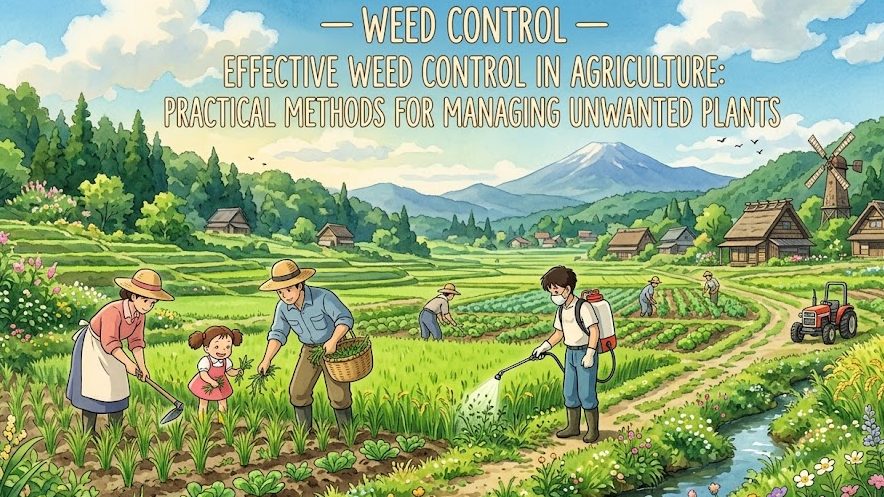
Weeds are among the most common challenges faced by farmers and gardeners. They can appear in crop fields, vegetable gardens, orchards, greenhouse areas, pathways, and even around irrigation systems. Although a few weeds may seem harmless, uncontrolled growth can gradually interfere with crops and make farm management more difficult.
Effective weed control is not simply about removing every unwanted plant. A better approach is to understand why weeds are appearing, identify the types of weeds present, and combine practical methods that reduce their growth while protecting crops and maintaining healthy soil.
Good weed management can improve field organization, reduce competition for resources, make harvesting easier, and support more consistent crop growth. The right method depends on the crop, soil, climate, farm size, available equipment, and the stage of crop development.
What Are Weeds?
A weed is generally a plant growing where it is not wanted. A plant that is useful in one location can become a weed when it competes with a crop in another.
Weeds may compete with crops for:
- Water
- Sunlight
- Soil nutrients
- Growing space
- Air circulation
Some weeds can also make field operations more difficult. Dense weed growth may interfere with machinery, harvesting, irrigation, and crop inspection.
Different farms may face completely different weed problems. Some fields may have mostly annual weeds that appear during a particular season, while others may struggle with perennial weeds that survive and return year after year.
Understanding this difference is one of the first steps toward better weed management.
Why Weed Control Matters
A small amount of weed growth does not always create a serious problem. However, weeds can become difficult to manage when they are allowed to produce large amounts of seed or spread through underground structures.
Early weed growth can be especially important because young crops may not yet have developed enough leaves or roots to compete effectively.
Weed control can help farmers:
- Reduce competition around young crops
- Keep crop rows easier to manage
- Improve access for field workers
- Make harvesting more efficient
- Reduce weed seed production
- Improve irrigation management
- Maintain a cleaner growing environment
The objective should be practical management rather than unnecessary disturbance of the entire field.
Start With Weed Identification
Before choosing a control method, identify what is actually growing in the field.
Weeds are often grouped into broad categories based on their physical characteristics.
Grassy Weeds
These usually have narrow leaves and can resemble crop grasses. Some grow quickly and establish dense patches.
Broadleaf Weeds
These generally have wider leaves and can develop different shapes depending on the species.
Sedges
Sedges often have narrow leaves and distinctive stems. They may become common in areas with higher moisture.
Annual Weeds
Annual weeds complete their life cycle within a relatively short period. Preventing them from producing seeds can significantly reduce future populations.
Perennial Weeds
Perennial weeds can survive for multiple years. Some may return from roots, rhizomes, bulbs, or other underground structures even after their above-ground growth has been removed.
Identification matters because a method that works well against one weed may be less effective against another.
Method 1: Prevent Weeds Before They Establish
One of the most useful weed-control strategies is prevention.
If weeds are repeatedly allowed to mature and produce seeds, the soil can accumulate a large reserve of weed seeds. Some seeds can remain viable for extended periods and emerge when conditions become suitable.
Farmers can reduce this problem by:
- Cleaning equipment between fields when practical
- Using clean planting materials
- Managing weeds before they produce mature seeds
- Keeping field borders under control
- Avoiding unnecessary movement of contaminated soil
- Monitoring irrigation channels and pathways
Prevention may require regular attention, but it can reduce the amount of weed pressure that needs to be managed later.
Method 2: Hand Weeding
Hand weeding remains useful, particularly in vegetable gardens, small farms, nurseries, and areas where precision is important.
Removing weeds by hand allows the farmer to work close to valuable crops without disturbing the plants.
For best results, weeds should generally be removed while they are still relatively small and before they become deeply established.
Hand weeding becomes less practical as field size increases, but it can be extremely useful for:
- Vegetable beds
- Small plots
- Around young trees
- Greenhouse crops
- Narrow planting rows
- Areas difficult to reach with machinery
The removed weeds should also be handled properly so mature weeds do not continue spreading seeds.
Method 3: Mechanical Weed Control
Mechanical control uses tools or machinery to physically disturb or remove weeds.
Common approaches include:
- Hoes
- Cultivators
- Rotary weeders
- Inter-row cultivation equipment
- Mowers
- Specialized mechanical weeders
Mechanical methods can cover larger areas more quickly than hand weeding.
However, timing is important. Cultivating too deeply can disturb crop roots, increase soil exposure, or bring buried weed seeds closer to the surface.
Shallow and targeted operations can often be more suitable when crops are established in clearly defined rows.
Method 4: Mulching
Mulching is another practical way to suppress weeds.
A layer of suitable material placed over the soil can reduce the amount of light reaching weed seeds and young plants.
Common mulch materials include:
- Straw
- Crop residues
- Leaves
- Compost-based materials
- Suitable organic mulches
- Certain agricultural fabric materials
Mulching can provide additional benefits beyond weed suppression. Depending on the material and conditions, it may help reduce evaporation, moderate soil temperature, and protect the soil surface from erosion.
The mulch should not be piled directly against plant stems or tree trunks because excessive moisture around plant bases can create other problems.
Method 5: Cover Crops
Cover crops can play an important role in longer-term weed management.
A healthy cover crop occupies growing space and can compete with weeds for light, water, and nutrients. Some cover crops also produce enough plant material to create a protective layer on the soil surface after termination.
The choice of cover crop depends on climate, soil conditions, farming system, and the next main crop.
Farmers should plan the entire rotation rather than choosing a cover crop in isolation. A poorly planned cover crop can sometimes create management difficulties of its own.
Method 6: Crop Rotation
Growing the same crop repeatedly can create conditions that favor certain weed species.
Crop rotation changes planting dates, crop structures, cultivation practices, and competition patterns. This can make it harder for a particular group of weeds to dominate continuously.
For example, rotating crops with different planting seasons or different row arrangements may disrupt established weed patterns.
Rotation can also support broader soil-management goals, making it useful as part of an integrated farming system.
Method 7: Maintain Strong Crop Competition
A healthy crop can naturally compete with weeds.
Farmers can support crop competitiveness through appropriate:
- Plant spacing
- Seed placement
- Soil preparation
- Nutrient management
- Irrigation
- Variety selection
- Plant population
When crops establish quickly and develop a strong canopy, less sunlight may reach the soil surface.
However, crop competition should be managed carefully. Excessively dense planting can create problems such as poor airflow or increased disease pressure depending on the crop and environment.
The goal is a balanced crop stand rather than simply maximizing plant density.
Method 8: Strategic Water Management
Water availability can influence weed growth significantly.
Over-irrigation may create favorable conditions for weeds, particularly in areas where moisture remains on or near the soil surface for long periods.
Drip irrigation can sometimes help place water closer to crop root zones rather than wetting the entire soil surface.
Efficient irrigation also supports better resource management because crops receive water where and when it is needed.
Water management should therefore be considered alongside weed control rather than treated as a completely separate task.
Method 9: Herbicides as One Part of Weed Management
Herbicides can be useful tools in commercial agriculture when selected and applied correctly.
However, herbicide use requires careful attention to the crop, weed species, application timing, product instructions, environmental conditions, and local regulations.
Farmers should always follow the product label and applicable agricultural guidance.
Important considerations can include:
- Correct product selection
- Appropriate application rate
- Crop safety
- Weed growth stage
- Weather conditions
- Spray equipment
- Protective measures
- Resistance management
Using the same herbicide repeatedly can also contribute to herbicide resistance in some weed populations.
For this reason, herbicides are often most useful when integrated with cultural, mechanical, and preventive methods rather than treated as the only solution.
Understanding Herbicide Resistance
Herbicide resistance occurs when a weed population develops the ability to survive an herbicide treatment that previously controlled it.
This can become a serious management challenge because resistant weeds may spread rapidly if they are repeatedly selected by the same control method.
Resistance management can involve:
- Rotating suitable herbicide modes of action
- Combining control methods
- Preventing surviving weeds from producing seeds
- Monitoring fields regularly
- Using herbicides according to their labels
A diversified weed-management program reduces dependence on a single method.
Weed Control in Orchards
Orchards require a slightly different approach because perennial trees occupy the field for many years.
Weeds around young trees can compete strongly for water and nutrients.
Useful orchard strategies may include:
- Mulching around trees
- Mowing between rows
- Maintaining managed ground cover
- Mechanical control where appropriate
- Carefully targeted herbicide programs where permitted
- Regular monitoring around tree bases
Extra care is needed when working close to tree trunks and shallow roots.
Weed Control in Vegetable Gardens
Vegetable crops often require frequent monitoring because many vegetables have limited competitive ability during early growth.
A practical vegetable-garden routine can include:
- Prepare the soil before planting.
- Remove established weeds.
- Plant crops at suitable spacing.
- Monitor rows frequently.
- Remove young weeds before they become established.
- Apply mulch where appropriate.
- Avoid allowing weeds to mature and produce seeds.
- Recheck the garden after irrigation or rainfall.
Frequent small interventions are often easier than allowing weeds to become a major problem and attempting to remove them all at once.
Integrated Weed Management
The most effective long-term approach is often called integrated weed management.
Instead of depending on one technique, farmers combine several compatible strategies.
For example, a crop system might use:
Before planting:
Field preparation + weed monitoring + removal of established weeds
During crop establishment:
Proper spacing + early cultivation + careful irrigation
During crop growth:
Mulching + mechanical control + targeted treatment where necessary
After harvest:
Residue management + rotation planning + prevention of seed production
This approach spreads the workload across the growing season.
Common Weed-Control Mistakes
Even a good weed-control method can become less effective when basic mistakes are repeated.
Waiting Too Long
Large, mature weeds are generally harder to remove and may already have produced seeds.
Using Only One Method
Depending entirely on one technique can increase management problems over time.
Ignoring Field Edges
Weeds growing around field borders can produce seeds that later move into cultivated areas.
Overworking the Soil
Repeated or deep cultivation can disturb soil structure and bring buried weed seeds toward the surface.
Poor Identification
Treating every weed in the same way can lead to unnecessary effort and poor results.
Ignoring Weather
Wind, rainfall, soil moisture, and temperature can influence the success of mechanical and chemical control operations.
Creating a Simple Weed-Control Plan
A practical plan does not need to be complicated.
Start by answering five questions:
1. Which weeds are present?
Identify the main species or groups.
2. When do they appear?
Record the time of year and crop-growth stage.
3. Where are they concentrated?
Look for patterns around irrigation lines, field edges, low areas, or specific crop rows.
4. Which control method is practical?
Consider labor, machinery, cost, crop sensitivity, and field size.
5. How can future weed pressure be reduced?
Think about rotation, cover crops, mulching, irrigation, and preventing seed production.
Keeping simple field records can make future decisions easier.
The Role of Technology in Weed Management
Modern agriculture is increasingly using technology to identify and manage weeds more precisely.
Cameras and computer-vision systems can help distinguish crops from unwanted plants. GPS-guided equipment can improve the accuracy of field operations. Some precision-agriculture systems can also create weed maps that show where weed populations are concentrated.
These technologies can be especially useful on larger farms where treating every part of a field identically may not be necessary.
Technology does not eliminate the need for field knowledge. Instead, it can help farmers make more targeted decisions.
A Practical Seasonal Approach
A useful way to think about weed management is as a continuous cycle:
Observe → Identify → Prevent → Control → Monitor → Record → Improve
Observation helps identify emerging problems.
Identification helps determine which methods are appropriate.
Prevention reduces future weed pressure.
Control addresses existing weeds.
Monitoring shows whether the strategy is working.
Records provide useful information for the next season.
Improvement comes from adjusting the plan based on what actually happened in the field.
Final Thoughts
Effective weed control is a combination of timing, observation, prevention, and appropriate intervention. There is rarely one method that works equally well for every farm, crop, soil type, and climate.
Hand weeding can be valuable in small areas. Mechanical methods can cover larger fields. Mulches and cover crops can reduce opportunities for weeds to establish. Crop rotation and proper irrigation can support long-term management, while herbicides can be useful when carefully selected and responsibly applied.
The strongest weed-management programs usually focus on preventing weeds from becoming a bigger problem in the first place. By identifying weeds early, protecting crop competitiveness, maintaining healthy soil, and combining several suitable methods, farmers can make weed control more manageable throughout the growing season.
Good weed management is not about keeping a field perfectly free of every unwanted plant. It is about keeping weed populations at manageable levels while protecting the crop, soil, resources, and long-term productivity of the farm.