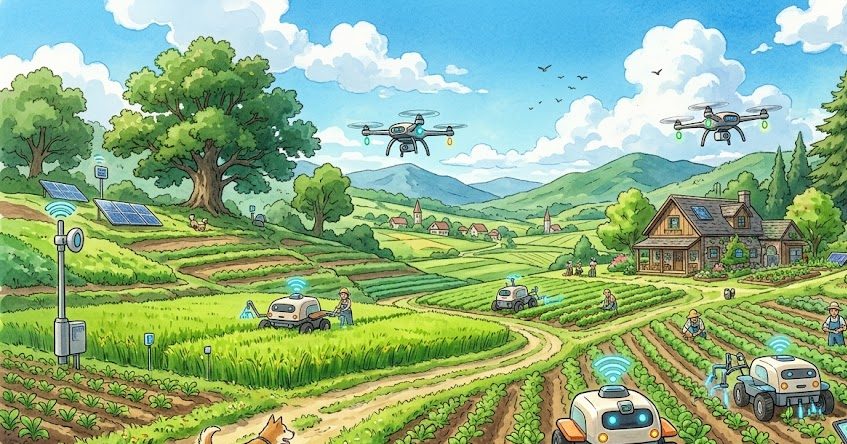
The agricultural industry is currently standing at the threshold of a new era. As we move through 2026, the integration of Artificial Intelligence (AI) and “Smart Technology” is no longer a futuristic concept—it is the operational standard for anyone seeking “Financial Freedom” in the digital age. For developers and digital marketers like Yagnik, this shift represents a “digital goldmine” where technology meets the earth to solve global food security challenges.
1. The Rise of AI-Driven Decision Making
Artificial Intelligence is the brain of the modern farm. In 2026, we have moved beyond simple automation to predictive intelligence. AI models now analyze decades of weather patterns, historical soil data, and real-time sensor feeds to provide a blueprint for every planting season.
- Predictive Analytics: AI can now forecast pest outbreaks with high accuracy, allowing for targeted natural pest management instead of blanket chemical use.
- Yield Optimization: Using advanced computer vision, AI monitors crop health in real-time, identifying nutrient deficiencies before they become visible to the human eye.
2. Precision Irrigation and Water-Saving Tech
Water management is perhaps the most critical “Smart Farming” innovation of our time. Modern systems ensure that not a single drop is wasted.
- IoT Soil Sensors: These sensors provide real-time moisture data directly to a farmer’s dashboard, triggering irrigation only when absolutely necessary.
- Smart Drip Systems: By delivering water directly to the root zone, these systems act as a vital “water-saving technique,” maintaining soil health and reducing evaporation.
3. Robotics and Autonomous Machinery
The labor-intensive nature of traditional farming is being revolutionized by robotics. This “low-maintenance” approach allows for 24/7 operations without human fatigue.
- Autonomous Tractors: GPS-guided machinery can plow, seed, and mulch with centimeter-level precision, optimizing land use for both large-scale operations and “Micro Farming”.
- Laser Weeding: Robots equipped with AI can identify and eliminate weeds between crop rows, offering a chemical-free alternative to herbicides.
4. Drones: The Eyes in the Sky
Drones have become an essential part of the “Farming Innovation Hub”. They provide a level of oversight that was previously impossible without satellite imagery.
- Multispectral Mapping: Drones map the “biological engine” of the farm, identifying areas of stress, disease, or dehydration.
- Aerial Spraying: Drones can hover and apply organic bio-inputs to specific plants, keeping costs at near-zero and ensuring “Zero Chemical” output.
5. Blockchain and Market Transparency
Transparency is a major trend for “High-Value Cash Crops” in 2026. Consumers want to know the origin and quality of their food.
- Traceability: Blockchain technology records every step of a crop’s life cycle, from seed selection to harvest.
- Direct-to-Market: Digital platforms allow farmers to bypass middlemen, securing fair pricing and immediate payments, which is a key pillar of “Financial Freedom”.
6. Controlled Environment Agriculture (CEA)
As the climate becomes more volatile, “Survival Farming” increasingly happens indoors.
- Hydroponics and Aeroponics: Growing plants in nutrient-rich mist or water eliminates the need for soil while doubling growth rates.
- Vertical Farming: This allows for massive production in urban “Micro Farming” setups, reducing the distance between the farm and the consumer.
Conclusion: A Tech-Forward Harvest
The future of farming is smart, natural, and highly profitable. By combining “Practical Farming” wisdom with modern AgriTech innovations, we are creating a “Closed-Loop” system that is both sustainable and lucrative.
Whether you are managing “High-Value Cash Crops” or building a self-sufficient “Survival Farm,” these tools are your greatest allies in the 2026 agricultural revolution.