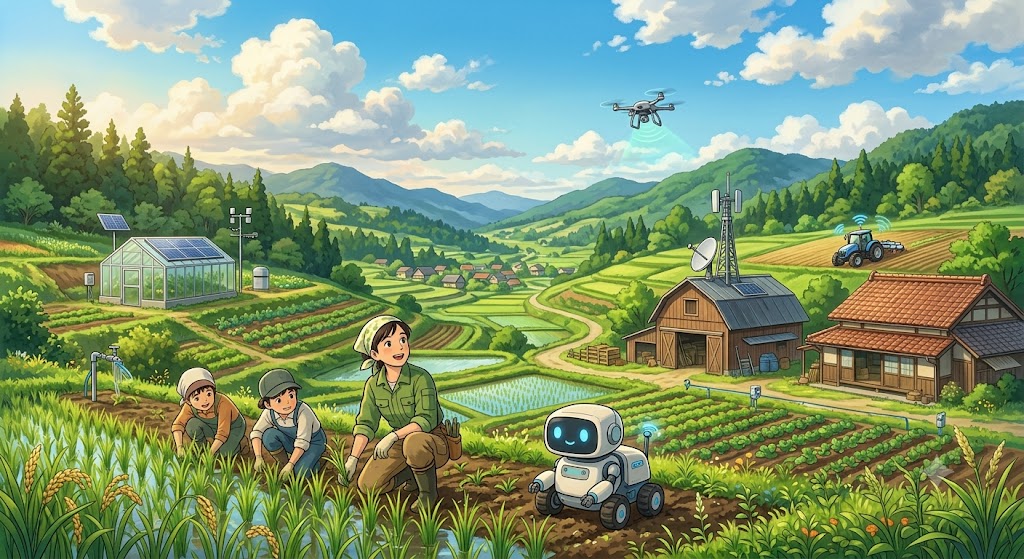
Agriculture is entering a new era in which decisions on the farm can be supported by sensors, connected machinery, satellite imagery, artificial intelligence, and real-time data.
For generations, farmers have relied on experience and direct observation to understand their land, crops, livestock, and weather. Those skills remain essential, but modern technology is giving farmers additional ways to collect information and respond to changing conditions.
Artificial intelligence and smart farming systems are now being used for tasks ranging from crop monitoring and irrigation management to machinery guidance, livestock observation, and farm planning.
The technology is particularly interesting for farms in the United States and United Kingdom, where agricultural businesses face different combinations of labour pressures, input costs, weather variability, and the need to manage resources efficiently.
AI is not simply about replacing people with machines. In many farming applications, its role is to process information, identify patterns, automate repetitive tasks, and help farmers make decisions.
The result is a more connected approach to agriculture in which traditional knowledge and digital tools can work together.
What Is Smart Farming?
Smart farming refers to the use of connected technologies and data-driven systems to monitor and manage agricultural operations.
These systems can include:
- Artificial intelligence
- Internet-connected sensors
- GPS and satellite technology
- Drones
- Automated machinery
- Weather stations
- Farm management software
- Computer vision
- Robotics
- Soil-monitoring equipment
Some technologies operate independently, while others can exchange information.
For example, a soil sensor can measure moisture, a weather service can provide rainfall information, and farm software can bring those data points together.
AI can then help analyse the information and identify patterns.
This creates a digital layer around traditional farming practices.
Why AI Is Becoming More Relevant to Agriculture
Farms generate enormous amounts of information.
Farmers may need to consider weather conditions, soil characteristics, planting dates, crop performance, machinery activity, fertiliser applications, irrigation, pest pressure, harvest timing, and financial information.
Managing all of this manually can be difficult.
AI systems are particularly useful when large amounts of data need to be processed quickly.
Instead of looking at individual pieces of information separately, an AI-enabled platform may analyse several variables together.
For example, a system could combine historical field information with current weather and crop observations to identify areas that may require closer attention.
The farmer still decides what action to take, but the technology can help make the decision-making process more informed.
AI-Powered Crop Monitoring
One of the most practical applications of AI is crop monitoring.
Traditional field scouting requires farmers or agricultural workers to physically inspect fields.
This remains important, but digital monitoring can help identify areas that deserve closer inspection.
Satellite imagery, drones, and cameras can capture information across large areas.
AI-based image analysis can then look for unusual patterns.
These patterns could include:
- Differences in crop growth
- Areas of water stress
- Weed presence
- Signs of disease
- Crop damage
- Uneven plant development
- Changes in vegetation
The technology does not necessarily determine the exact cause of every problem.
Instead, it can act as an early-warning system.
If one section of a field looks different from the surrounding area, the farmer can investigate that location directly.
This can make field scouting more targeted.
Computer Vision Is Giving Machines Better Eyes
Computer vision allows software to interpret images or video.
In agriculture, cameras can be mounted on tractors, drones, robots, or fixed monitoring systems.
The software can analyse what the camera sees.
One potential application is distinguishing crops from weeds.
A camera mounted on agricultural equipment can capture images while machinery moves through a field. Software can analyse those images and identify plants based on characteristics such as shape, colour, or position.
If the system is sufficiently accurate, equipment may be able to target specific plants rather than treating an entire area uniformly.
This could support more precise weed management.
However, accuracy depends on the crop, weed species, lighting, camera quality, environmental conditions, and the quality of the underlying AI model.
Human oversight remains important, particularly when a mistake could affect crop health.
Smart Irrigation Uses Data Instead of Guesswork
Water management is another area where smart technology can be valuable.
Traditional irrigation schedules may be based on fixed timings or general estimates.
Smart irrigation systems can use additional information such as soil moisture, weather forecasts, crop requirements, and recent rainfall.
For example, a soil sensor can detect that moisture remains relatively high after rainfall.
Instead of following a predetermined irrigation schedule, a connected system may adjust the plan according to actual conditions.
This can be useful in areas where water availability is limited.
In parts of the United States, irrigation is an important component of crop production, while UK growers may also need to manage irrigation during periods of dry weather.
The technology does not remove the need for agricultural judgement. Soil sensors can fail, weather forecasts can change, and different crops have different requirements.
Smart irrigation works best when digital information is combined with practical field knowledge.
Predictive Analytics Can Help Farmers Plan Ahead
One of AI’s biggest differences from traditional software is its ability to identify patterns within large datasets.
Predictive systems can use historical information to estimate possible future conditions.
Agricultural applications can include:
- Crop yield estimates
- Disease-risk monitoring
- Pest-risk assessment
- Irrigation planning
- Harvest scheduling
- Equipment maintenance
- Weather-related planning
For example, an AI system may examine historical weather patterns, crop information, and current field conditions to identify periods when a crop could face increased stress.
Such predictions should not be treated as guarantees.
Agriculture is highly dependent on changing environmental conditions, and unexpected events can occur.
The value comes from giving farmers another source of information that can be considered alongside forecasts, observations, and professional advice.
Smart Machinery Is Changing Field Operations
Modern agricultural machinery is becoming increasingly connected.
GPS guidance can help tractors and other equipment follow precise routes.
Automated steering can reduce unnecessary overlap during field operations.
Machine data can also provide information about fuel consumption, operating hours, engine conditions, and equipment performance.
This can improve planning and reduce unnecessary manual record keeping.
For large farms, even small efficiency improvements can become significant when repeated across hundreds or thousands of acres.
In the United States, large-scale grain farming provides an obvious example of where precision machinery can be valuable.
The same principles can also apply to UK farms, although field sizes, crops, terrain, and machinery requirements may be very different.
Autonomous Farm Equipment
Agricultural robotics is moving beyond simple automation.
Some machines are being developed to perform specific tasks with limited direct control.
Potential applications include:
- Weed detection and removal
- Crop monitoring
- Automated harvesting
- Transporting materials
- Mowing
- Soil monitoring
- Livestock observation
Small robotic machines can be particularly interesting for tasks where large tractors are inefficient or where highly targeted work is desirable.
However, autonomous farming is not yet a universal replacement for conventional machinery.
Cost, reliability, terrain, safety, regulation, battery life, connectivity, and maintenance all affect whether a robotic system makes sense for a particular farm.
AI Is Also Changing Livestock Management
Smart farming technology is not limited to crops.
Livestock producers can use sensors, cameras, connected devices, and software to monitor animals.
Depending on the system, technology can track activity, movement, feeding behaviour, location, or other measurable characteristics.
Unusual behaviour may trigger an alert for the farmer to investigate.
Automated feeding and environmental monitoring systems can also help manage livestock buildings.
For example, sensors can monitor environmental conditions and provide information when conditions move outside desired ranges.
This type of monitoring can give farmers additional information between routine inspections.
The purpose is not to replace human observation. Instead, it can help farmers notice changes that might otherwise be difficult to detect consistently.
Drones Are Becoming Agricultural Tools
Drones can provide farmers with an aerial perspective of their land.
A drone can cover areas that would take considerable time to inspect on foot.
Depending on the equipment and software, aerial images can be used to examine:
- Crop development
- Drainage patterns
- Field boundaries
- Storm damage
- Plant stress
- Areas requiring closer inspection
The value of drone technology comes from turning aerial images into useful information.
Simply collecting thousands of photographs does not necessarily improve farming.
The important step is analysing those images and connecting the results with practical field decisions.
Drone use is also subject to aviation and privacy regulations, which vary by country and situation. Farmers should follow applicable local requirements before operating drones.
Soil Sensors Can Reveal Hidden Conditions
A field can look healthy from above while conditions below the surface are very different.
Soil sensors can provide information that is difficult to estimate visually.
Depending on the equipment, sensors may measure factors such as:
- Soil moisture
- Temperature
- Electrical properties
- Other soil-related measurements
Connected sensors can send information to a central platform.
This allows farmers to monitor conditions over time rather than relying only on occasional measurements.
For example, moisture levels can be compared between different areas of a field.
If one section consistently behaves differently from another, the farmer can investigate possible differences in soil type, drainage, irrigation, or crop development.
AI Can Help With Farm Management
Agriculture is also a business, so farm technology is not limited to field operations.
Farm management software can organise information about:
- Costs
- Inputs
- Equipment
- Labour
- Fields
- Crop activities
- Harvests
- Inventory
- Weather
- Livestock
AI tools can potentially help identify trends within these records.
For example, a farmer may compare input costs across fields and seasons.
This can help reveal where resources are being used most heavily and where management practices may need closer examination.
Better records can also make planning easier.
Technology Can Help Address Labour Challenges
Labour availability is an important issue for many agricultural businesses.
Certain farming tasks are repetitive, physically demanding, or require workers during short seasonal windows.
Automation can potentially reduce the amount of manual labour required for specific activities.
Robotics, automated machinery, computer vision, and remote monitoring can all contribute to this process.
However, technology does not eliminate the need for skilled agricultural workers.
Instead, the nature of some jobs may change.
Workers may increasingly spend more time supervising machines, analysing information, maintaining equipment, and making decisions rather than performing every repetitive task manually.
The Cost of Smart Farming Technology
Advanced technology can be expensive.
A farm may need sensors, connectivity, software subscriptions, compatible machinery, installation, maintenance, and training.
This can make adoption difficult, especially for smaller agricultural businesses.
The best technology is not necessarily the most advanced technology.
A farmer should first ask what problem needs to be solved.
If irrigation is the main concern, a soil-moisture monitoring system may provide more practical value than investing in a complex autonomous machine.
If machinery efficiency is the issue, GPS guidance might be a more appropriate starting point.
Technology should solve a real problem rather than become an expense simply because it is new.
Connectivity Is Still a Major Challenge
Smart farming depends on reliable communication.
Sensors and connected machinery need a way to transmit information.
Rural areas can sometimes have weaker broadband or mobile connectivity than urban locations.
This can limit the usefulness of cloud-based agricultural systems.
Farmers may therefore need to consider connectivity before investing in connected technology.
Offline functionality, local data storage, and reliable communication infrastructure can all become important factors.
The technology may be excellent, but if the farm cannot reliably connect to it, its practical value can be limited.
Farmers Still Need to Verify AI Recommendations
Artificial intelligence can process large amounts of information, but it is not perfect.
An AI system may produce an incorrect classification or prediction.
For agriculture, mistakes can have real financial consequences.
A crop may be incorrectly identified as diseased. A weed may be confused with a crop. A weather prediction may change.
This is why AI should generally be treated as a decision-support tool rather than an unquestionable authority.
Farmers can combine technology-generated recommendations with field inspections, historical experience, local knowledge, and professional agricultural advice.
Human judgement remains particularly important when decisions involve expensive inputs or potential crop losses.
Data Ownership and Privacy Matter
As farms become increasingly digital, agricultural data becomes an important consideration.
Farmers may generate information about yields, soil conditions, machinery performance, field locations, and production practices.
Before adopting a digital platform, it can be useful to understand:
- Who owns the data
- Where information is stored
- Who can access it
- Whether data can be exported
- How long it is retained
- What happens if the service ends
These questions are becoming more relevant as farmers rely on multiple connected platforms.
A technology solution should be evaluated not only for what it can do but also for how it handles the information generated by the farm.
What Could the Future Farm Look Like?
The future farm is unlikely to rely on one single technology.
Instead, different systems may become increasingly connected.
A possible digital farming system could combine:
Soil sensors to monitor field conditions.
Weather data to track changing environmental conditions.
Satellite imagery to monitor large areas.
AI software to identify patterns.
Robotic equipment to perform selected tasks.
Farm management platforms to organise information.
Connected machinery to report performance.
The farmer could see information from these systems through one digital platform.
This type of integration could make it easier to move from simply collecting data to actually using it.
Making Smart Farming More Accessible
As technology develops, smart farming does not necessarily need to remain limited to very large agricultural businesses.
Cloud software, mobile applications, lower-cost sensors, and increasingly capable consumer hardware may make certain technologies more accessible.
Farmers can also adopt technology gradually.
A practical approach could be:
- Identify one significant farm-management problem.
- Research technologies designed to address it.
- Start with a limited trial.
- Measure the results.
- Compare the cost with the practical benefit.
- Expand only if the technology proves useful.
This reduces the risk of making a large investment before understanding whether a system works under local conditions.
AI and Farming Are Moving Toward Greater Collaboration
The most important change brought by AI may not be the machines themselves.
It may be the ability to combine information from many different sources.
Farmers have always collected knowledge through experience. Modern technology can add another layer by continuously collecting measurements and identifying patterns.
A farmer can then combine both forms of knowledge.
A computer might identify an unusual section of a field, but the farmer understands the land’s history.
A sensor might report low moisture, but the farmer knows that heavy rain is expected later in the day.
A camera might identify possible crop damage, but a physical inspection can confirm what is actually happening.
The strongest systems are likely to be those that support this relationship rather than attempting to remove people from the process.
The Future of Modern Farming
Artificial intelligence and smart technology are changing agriculture from the field level to the business office.
Sensors can provide real-time information. Drones can offer aerial observations. GPS can improve machinery guidance. Computer vision can identify plants and crop conditions. AI can analyse large datasets and identify patterns. Automated systems can take care of selected repetitive tasks.
But technology alone does not create a successful farm.
Farmers still need to understand soil, weather, crops, livestock, machinery, economics, and local conditions.
The most practical future is therefore not one where technology simply replaces traditional farming knowledge. It is one where digital tools make that knowledge more powerful.
For farms in the United States, United Kingdom, and elsewhere, smart farming will likely continue developing as farmers look for practical ways to manage resources, improve efficiency, respond to changing conditions, and make better-informed decisions.
The farms that benefit most from AI may not necessarily be those that adopt the largest number of technologies. They may be the ones that choose useful tools carefully, understand their limitations, and combine digital information with real-world agricultural experience.