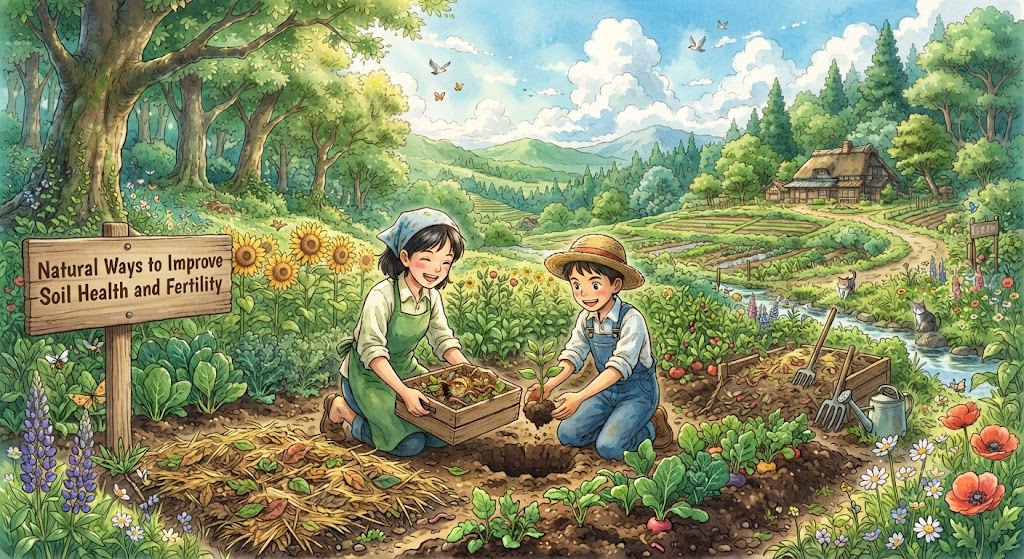
Healthy soil is one of the most important foundations of successful agriculture and gardening. Plants need more than water and sunlight to grow well; they also depend on soil that can provide nutrients, hold moisture, support roots, and maintain a healthy biological environment.
Fertile soil does not have to depend entirely on synthetic inputs. Many natural farming and gardening practices can gradually improve soil structure, organic matter, nutrient cycling, and biological activity.
From compost and cover crops to crop rotation, mulch, manure, and living roots, there are several practical ways to improve soil naturally.
The best approach depends on the type of soil, climate, crops, and existing condition of the land. A method that works well on a vegetable garden in the UK may need to be adapted for a dry agricultural region in the United States.
The good news is that soil improvement does not usually require one dramatic change. Consistent management over several growing seasons can gradually create healthier and more productive soil.
What Makes Soil Healthy?
Healthy soil is a living system.
It contains minerals, organic matter, water, air, plant roots, microorganisms, fungi, insects, and other organisms. These components interact continuously.
Good agricultural soil should generally provide suitable conditions for:
- Root growth
- Water movement
- Nutrient availability
- Microbial activity
- Air movement
- Organic matter decomposition
- Plant development
Soil fertility is related to the availability of nutrients required for plant growth, while soil health is a broader concept that includes physical, chemical, and biological properties.
A soil can contain nutrients but still have problems with compaction or drainage.
That is why improving soil should involve more than simply adding fertiliser.
Start With a Soil Test
Before adding anything to the soil, it is useful to understand what is already there.
A soil test can provide information about factors such as pH and nutrient levels.
This information helps prevent unnecessary amendments.
For example, adding a nutrient that is already present at an adequate level may not provide any benefit and could create other problems.
Soil testing is useful for both farms and gardens.
In the United States, agricultural extension services and soil laboratories can provide testing resources in many areas. UK growers can also use soil-testing laboratories and agricultural services for analysis.
Testing should be repeated periodically rather than assuming that soil conditions remain unchanged forever.
Add Compost to Build Organic Matter
Compost is one of the most common natural materials used to improve soil.
It is made from decomposed organic materials such as plant residues and other suitable materials.
Well-produced compost can contribute organic matter and support soil structure.
When incorporated appropriately, compost can help create conditions that are more favourable for soil organisms and plant roots.
Compost can be particularly useful in gardens and smaller growing areas.
Farmers may use compost on a larger scale where it is economically and logistically practical.
The quality of compost matters.
Unfinished or contaminated compost may create problems, so growers should use properly processed material from reliable sources.
It is also important to apply compost according to soil and crop needs rather than assuming that larger quantities will always produce better results.
Use Well-Managed Animal Manure
Animal manure has traditionally been used to improve agricultural soils.
It can provide organic matter and nutrients, but it needs to be managed carefully.
Fresh manure may contain pathogens, weed seeds, or nutrient concentrations that can create problems if applied incorrectly.
Composted or appropriately aged manure is often easier to manage for many growing situations.
Farmers should consider the nutrient content of manure before applying it.
Repeated applications without testing can result in excessive levels of certain nutrients.
For livestock farms, using manure as part of a nutrient-management plan can help return nutrients to agricultural land rather than treating manure simply as waste.
Local regulations should also be followed, particularly where manure is applied near waterways or food crops.
Keep Soil Covered With Mulch
Bare soil is more exposed to environmental stress.
Mulching creates a protective layer over the soil surface.
Natural mulch materials can include:
- Straw
- Chopped leaves
- Grass clippings when appropriate
- Wood-based materials
- Crop residues
- Compost
Mulch can help reduce evaporation, moderate soil temperature, and protect the surface from rainfall impact.
It can also reduce opportunities for some weeds to establish.
In dry parts of the United States, maintaining soil cover can be particularly useful for conserving moisture.
In cooler and wetter parts of the UK, mulch can provide other benefits, although growers should consider drainage and moisture conditions before applying thick layers.
The appropriate mulch material and depth depend on the crop and growing environment.
Grow Cover Crops
Cover crops are plants grown primarily to protect and improve the soil rather than being harvested as the main commercial crop.
They can be used between production cycles to keep living roots in the ground.
Common cover crops include:
- Rye
- Oats
- Barley
- Clover
- Vetch
- Certain types of legumes
- Radishes and other suitable species
Cover crops can help reduce erosion and provide organic material when they decompose.
Their roots also interact with soil microorganisms while the plants are growing.
Different cover crops provide different benefits, so farmers should select species according to their soil, climate, planting window, and following crop.
A cover crop that works well in one region may not perform equally well somewhere else.
Use Crop Rotation Instead of Repeating One Crop
Growing the same crop repeatedly can place recurring pressure on the soil.
Different crops have different nutrient requirements and root systems.
Crop rotation introduces variation.
A farmer might rotate cereals with legumes or other crops rather than planting the same crop continuously.
Rotations can also help break certain pest and disease cycles.
For example, a pest that depends heavily on one particular crop may have fewer opportunities to build up when that crop is removed from the field for one or more seasons.
Crop rotation is not a universal solution, but it is a practical way to think about soil management over multiple years rather than one harvest at a time.
Keep Living Roots in the Soil
Plants do more underground than simply absorb water and nutrients.
Roots interact with microorganisms and contribute organic material to the soil system.
Keeping living roots in the soil for more of the year can therefore support biological activity.
Cover crops are one way to achieve this.
Perennial crops and suitable pasture systems can provide another.
The exact benefits depend on the plant species and soil conditions.
The basic principle is simple: healthy roots are an active part of healthy soil.
Reduce Unnecessary Tillage
Tillage can help prepare fields and manage certain agricultural problems, but repeated soil disturbance can affect soil structure and biological communities.
Reduced-tillage and no-till systems aim to minimise unnecessary disturbance.
Leaving crop residues on the surface can also help protect soil from erosion.
However, no single tillage system works perfectly everywhere.
Some farms may face weed, drainage, soil-temperature, or planting challenges that require specific forms of soil disturbance.
The goal is not necessarily to eliminate tillage in every situation. Instead, farmers can evaluate whether each operation is necessary and whether soil disturbance can be reduced without creating larger problems elsewhere.
Prevent Soil Compaction
Healthy soil needs spaces between particles for air and water movement.
Heavy machinery, livestock, and repeated traffic can compress these spaces.
Compacted soil can restrict root development and reduce infiltration.
One natural approach to protecting soil structure is to avoid working fields when they are excessively wet.
Farmers can also manage machinery traffic and use suitable equipment settings to reduce pressure on vulnerable soils.
Strong root systems and organic matter can support soil structure, but preventing severe compaction is often easier than trying to correct it later.
Encourage Earthworms and Soil Organisms
A healthy soil contains a diverse community of organisms.
Earthworms are among the most familiar examples.
They can create channels through soil and contribute to the movement and breakdown of organic material.
Microorganisms such as bacteria and fungi also play important roles in decomposition and nutrient cycling.
Management practices that maintain organic matter and reduce unnecessary disturbance can help create better conditions for these organisms.
Instead of thinking of soil as an inactive material, it can be more useful to view it as a living ecosystem.
That perspective can change how farmers approach cultivation, residues, compost, and crop rotations.
Choose Natural Fertility-Building Plants
Certain plants can contribute to soil fertility as part of a well-designed rotation.
Legumes are particularly important because they form relationships with specific soil bacteria that can help make atmospheric nitrogen available to plants.
Examples include:
- Clover
- Peas
- Beans
- Vetch
- Alfalfa
- Other suitable legumes
The amount of nitrogen contributed varies according to species, growing conditions, biomass production, and management.
Legumes should therefore be viewed as one component of a broader nutrient-management system rather than a guaranteed replacement for every fertiliser requirement.
Return Suitable Crop Residues to the Soil
After harvest, crop residues can become a valuable source of organic material.
Leaves, stems, roots, and other plant material can decompose and return nutrients and carbon to the soil.
Leaving appropriate residues in the field can also provide surface protection.
However, residue management needs to consider pests, diseases, planting equipment, and the next crop.
In some situations, excessive residue can interfere with establishment or create other challenges.
The goal is to manage residues strategically rather than automatically removing or retaining everything.
Use Mulch and Plants Together
Mulching and cover crops are sometimes treated as completely separate techniques, but they can complement each other.
A cover crop protects the soil while it is growing.
After it is terminated or naturally dies, its remaining material can continue providing surface cover.
This creates a transition from living protection to residue-based protection.
For example, a grower might use a winter cover crop and then leave some plant material on the surface when the next crop is established.
The exact system depends on the crop and local climate.
Improve Water Management Naturally
Healthy soil can help manage water more effectively.
Soil with good structure can allow rainfall to infiltrate rather than immediately running across the surface.
Organic matter can also contribute to water-holding capacity.
Keeping the soil covered can reduce direct evaporation and protect the surface from heavy rainfall.
These benefits are particularly relevant as farms experience variable weather.
A grower in a dry region may focus heavily on moisture retention, while a grower in a wet region may need to prioritise drainage and avoiding compaction.
Good soil management must therefore balance water storage with water movement.
Use Diverse Plantings When Practical
Plant diversity can contribute to a more active soil ecosystem.
Different plants interact with the soil in different ways.
Some develop deep roots, others remain relatively shallow. Some produce large amounts of residue, while others have different nutrient requirements.
Combining or rotating diverse plants can therefore create a wider range of biological interactions.
For gardens, this might involve growing several crop families rather than relying on one type of plant.
For farms, it may involve longer crop rotations, cover crops, or mixed systems.
The specific combination should always reflect the farm’s production goals.
Be Careful With Natural Amendments
“Natural” does not automatically mean that a material can be applied without limits.
Natural products can still contain concentrated nutrients or minerals.
For example, excessive application of manure, compost, lime, or other amendments can alter soil chemistry.
This is another reason soil testing is valuable.
Before applying a large amount of any amendment, growers should understand what it contains and how it could affect the soil.
Following reliable agricultural guidance and product recommendations is safer than assuming that more material will always produce healthier soil.
Protect Soil From Erosion
Erosion removes valuable topsoil.
Water and wind can carry soil particles away when the surface is exposed or poorly protected.
Several natural practices can help reduce erosion:
- Cover crops
- Crop residues
- Mulching
- Permanent vegetation
- Grass waterways
- Buffer strips
- Appropriate crop rotations
- Reduced soil disturbance
Field design also matters.
On sloping land, planting and vegetation management can influence how water moves across the field.
Farmers should consider local soil-conservation guidance when managing areas vulnerable to erosion.
Give Soil Time to Improve
One of the most important lessons in soil management is that improvement takes time.
Adding compost can produce visible changes relatively quickly in some garden settings, but rebuilding soil structure and organic matter across agricultural land can take years.
This is why consistency matters.
A farmer who uses cover crops for several seasons, manages residues carefully, avoids unnecessary compaction, and maintains diverse rotations may gradually see changes in soil behaviour.
The results should be measured over time rather than judged after a single season.
A Simple Natural Soil-Improvement Plan
For anyone unsure where to begin, the process can be kept simple.
Step 1: Test the soil.
Find out the current pH and nutrient condition.
Step 2: Identify the main problem.
Is the soil compacted, low in organic matter, poorly drained, excessively dry, or vulnerable to erosion?
Step 3: Add organic material appropriately.
Use suitable compost, manure, or crop residues where needed.
Step 4: Keep the surface protected.
Use mulch, crop residue, or suitable vegetation.
Step 5: Grow more living roots.
Consider cover crops, diverse rotations, or other suitable plants.
Step 6: Reduce unnecessary disturbance.
Avoid excessive tillage and field traffic when possible.
Step 7: Monitor the results.
Repeat soil testing and observe crop performance over time.
This gradual approach can be more practical than trying to introduce every soil-health practice at once.
Natural Soil Management in Different Climates
Soil management should always account for local conditions.
In much of the United States, farmers may have to manage drought, high summer temperatures, wind erosion, or irrigation requirements depending on the region.
In the United Kingdom, growers may deal with frequent rainfall, wet soils, seasonal temperature changes, and drainage concerns.
A practice that conserves moisture in a dry region may need modification in a location where excess moisture is the main problem.
There is no universal recipe for healthy soil.
The underlying principles remain useful, but implementation should be adapted to the local environment.
Measuring Whether Soil Is Improving
It is difficult to manage soil effectively without tracking changes.
Useful indicators can include:
- Soil-test results
- Organic matter levels
- Crop performance
- Water infiltration
- Visible erosion
- Soil structure
- Root development
- Earthworm activity
- Weed pressure
- Compaction
- Yield trends
No single measurement tells the entire story.
A combination of laboratory testing, field observations, and crop records provides a more useful picture.
Farmers can also compare different fields or management methods to determine which practices perform best under their own conditions.
Healthy Soil Supports Healthy Crops
Improving soil naturally is not about finding one magic amendment.
It is about creating an environment where plants, roots, microorganisms, water, nutrients, and organic matter can interact effectively.
Compost can add organic material. Cover crops can protect the ground. Crop rotations can diversify the system. Mulch can protect the surface. Living roots can support biological activity. Careful traffic management can reduce compaction.
Together, these practices can create a stronger foundation for crop production.
Building Fertile Soil for the Long Term
Healthy soil is an agricultural asset that becomes more valuable when it is managed over many seasons.
For farmers and growers in the United States, United Kingdom, and elsewhere, natural soil-management practices can provide practical ways to improve the condition of land while reducing unnecessary dependence on intensive inputs.
The most effective strategy will depend on the soil, climate, crop, and goals of the individual farm or garden.
Start with testing. Identify the biggest limitation. Make one or two sensible changes. Monitor what happens and adjust the approach as new information becomes available.
Over time, consistent practices such as maintaining organic matter, protecting the soil surface, encouraging living roots, diversifying crops, and avoiding unnecessary disturbance can help create a healthier growing environment.
Fertile soil is not simply something a farm uses. It is a resource that farmers can build, protect, and improve for future growing seasons.