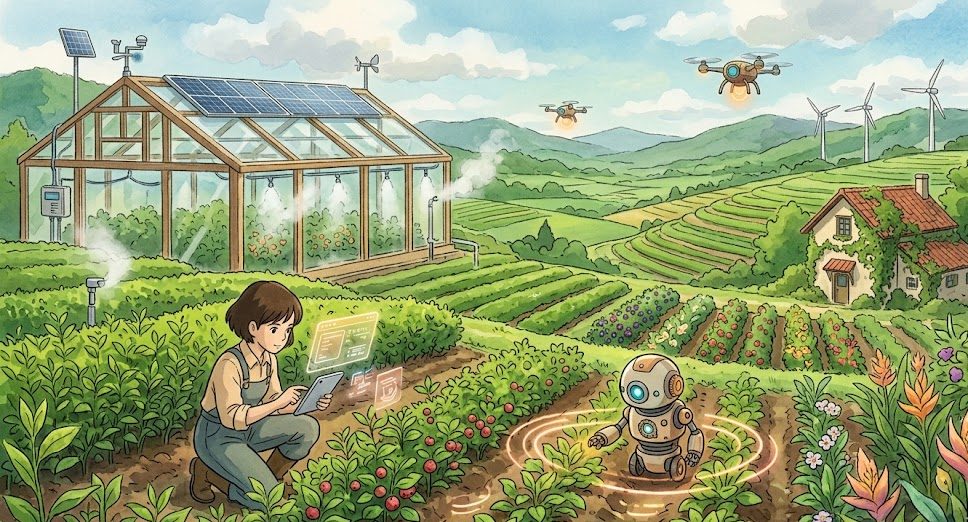
The agricultural sector is undergoing a massive transformation. We are no longer in the era of simple manual labor; we have entered the Digital Frontier. For farmers focusing on High-Value Cash Crops, the integration of Artificial Intelligence (AI) and Smart Technology is no longer an option—it is a necessity for staying competitive and maximizing profitability.
In this comprehensive guide, we will explore how cutting-edge innovations are redefining the way we grow, manage, and scale high-value produce.
The Rise of the “Smart Farm”
A “Smart Farm” uses IoT (Internet of Things) sensors, drones, and AI algorithms to create a closed-loop system of efficiency. For high-value crops like saffron, exotic berries, or medicinal herbs, even a small error in temperature or moisture can lead to massive financial losses. Smart technology acts as a 24/7 insurance policy for your harvest.
1. AI-Driven Predictive Analytics
AI doesn’t just collect data; it learns from it. By analyzing historical weather patterns and current soil conditions, AI can predict potential pest outbreaks or drought cycles before they happen. This “Climate Intelligence” allows farmers to take preventive action, saving the crop and reducing the need for expensive emergency treatments.
2. Precision Irrigation and Fertigation
High-value cash crops often have very specific nutrient requirements. Automated “Smart Fertigation” systems use sensors to deliver the exact amount of water and liquid fertilizer directly to the roots. This prevents nutrient runoff and ensures that not a single drop of expensive resources is wasted.
Revolutionizing High-Value Cash Crops
Cash crops are grown for profit rather than subsistence. Because the stakes are higher, the technology used must be more precise.
Autonomous Monitoring via Drones
Drones equipped with multispectral sensors can fly over vast fields and “see” things the human eye cannot. They can detect early signs of nitrogen deficiency or fungal infections across thousands of acres in minutes. For a high-value plantation, this early detection can mean the difference between a record-breaking harvest and a total loss.
Computer Vision for Quality Grading
AI-powered cameras are now used during the harvest and packaging stages. Computer vision algorithms can sort crops based on size, color, and ripeness with 99% accuracy. This ensures that only the “Grade A” produce reaches the premium markets, allowing farmers to command much higher prices.
Healing the Soil with Smart Tech
Revolutionizing agriculture isn’t just about high yields; it’s about sustainability. “Smart” farming also means “Natural” farming.
- Soil Health Mapping: AI creates 3D maps of soil health, identifying “dead zones” that need natural restoration. Instead of treating the whole field, farmers can focus their soil-healing efforts exactly where they are needed.
- Variable Rate Technology (VRT): This technology allows equipment to change the rate of application for seeds or amendments on the fly. It ensures that healthy soil stays productive while depleted soil gets the extra care it needs to recover naturally.
The Economic Impact of Digital Integration
For many, the initial cost of AI and Smart Tech seems high. However, the Return on Investment (ROI) in the high-value cash crop sector is unparalleled.
1. Labor Optimization
By automating routine tasks like irrigation, monitoring, and even robotic weeding, farmers can reduce their dependency on manual labor. In an era of rising labor costs and shortages, this transition ensures that the farm remains operational and profitable.
2. Supply Chain Transparency
Blockchain and AI integration allow for “Farm-to-Fork” traceability. Premium buyers in international markets are willing to pay more for crops that come with a verified digital history of how they were grown, what tech was used, and their organic certification status.
Overcoming the Barriers to Entry
Moving toward the digital frontier requires a strategic approach. It isn’t about buying every gadget available; it’s about choosing the right tools for your specific niche.
Starting with “Micro-Farming” Tech
If you are managing a smaller operation or “Micro-Farming” setup, start with basic IoT sensors for soil moisture and temperature. These small investments provide immediate data that can improve your yield significantly without a massive upfront cost.
Scaling with Integrated Hubs
As your operation grows, these individual sensors should be connected to a central Farming Innovation Hub. This software acts as the “brain” of the farm, coordinating between drones, automated machinery, and market data to make real-time decisions.
The Future: AI and the Bio-Digital Age
Looking ahead, we are moving toward a “Bio-Digital” age where plants and machines communicate. We are seeing the development of “Plant-Wearables”—tiny sensors attached to leaves that send a signal to the farmer’s smartphone the moment the plant feels “stressed.”
This level of intimacy with the crop ensures that high-value harvests are nurtured to their full genetic potential.
Conclusion: Lead the Revolution
The digital frontier of agriculture is an exciting space full of opportunities for those willing to embrace change. By leveraging AI and Smart Technology, we are not just growing crops; we are building an intelligent, sustainable, and highly profitable ecosystem.
For the modern farmer and digital creator, the goal is clear: use technology to protect the earth, heal the soil naturally, and maximize the value of every single seed planted. The revolution has started—is your farm ready?
SEO Meta Details:
- Focus Keyword: Digital Frontier of Agriculture
- Secondary Keywords: AI in Farming, Smart Technology, High-Value Cash Crops, Precision Agriculture, Future of Farming.
- Meta Description: Explore how AI and Smart Technology are revolutionizing high-value cash crops. Learn about predictive analytics, drone monitoring, and the future of the digital frontier in agriculture.