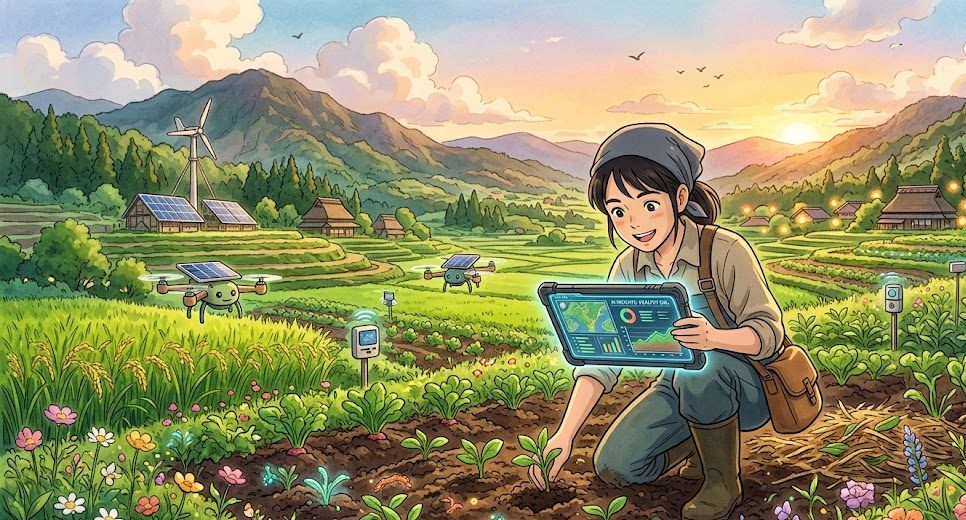
For decades, the relationship between technology and agriculture was seen as a zero-sum game. On one side stood “High-Tech Farming,” defined by heavy machinery, synthetic chemicals, and a “nature-subjugation” mindset. On the other stood “Natural Farming,” focused on soil health, biodiversity, and manual labor.
In 2026, that divide has finally collapsed. We are entering the era of Regenerative Precision Agriculture.
By synergizing the ancient wisdom of soil biology with the hyper-efficiency of Artificial Intelligence (AI), farmers are achieving the “impossible”: healing the earth’s crust while simultaneously shattering previous yield records. This post explores how AI-driven insights are becoming the ultimate tool for eco-conscious food security.
1. The Core Conflict: Why Soil Needs Healing
Before we look at the solution, we must acknowledge the crisis. Modern industrial farming has treated soil like a hydroponic medium—a dead substrate used only to hold plants upright while they are pumped with liquid chemicals.
This has led to:
- Carbon Depletion: Soil that once breathed and stored carbon is now inert, contributing to atmospheric CO2.
- Microbial Collapse: Pesticides and over-tilling have wiped out the bacteria and fungi essential for natural nutrient cycling.
- Yield Plateaus: Despite more chemicals, yields are leveling off because the biological “engine” of the plant is broken.
AI-Driven Synergism changes this by treating the farm as a complex, living data set.
2. Digital Eyes Underground: AI and Soil Sensors
The first step in healing the soil is understanding it. Traditionally, soil testing involved taking a few samples to a lab and waiting weeks for a report. AI has turned this into a real-time conversation.
High-Resolution Mapping
Using IoT (Internet of Things) sensors and satellite imagery, AI creates “Digital Twins” of a farm’s soil profile. It measures:
- Volatile Organic Compounds (VOCs): Detecting the “smell” of healthy soil microbiology.
- Moisture Conductivity: Mapping exactly where water stays and where it drains.
- Nutrient Variance: Identifying specific patches that need help, rather than blanket-spraying an entire 100-acre field.
By knowing exactly what a specific square meter of earth needs, we stop the “over-medication” of the land.
3. Precision Regeneration: The AI Prescription
Once the data is collected, AI algorithms provide a Regenerative Prescription. This isn’t about which chemical to buy; it’s about how to assist nature’s own processes.
- Variable Rate Cover Cropping: AI analyzes soil depletion levels and suggests a specific “cocktail” of cover crops (e.g., 30% clover for nitrogen, 40% rye for biomass, 30% radish for aeration) for different parts of the field.
- Optimized Grazing Patterns: For integrated livestock farms, AI tracks herd movement and grass regrowth rates, ensuring animals stimulate soil growth through “planned trampling” without overgrazing.
- Carbon Sequestration Tracking: AI models can now predict exactly how much carbon a farm is “sinking” into the ground, allowing farmers to monetize their eco-conscious efforts through carbon credits.
4. Maximizing Yield Without the “Cost”
The most common criticism of natural farming is that it can’t feed the world. AI proves this wrong. When technology handles the logistics, nature handles the production.
Predictive Pest Management
Instead of “preventative” pesticide spraying (which kills beneficial insects), AI uses weather data and insect migration patterns to predict an outbreak before it happens. This allows for the use of targeted biological controls (like releasing predatory ladybugs) at the exact moment they are needed.
The “Golden Harvest” Window
AI analyzes hyper-local weather patterns and plant stress levels to determine the precise hour for harvesting. This ensures the highest nutrient density and longest shelf-life, reducing post-harvest waste—the hidden killer of global food yields.
5. The Hardware: From Heavy Iron to Autonomous Swarms
The visual symbol of this synergy is the move away from massive, soil-compacting tractors to Autonomous Ag-Bots.
- Lightweight Impact: Small, solar-powered robots crawl through fields. Because they are light, they don’t crush the soil pores (macro-pores) that are vital for oxygen and water flow.
- Laser Weeding: Rather than using herbicides, AI-powered bots identify weeds and zap them with high-precision lasers or pull them mechanically. The “weed” is then left on the surface to decompose back into the soil as mulch.
6. SEO & Adsense Strategy: Sharing the Synergy
If you are a tech-agri blogger or an eco-entrepreneur, this niche is incredibly “Adsense friendly” because it attracts high-value advertisers from both the Tech and Green-Energy sectors.
Key Content Pillars for High Engagement:
- Case Studies: “How AI increased my corn yield by 15% while cutting fertilizer costs by 40%.”
- Tool Reviews: Comparative guides on the best soil sensors for small-scale vs. large-scale farming.
- Educational Deep-Dives: Explaining the Rhizosphere (the area around plant roots) through the lens of data science.
Pro Tip: Use keywords like “Sustainable AgTech,” “AI Soil Health,” and “Regenerative Yield Optimization” to capture high-intent search traffic.
7. Comparison: Traditional vs. AI-Natural Synergy
| Feature | Industrial Farming | AI-Natural Synergy |
|---|---|---|
| Philosophy | Control and Extraction | Partnership and Regeneration |
| Nutrient Source | Synthetic NPK | Microbial Activity & Cover Crops |
| Pest Control | Chemical Blanketing | AI-Predicted Biological Intervention |
| Data Usage | Historical/Average | Real-Time/Hyper-Local |
| Long-Term Yield | Declining (Soil Fatigue) | Increasing (Building Fertility) |
Export to Sheets
8. The Human Element: The Farmer as Data Scientist
This synergy doesn’t replace the farmer; it upgrades them. The modern farmer is part biologist, part data analyst, and part steward. AI removes the “guesswork” and the back-breaking repetitive labor, allowing the farmer to focus on high-level strategy and ecological health.
The intuition of the “old-school” farmer—knowing when the rain feels “right”—is now being backed by petabytes of data. This is not the end of traditional farming; it is its evolution.
Conclusion: A Future of Abundance
“Synergizing Tech and Nature” is more than a catchy title; it is the only viable path forward for a planet with a growing population and a changing climate. By using AI to listen to what the soil is telling us, we stop fighting against nature and start flowing with it.
We can have the high yields the world needs. We can have the healthy, carbon-sequestering soil the planet needs. Through AI-driven insights, we finally have the tools to achieve both.
The future isn’t just green; it’s smart.