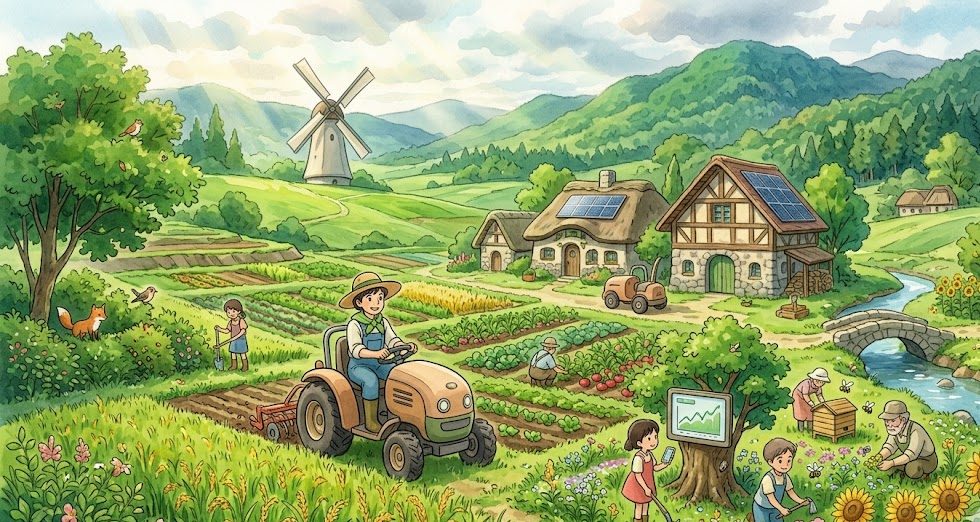
The agricultural landscape is undergoing its most significant transformation since the industrial revolution. For decades, “modern” farming meant more chemicals, larger machines, and higher yields—at any cost. But we’ve hit a wall. Soil health is declining, input costs are skyrocketing, and climate unpredictability is making traditional methods risky and unprofitable.
The Smart Farming Revolution is the answer. It isn’t just about drones and sensors; it is about the “smart” integration of ancient biological wisdom with cutting-edge technology. It is a shift from viewing a farm as a chemical factory to treating it as a high-performance biological ecosystem.
Here is your comprehensive guide to restoring the land while maximizing your bottom line.
1. The Core Philosophy: Restorative Profitability
The biggest myth in agriculture is that you must choose between being “eco-friendly” and being “profitable.” In the Smart Farming Revolution, these two goals are identical.
Natural soil restoration reduces your dependency on expensive synthetic inputs (fertilizers, pesticides, and herbicides), which currently account for nearly 40% of a conventional farmer’s operating costs. By restoring the soil, you aren’t just “saving the planet”—you are slashing your overhead and insulating your business from global supply chain shocks.
2. Part I: The Science of Natural Soil Restoration
Soil is not a dead substrate; it is a living, breathing community. Restoring it requires a transition from “feeding the plant” to “feeding the soil.”
A. The End of Tillage: Protecting the Architecture
Every time a plow turns the earth, it destroys the complex architecture created by fungi and earthworms. This “structural damage” leads to erosion and water runoff.
- The Smart Move: Adopt No-Till or Strip-Till methods. This keeps the soil’s “biological internet” (the mycorrhizal fungal networks) intact, allowing plants to communicate and share nutrients.
B. Cover Cropping as “Green Manure”
Bare soil is dying soil. In nature, you never see bare earth unless there is a catastrophe.
- The Smart Move: Plant multi-species cover crops (like clover, vetch, and radish) during the off-season. These plants act as a living armor, fixing nitrogen from the atmosphere into the soil for free—replacing the need for synthetic urea.
C. The Carbon Cycle and Organic Matter
High-profit farming relies on the Soil Carbon Sponge. Increasing soil organic matter (SOM) by just 1% can allow an acre of land to hold an additional 20,000 gallons of water. This makes your crops “drought-proof,” ensuring profit even during dry years.
3. Part II: High-Profit Crop Management
Once the soil is restored, the management of the crop itself must become “smart”—meaning data-driven and precision-oriented.
A. Precision Nutrition (The 4R Framework)
Using the Right Source, at the Right Rate, at the Right Time, and in the Right Place.
- Instead of blanket-spraying a whole field, smart farmers use variable-rate technology (VRT). Drones or sensors identify which specific 10-meter patch of land needs nutrients, reducing waste and preventing the “burning” of young crops.
B. Integrated Pest Management (IPM) 2.0
In a restored ecosystem, nature does the pest control for you. By planting “refuge rows” of wildflowers, you attract predatory insects like ladybugs and parasitic wasps that hunt the pests.
- The Profit Logic: Biological control is self-sustaining. A gallon of pesticide is a one-time expense that kills everything (including the good bugs); a colony of beneficial insects is a permanent workforce that reproduces for free.
C. Diversification and Intercropping
Monoculture (growing only one crop) is a high-risk gamble. The Smart Revolution favors Relay Cropping or Intercropping—growing two or more crops together.
- Example: Growing legumes under corn. The legumes provide nitrogen for the corn, while the corn provides shade for the legumes. You get two harvests from one piece of land.
4. Part III: The Tech Stack of the Smart Farmer
To implement these natural principles at scale, we use technology as an equalizer.
| Technology | Role in Restoration | Profit Impact |
|---|---|---|
| IoT Soil Sensors | Monitor moisture and NPK levels in real-time. | Prevents over-irrigation and saves 20-30% on water. |
| Satellite Imagery | Tracks “Normalized Difference Vegetation Index” (NDVI). | Identifies crop stress weeks before the human eye can see it. |
| AI Yield Mapping | Correlates soil health with final harvest data. | Helps decide which seeds to buy for the next season based on data, not guesses. |
| Autonomous Weeders | Uses lasers or mechanical “fingers” to pull weeds. | Eliminates the need for glyphosate and other toxic herbicides. |
Export to Sheets
5. Managing the Transition: The 3-Year Rule
Restoring soil that has been chemically treated for decades takes time. Smart farmers plan for a “Transition Period.”
- Year 1: The Detox. Stop heavy tillage and start cover cropping. Yields might dip slightly, but input costs will drop immediately.
- Year 2: The Reawakening. Soil biology begins to return. You’ll notice more earthworms and better water infiltration.
- Year 3: The Synergy. This is where high profits kick in. The soil is now doing the work for you. The “Smart” system is fully operational, and your margin per acre typically exceeds conventional farming.
6. The Future: Carbon Markets and Premium Branding
The Smart Farming Revolution offers a hidden “Second Harvest”: Carbon Credits. Companies are now paying farmers for the carbon they sequester in their restored soil. By moving to a Nature-First, Smart-Tech model, you can get paid for the air just as much as the grain.
Furthermore, “Regeneratively Grown” is the new “Organic.” Consumers are willing to pay a premium for food that they know helped restore the planet. This allows smart farmers to move away from being “commodity price takers” to “premium price makers.”
Conclusion: The New Frontier
The Smart Farming Revolution is not about going back to the past; it is about moving forward with better tools. By combining the microscopic precision of Soil Science with the macroscopic power of Climate Tech, we are creating a version of agriculture that is resilient, sustainable, and—most importantly—wildly profitable.
The logic is undeniable: A farmer who works against nature must pay for every victory. A farmer who works with nature has a partner that never sends a bill.
Welcome to the revolution.