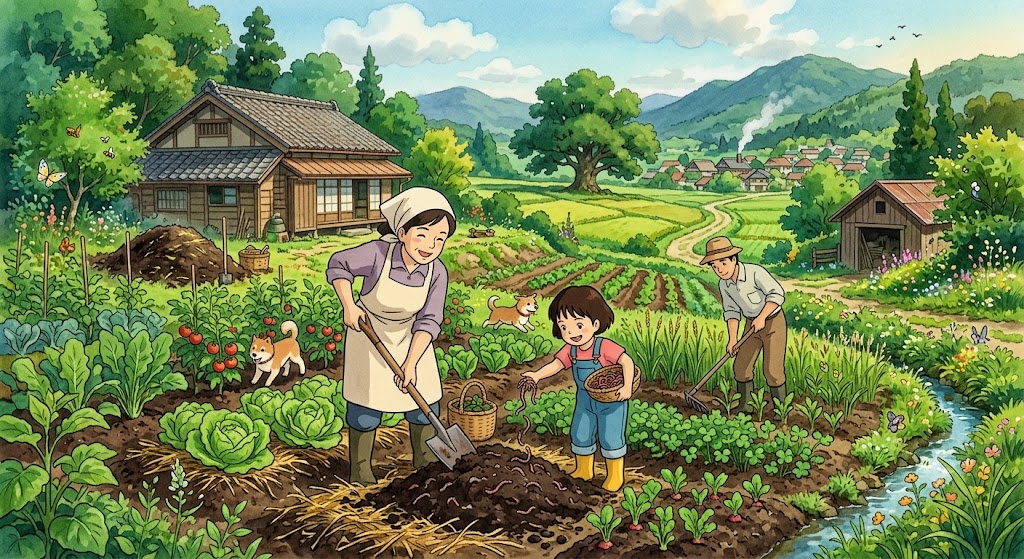
Productive farming begins below the surface. Crops may look healthy for a season after receiving fertilisers and irrigation, but long-term farm productivity depends on the condition of the soil. When soil loses organic matter, beneficial organisms, moisture-holding capacity, and natural structure, farmers often experience weaker crops, rising input costs, erosion, and unstable yields.
Restoring soil naturally means rebuilding its physical, chemical, and biological health instead of depending only on quick external inputs. This process takes time, but it creates benefits that continue across multiple seasons.
Healthy soil allows roots to grow deeply, stores water during dry periods, drains excess rainfall, and makes nutrients more available to crops. Farmers can achieve these improvements through practical methods such as composting, cover cropping, crop rotation, reduced tillage, mulching, and careful livestock integration.
Begin by Understanding the Soil
Before improving soil, farmers must understand its current condition. A field may appear unproductive because of nutrient deficiency, but the real problem could be compaction, poor drainage, unsuitable pH, erosion, or low organic matter.
A soil test provides useful information about acidity, alkalinity, major nutrients, and sometimes organic carbon. This prevents farmers from applying fertilisers without knowing what the field actually requires.
Physical observation is equally important. Farmers should check whether water enters the soil quickly or runs across the surface. Hard layers, shallow roots, standing water, cracks, and low earthworm activity can indicate poor soil structure.
Healthy soil usually has a loose, crumb-like texture and a fresh, earthy smell. It allows water and air to move through spaces between soil particles while still holding enough moisture for crops.
Understanding the starting condition makes it easier to select restoration methods that address the actual problem.
Return Organic Matter to the Field
Organic matter is one of the most important ingredients in productive soil. It feeds microorganisms, improves nutrient storage, supports soil structure, and increases water-holding capacity.
Farmers can build organic matter with compost, well-decomposed manure, crop residues, green manure, and plant-based mulches. These materials should be added regularly because organic matter continues breaking down over time.
Compost is especially valuable because it contains stabilised organic material that can improve both sandy and clay soils. In sandy fields, it helps hold water and nutrients. In heavy clay soil, it improves aeration and makes the surface easier to manage.
Fresh manure should be handled carefully. Applying large quantities immediately before planting may damage seedlings or create nutrient imbalance. Properly composted manure is generally safer and easier to use.
Burning crop residues removes a valuable source of carbon and exposes the field to erosion. Where possible, residues should be chopped, composted, used as mulch, or returned carefully to the soil.
Keep Living Roots in the Soil
Soil organisms depend on plants for food. Living roots release natural compounds that feed beneficial bacteria and fungi around the root zone.
After a main crop is harvested, leaving the field completely bare interrupts this biological activity. Cover crops can keep roots growing between commercial crop seasons.
Legumes such as clover, cowpea, or vetch may support nitrogen cycling. Grasses such as rye or oats produce large amounts of biomass and protect the surface. Deep-rooted crops can help open compacted soil layers and improve water movement.
| Soil Problem | Helpful Natural Practice |
|---|---|
| Low organic matter | Compost and crop residues |
| Surface erosion | Mulch and cover crops |
| Nitrogen shortage | Legume rotation |
| Compacted soil | Deep-rooted cover crops |
| Poor moisture retention | Organic matter and mulch |
| Weak biological activity | Living roots and reduced chemicals |
Cover crops should be selected according to local rainfall, temperature, water availability, and the next crop. They must also be terminated at the correct time so they do not compete with the main crop for moisture.
Rotate Crops Instead of Repeating One Crop
Continuous cultivation of the same crop removes similar nutrients every season and allows certain pests and diseases to become established.
Crop rotation creates diversity below and above the ground. Different crops develop different root systems, use nutrients at different depths, and support different groups of microorganisms.
A farmer might rotate a cereal crop with a legume, followed by a vegetable or root crop. Legumes can support nitrogen availability, while deep-rooted crops may collect nutrients from lower soil layers.
Rotation also reduces the pressure of weeds, insects, and soil-borne diseases. However, crops from the same botanical family may share similar problems, so a useful rotation should include genuinely different crop groups.
The best rotation is not necessarily complicated. Even alternating two or three suitable crops can provide better results than growing the same crop continuously.
Reduce Excessive Soil Disturbance
Ploughing can control weeds and prepare a seedbed, but repeated deep tillage damages natural soil structure. It breaks fungal networks, disturbs earthworms, increases moisture loss, and exposes organic matter to rapid breakdown.
Reduced tillage allows soil particles and organic materials to form stable aggregates. These small clusters create spaces for water, air, microorganisms, and roots.
Farmers do not need to stop tillage immediately. The system can be changed gradually by reducing the number of passes, using shallower cultivation, or testing minimum tillage in a small area.
Fields with severe compaction may first need corrective action. After the compacted layer is addressed, cover crops and controlled machinery movement can help prevent the problem from returning.
Reducing unnecessary cultivation also saves fuel, labour, and machinery expenses.
Protect the Surface With Mulch
Soil should be protected in the same way that plants protect natural ground. Organic mulch forms a layer between the surface and the weather.
Suitable materials include straw, dry leaves, grass clippings, wood chips, and healthy crop residues. Mulch reduces water evaporation, controls weeds, softens the impact of rainfall, and protects the soil from extreme temperatures.
As organic mulch breaks down, it contributes carbon and nutrients to the upper soil layer. It also creates favourable conditions for earthworms and other decomposers.
Mulch should not be pressed directly against crop stems because constant moisture can encourage rot. Farmers should also avoid using diseased residues or materials containing mature weed seeds.
In dry regions, mulching can make a major difference by helping crops use limited moisture more efficiently.
Support Beneficial Soil Life
A healthy field contains enormous numbers of bacteria, fungi, earthworms, insects, and other organisms. These living communities decompose residues, release nutrients, create soil channels, and form relationships with plant roots.
Excessive pesticide use, unnecessary fungicides, waterlogging, burning, and repeated deep tillage can reduce biological diversity.
Farmers can support soil life by keeping the soil covered, adding organic matter, maintaining living roots, and avoiding unnecessary chemical applications.
Earthworms are particularly useful indicators. Their tunnels improve aeration and water infiltration, while their activity mixes organic materials with mineral soil.
Mycorrhizal fungi form partnerships with plant roots and can improve access to water and nutrients. These fungal networks are more likely to survive when soil disturbance is limited and living plants remain in the field.
Integrate Livestock Carefully
Livestock can contribute to soil restoration when grazing and manure are managed correctly. Animals convert crop residues and pasture into manure that returns nutrients and organic material to the land.
Controlled or rotational grazing gives pasture plants time to recover and prevents animals from repeatedly damaging the same area. Short grazing periods followed by adequate rest can encourage stronger root growth and better ground cover.
Poorly managed grazing has the opposite effect. Too many animals can remove vegetation, compact wet soil, and increase erosion.
Manure should be distributed evenly or composted before field application. Concentrated waste around feeding areas can create nutrient overload rather than improving soil.
Crop and livestock systems work best when the movement of nutrients is planned carefully.
Manage Water to Protect Soil Structure
Both drought and excess water can damage soil health. Dry soil loses biological activity, while saturated soil lacks enough oxygen for healthy roots.
Improving organic matter helps regulate both extremes. Healthy soil absorbs rainfall more effectively and stores water for later use.
Farmers should repair drainage problems, maintain field channels, and prevent irrigation water from flowing too quickly across exposed soil. On slopes, contour planting, grass strips, terraces, or small barriers can slow runoff.
Irrigation should be based on crop need and soil moisture. Repeated overwatering can cause compaction, nutrient loss, and root diseases.
Water should enter the soil gradually rather than running away with valuable topsoil.
Measure Progress Over Several Seasons
Natural soil restoration does not produce all its benefits immediately. Farmers should observe changes over several seasons rather than expecting complete recovery after one treatment.
Useful signs of improvement include deeper roots, easier field cultivation, more earthworms, better water infiltration, reduced surface crusting, and improved crop growth during dry periods.
Records can help compare soil tests, fertiliser use, irrigation needs, yield, and production costs. These measurements show whether restoration methods are creating practical and financial benefits.
New practices should initially be tested on a small section of the farm. Comparing treated and untreated areas helps farmers decide which methods suit their soil, climate, crops, and budget.
Frequently Asked Questions
How long does natural soil restoration take?
Some improvements may appear within one season, but major changes in structure and organic matter often require several years of consistent management.
What is the easiest way to begin?
Applying good-quality compost, keeping the soil covered, and rotating crops are practical starting points for most farms.
Can damaged soil become productive again?
In many cases, yes. Recovery depends on the level of damage, local climate, available organic materials, and consistent management.
Does healthy soil reduce fertiliser use?
Healthy soil improves nutrient cycling and may reduce dependence on fertilisers over time, although crops may still require additional nutrients.
Is zero tillage suitable for every farm?
No. Soil type, climate, crop choice, machinery, and weed pressure should be considered before adopting a no-till system.
Conclusion
Restoring soil naturally is a long-term investment in the future of the farm. Compost, crop rotation, cover crops, mulching, reduced tillage, biological diversity, and careful water management work together to rebuild fertility and structure.
There is no single treatment that can heal every field. The most effective strategy begins with understanding the soil and applying gradual improvements that match local conditions.
Farmers who protect their soil today can achieve stronger crops, lower input waste, better drought resistance, and more reliable productivity for many seasons to come.