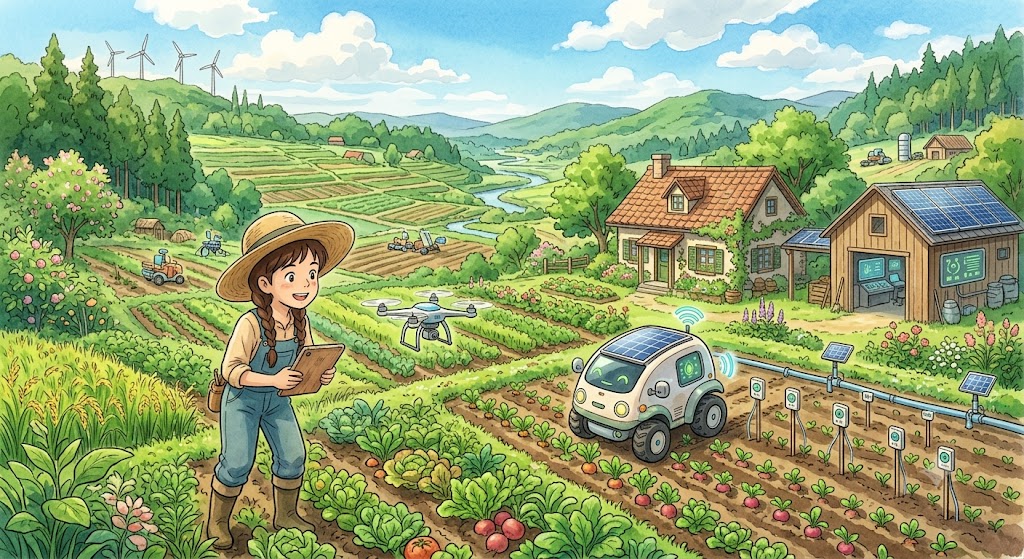
Agriculture is becoming more intelligent, connected, and precise. Farmers once depended mainly on personal experience, seasonal patterns, and physical field inspection. These skills are still essential, but artificial intelligence and smart technology now provide additional information that can help farmers make faster and more accurate decisions.
Artificial intelligence, commonly called AI, can analyse large amounts of information collected from sensors, satellites, drones, cameras, machinery, and weather systems. Smart farming tools then turn this information into practical recommendations about irrigation, crop nutrition, pest control, harvesting, and farm management.
The goal is not to remove farmers from agriculture. It is to give them better tools for producing healthy crops, reducing waste, managing risks, and using limited resources more efficiently.
From Guesswork to Data-Based Farming
Fields are rarely uniform. One area may contain more moisture, another may have poor fertility, and a third may be affected by pests. Applying the same quantity of water, fertiliser, or pesticide everywhere can waste money and create environmental problems.
Smart agriculture allows farmers to manage these differences more accurately. Soil sensors, GPS maps, satellite images, and crop-monitoring systems collect information from different areas of the farm. AI can analyse that data and highlight sections that require attention.
Instead of treating an entire field, a farmer may apply additional nutrients only where crops show deficiency. Irrigation can also be adjusted according to actual soil moisture rather than a fixed timetable.
FAO describes digital agriculture and AI as important tools for precision farming, climate-smart agriculture, supply-chain management, and better market access.
This targeted approach can lower input costs while improving crop health and productivity.
Smart Sensors Improve Water and Soil Management
Sensors are among the most practical smart technologies available to farmers. They can be placed in fields, irrigation systems, greenhouses, storage facilities, and livestock areas.
Depending on the equipment, sensors may measure soil moisture, temperature, humidity, nutrient conditions, water levels, or greenhouse climate. Farmers can view the information through a mobile application or computer.
A soil-moisture sensor helps determine whether irrigation is actually required. This prevents farmers from watering soil that is already wet or allowing crops to remain dry during an important growth stage.
Some modern systems combine field sensors, satellite images, and AI to optimise irrigation and crop management. FAO reported in July 2026 that such a system in Bolivia was helping farmers move from fixed irrigation schedules toward decisions based on real-time soil moisture, temperature, and nutrient information.
Sensors do not replace field inspection, but they provide continuous information that farmers may otherwise miss.
AI Can Detect Crop Problems Earlier
Pests, diseases, and nutrient deficiencies often begin in small areas before spreading throughout a field. Early identification can significantly reduce crop damage and treatment costs.
AI-powered applications can analyse photographs of leaves, stems, fruits, or insects. A farmer may upload an image through a smartphone, and the system can suggest possible diseases, pests, or nutritional problems.
Computer vision can also analyse images captured by drones or field cameras. It can identify unusual colour, weak growth, weed patches, missing plants, or signs of water stress.
The World Bank notes that machine-learning tools can use drone and smartphone data to support early pest and disease detection. AI-based computer vision may also identify weeds and support more targeted treatment instead of spraying an entire field.
These tools are most reliable when combined with local agricultural knowledge. A poor-quality image or incomplete database can produce an incorrect recommendation, so important decisions should still be checked carefully.
Drones and Satellites Provide a Wider View
Walking through a field remains valuable, but inspecting every plant on a large farm is difficult. Drones and satellite technology provide a faster view of crop conditions across wider areas.
Drone images can reveal uneven growth, irrigation problems, pest hotspots, storm damage, and areas affected by nutrient deficiency. Satellite images allow farmers to compare crop development over time and identify sections performing differently from the rest of the field.
Some drones can also support spraying, mapping, seed distribution, and crop counting. When combined with AI, images can be processed automatically instead of being reviewed manually.
| Smart Technology | Common Agricultural Use |
|---|---|
| Soil sensors | Measuring moisture and field conditions |
| AI crop applications | Identifying pests and diseases |
| Agricultural drones | Mapping and crop inspection |
| Satellite imagery | Monitoring large fields over time |
| GPS machinery | Accurate planting and input application |
| Smart irrigation | Automated water delivery |
| Farm software | Managing costs, records, and inventory |
The value of these tools comes from action. Collecting images without using the information to solve a farm problem provides little benefit.
Robots and Automation Reduce Repetitive Work
Agricultural work can be physically demanding and time-sensitive. Labour shortages during planting, weeding, harvesting, or livestock management may result in production losses.
Automation can perform repetitive tasks with greater consistency. Examples include robotic weeders, automatic milking systems, fruit-picking machines, feeding systems, greenhouse controls, and GPS-guided tractors.
Camera-guided weeders can distinguish between crops and unwanted plants. They may remove or treat individual weeds without applying herbicide across the complete field.
USDA’s National Institute of Food and Agriculture highlights the use of machine learning, remote sensing, drones, satellite imagery, and precision technologies for crop and soil monitoring. It also notes that autonomous robots are being developed for labour-intensive jobs such as harvesting.
Automation does not necessarily eliminate farm jobs. It can shift workers away from repetitive labour toward equipment operation, crop supervision, maintenance, and quality management.
Smarter Weather and Climate Decisions
Weather remains one of the greatest uncertainties in farming. Sudden rain, drought, heat, frost, or strong wind can affect planting, spraying, irrigation, and harvesting.
AI weather systems can combine forecasts with local sensor data and historical farm records. They may help farmers estimate the most suitable sowing period, irrigation requirement, disease risk, or harvesting window.
For example, a smart system may warn that warm and humid conditions are likely to increase fungal disease risk. The farmer can then inspect vulnerable crops and take preventive action before symptoms become severe.
AI tools can also support climate adaptation by helping farmers select suitable crop varieties, adjust planting dates, and manage water more efficiently.
FAO has noted that AI algorithms can assist with decisions such as when to sow seeds, harvest produce, apply fertiliser, or provide specific livestock treatments.
Digital Farm Management and Market Access
Smart technology is changing farm business management as well as crop production. Digital platforms can store records for seed purchases, fertiliser use, irrigation, labour, machinery expenses, yields, and sales.
Accurate records allow farmers to calculate the real cost of production. They can compare fields, crop varieties, and seasons instead of depending on memory.
Mobile platforms may also provide market prices, digital payments, insurance services, machinery rentals, weather alerts, transport support, and direct connections with buyers.
AI can analyse previous production and sales information to help estimate future demand or identify profitable selling periods. However, market predictions are never guaranteed and should be used as guidance rather than certainty.
Better access to information can be especially valuable for small farmers who previously depended on a limited number of local buyers.
Challenges Farmers Must Consider
Smart agriculture offers major opportunities, but it also creates practical concerns. Advanced equipment may be expensive, and some rural regions lack reliable electricity, internet access, training, or repair services.
Farm data privacy is another important issue. Farmers should understand who owns information collected by sensors, machinery, applications, and digital platforms.
AI systems can also make mistakes when they are trained using incomplete or unsuitable data. Recommendations developed for one country, climate, or crop may not work in another region.
The World Bank states that AI can support agricultural transformation, but success depends on suitable infrastructure, governance, skills, inclusion, and ethical use.
Farmers should therefore avoid purchasing technology simply because it is new. Every investment should solve a clear problem and provide measurable value.
A Practical Starting Point for Farmers
A farm does not need robots and expensive drones to become smarter. Farmers can begin with simple tools such as a mobile weather application, digital expense records, soil-moisture meters, GPS field maps, or pest-identification applications.
New technology should first be tested on a small area. Farmers can compare water use, labour, yield, crop quality, and production costs against their existing method.
If the tool produces a clear benefit and is easy to maintain, it can gradually be expanded. This reduces financial risk and allows farmers to learn how the system works.
Frequently Asked Questions
What is AI in agriculture?
AI in agriculture refers to computer systems that analyse farm information and support decisions related to crops, livestock, weather, machinery, and markets.
Can small farmers use smart technology?
Yes. Mobile applications, basic sensors, digital records, weather alerts, and shared machinery services can be affordable starting points.
Can AI identify crop diseases accurately?
AI can suggest possible diseases from images, but results should be confirmed because poor images or limited data may cause mistakes.
Will smart machines replace farmers?
No. Technology can automate certain tasks, but farmers remain essential for planning, observation, maintenance, and final decision-making.
What is the greatest benefit of smart farming?
Its greatest benefit is helping farmers use water, fertiliser, pesticides, labour, and time more accurately.
Conclusion
AI and smart technology are transforming modern agriculture by turning farm information into practical decisions. Sensors monitor soil and water, drones inspect crops, AI detects problems, robots perform repetitive work, and digital platforms improve farm and market management.
These technologies can support better yields, lower waste, improved climate resilience, and more sustainable resource use. However, they work best when combined with healthy soil, local knowledge, responsible management, and careful field observation.
The future of agriculture will not depend on technology alone. It will depend on how wisely farmers use technology to solve real problems and build productive, resilient, and sustainable farming systems.