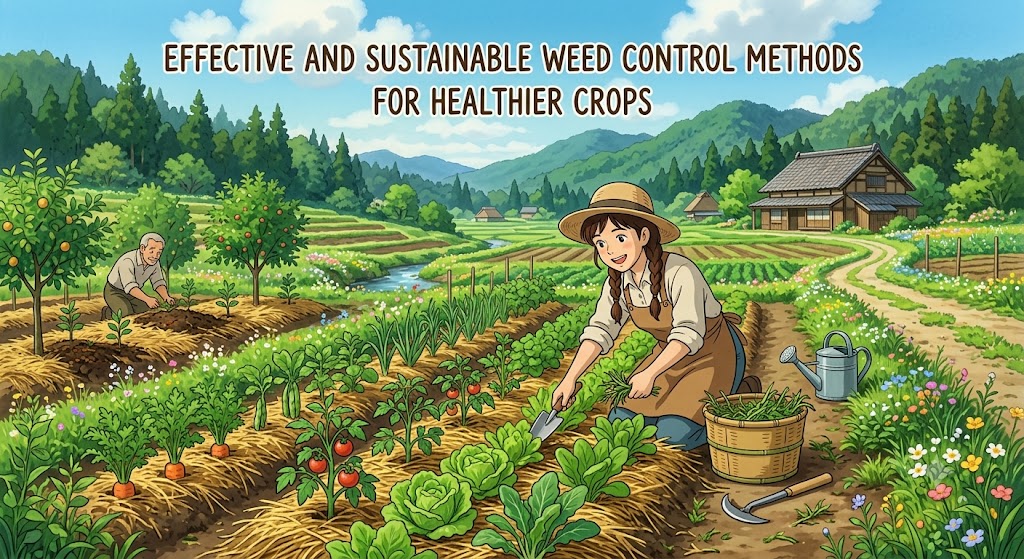
Weeds are one of the most common challenges faced by farmers and gardeners. They grow quickly, compete with crops, reduce productivity, and can make harvesting more difficult. Some weeds also carry insects and diseases that may damage nearby plants.
Effective weed control does not always mean using strong chemical herbicides. Farmers can manage weeds successfully by combining preventive, mechanical, biological, cultural, and carefully selected chemical methods. This balanced approach is known as integrated weed management.
Sustainable weed control protects crop health while improving soil quality, reducing chemical dependence, and supporting long-term farm productivity.
Why Weed Control Is Important
Weeds compete with crops for essential resources, including:
- Water
- Sunlight
- Soil nutrients
- Growing space
- Carbon dioxide
When weeds are allowed to grow freely, they may reduce crop yield and quality. Fast-growing weeds can cover young seedlings, while weeds with deep root systems may consume large amounts of water and nutrients.
Some weeds can also release natural chemicals into the soil that slow the growth of nearby crops. Others may become hosts for harmful insects, fungi, bacteria, and plant viruses.
Timely weed control helps crops establish stronger roots, receive proper nutrition, and grow without unnecessary competition.
Identify Weeds Before Choosing a Control Method
Not all weeds behave in the same way. Correct identification makes weed management more effective.
Annual Weeds
Annual weeds complete their life cycle within one growing season. They usually spread through seeds. Examples include chickweed and pigweed.
Removing annual weeds before they produce seeds can significantly reduce future infestations.
Biennial Weeds
Biennial weeds generally take two years to complete their life cycle. During the first year, they develop leaves and roots. In the second year, they flower and produce seeds.
They are easier to control during their early growth stage.
Perennial Weeds
Perennial weeds live for several years. They may reproduce through seeds, roots, rhizomes, bulbs, or underground stems.
Examples include bindweed and nutsedge. Simply cutting the upper portion may not kill them because they can regrow from underground parts.
Prevent Weeds Before They Spread
Prevention is usually cheaper and easier than controlling a severe weed infestation.
Farmers should use clean, certified seeds that are free from weed seeds. Agricultural tools and machines should be cleaned before moving from one field to another. This prevents weed seeds and root fragments from spreading.
Compost and animal manure should be properly decomposed before being applied to fields. Fresh manure may contain living weed seeds that can germinate later.
It is also important to control weeds around irrigation channels, field boundaries, roadsides, and storage areas. Weeds growing in these places can spread seeds into cultivated fields.
Use Crop Rotation
Growing the same crop repeatedly can encourage weeds that are well adapted to that crop’s planting schedule and farming practices.
Crop rotation interrupts weed life cycles. Farmers can rotate crops with different planting times, growth habits, and cultivation requirements.
For example, rotating a cereal crop with a legume or a vegetable crop changes the field environment. A weed that thrives in one crop may struggle under another.
Crop rotation can also improve soil fertility, reduce pest problems, and lower the risk of crop diseases.
Apply Mulch Around Crops
Mulching is one of the simplest and most sustainable weed control methods. A layer of mulch blocks sunlight from reaching weed seeds, making germination more difficult.
Organic mulching materials include:
- Straw
- Dry leaves
- Grass clippings
- Compost
- Wood chips
- Crop residue
Organic mulch also helps conserve soil moisture, regulate soil temperature, and add organic matter as it decomposes.
Plastic or biodegradable mulch can be used in vegetable production. However, farmers should remove non-biodegradable plastic carefully after use to prevent soil pollution.
The mulch layer should be thick enough to suppress weeds but should not completely cover the crop stems.
Remove Weeds Mechanically
Mechanical weed control includes hand pulling, hoeing, mowing, tilling, and using specialised weed-removal equipment.
Hand weeding is practical for small farms, gardens, and high-value crops. It works best when the soil is slightly moist because roots can be removed more easily.
Hoeing is effective for young weeds. It cuts weeds near the soil surface before they become established.
Mowing helps prevent mature weeds from flowering and producing seeds. However, it may need to be repeated because some weeds grow again after cutting.
Mechanical control should be done carefully. Excessive tillage can damage soil structure, increase erosion, reduce moisture, and bring buried weed seeds to the surface.
Grow Cover Crops
Cover crops are planted mainly to protect and improve the soil rather than for direct sale. They can reduce weed growth by covering the soil and competing with weeds for light, water, and nutrients.
Common cover crops include:
- Clover
- Rye
- Oats
- Mustard
- Cowpea
- Vetch
Fast-growing cover crops create a dense canopy that blocks sunlight from reaching weeds. Their roots also improve soil structure and reduce erosion.
After termination, some cover crops can be left on the soil surface as natural mulch.
Farmers should select cover crops according to climate, soil type, water availability, and the next main crop.
Improve Crop Competition
Healthy crops naturally compete better with weeds. Farmers can give crops an advantage by using high-quality seeds, proper spacing, suitable planting dates, and balanced nutrition.
Planting crops in narrower rows may allow the crop canopy to close more quickly. This reduces the sunlight available to weeds.
However, crops should not be planted too closely because overcrowding may increase disease risk and reduce airflow.
Correct irrigation is also important. Overwatering the entire field can encourage weed growth. Drip irrigation delivers water near crop roots and leaves surrounding areas relatively dry, making conditions less favourable for weeds.
Use Solarisation
Soil solarisation uses the sun’s heat to control weed seeds, pests, and certain soil-borne diseases.
The soil is watered and then covered with transparent plastic during the hottest part of the year. Heat builds up beneath the plastic and raises the soil temperature.
Solarisation is most effective in sunny regions and may take several weeks. It is useful for small fields, nurseries, seedbeds, and vegetable-growing areas.
This method reduces chemical use, although it requires enough sunlight and temporary removal of the land from production.
Consider Biological Weed Control
Biological weed control uses living organisms to reduce specific weeds. Certain insects, fungi, grazing animals, or plant pathogens may be used against targeted weed species.
For example, controlled grazing by sheep or goats can reduce weeds in orchards, unused areas, and field boundaries.
Biological control must be carefully planned. An introduced organism should not harm crops, native plants, livestock, or the wider environment. Farmers should follow local agricultural recommendations before using any biological agent.
Use Herbicides Responsibly
Herbicides can be useful when weed infestations are severe or when manual control is not practical. However, they should be used as part of an integrated strategy rather than as the only solution.
Farmers should select a herbicide approved for the crop and target weed. The product label must be followed carefully regarding dosage, timing, protective equipment, weather conditions, and waiting periods.
Repeated use of the same herbicide can cause herbicide-resistant weeds. Rotating herbicides with different modes of action and combining them with non-chemical methods reduces this risk.
Herbicides should not be sprayed near water sources or during strong winds. Equipment must be calibrated correctly to prevent overapplication and crop damage.
Monitor Fields Regularly
Regular field inspection helps farmers control weeds while they are still small. Young weeds are easier and less expensive to remove than mature weeds.
Farmers should record the types of weeds found, their locations, the methods used, and the results. These records make it easier to plan future control strategies.
Special attention should be given to newly introduced weeds. Removing a small patch early may prevent it from spreading across the entire farm.
Conclusion
Sustainable weed control requires planning, regular monitoring, and a combination of different methods. Prevention, crop rotation, mulching, cover crops, mechanical removal, efficient irrigation, and responsible herbicide use can work together to protect crops.
The best approach depends on the crop, weed species, farm size, climate, soil condition, labour availability, and production system.
By managing weeds before they flower and produce seeds, farmers can gradually reduce the weed population. An integrated weed management programme not only protects crop yield but also supports healthier soil, cleaner water, lower production costs, and more sustainable farming.
Frequently Asked Questions
1. What is the most sustainable way to control weeds?
Combining prevention, mulching, crop rotation, cover crops, hand weeding, and limited herbicide use is generally the most sustainable approach.
2. When is the best time to remove weeds?
Weeds should be removed when they are young and before they flower or produce seeds. Early control requires less labour and prevents future infestations.
3. Can mulch completely stop weed growth?
Mulch can greatly reduce weed germination, but a few weeds may still appear. These weeds should be removed before they become established.
4. Does tilling always help control weeds?
Light tilling can control young weeds, but excessive tillage may damage soil structure and bring buried weed seeds to the surface.
5. How can farmers prevent herbicide resistance?
Farmers can rotate herbicides with different modes of action, use the recommended dosage, avoid repeated applications of one product, and combine chemical control with non-chemical methods.