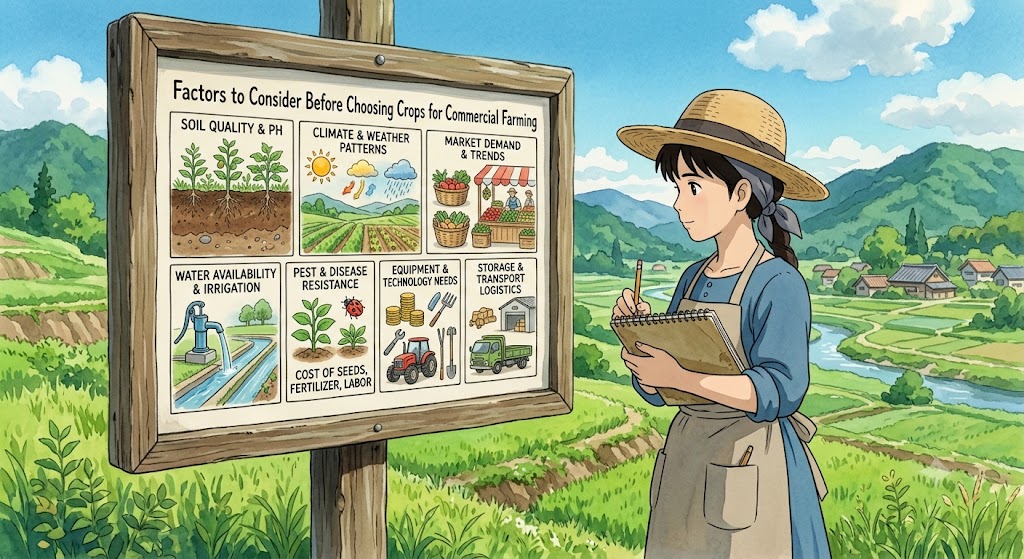
Crop selection is one of the most important decisions a commercial farmer can make. The choice of crop influences production costs, profitability, resource requirements, labor needs, market opportunities, and overall farm success. Even the most skilled farmers can struggle if they grow crops that are poorly suited to local conditions or lack sufficient market demand.
Successful commercial farming begins long before seeds are planted. It requires careful evaluation of environmental conditions, available resources, market trends, and long-term business objectives. By selecting the right crops for the right location and market, farmers can improve productivity, reduce risks, and maximize returns on investment.
This guide explores the key factors every farmer should consider before choosing crops for commercial farming.
Why Crop Selection Matters
Crop choice affects nearly every aspect of agricultural production.
The selected crop influences:
- Yield potential
- Production costs
- Water requirements
- Labor demands
- Pest management needs
- Market opportunities
- Profitability
A well-chosen crop can provide strong returns and long-term sustainability, while poor crop selection may lead to financial losses and production challenges.
Careful planning is essential before committing resources to any commercial crop.
Evaluate Local Climate Conditions
Climate is one of the most important factors influencing crop success.
Farmers should assess:
- Average temperatures
- Rainfall patterns
- Humidity levels
- Frost risks
- Length of the growing season
- Extreme weather events
Different crops have different environmental requirements.
Selecting crops adapted to local climatic conditions improves productivity and reduces production risks.
Analyze Soil Characteristics
Soil quality directly affects crop growth and yield potential.
Important soil factors include:
Soil Texture
Determines water retention and drainage characteristics.
Soil Fertility
Influences nutrient availability and crop performance.
Soil pH
Affects nutrient uptake and plant health.
Organic Matter Content
Supports water retention and biological activity.
Conducting soil tests before crop selection helps identify which crops are most suitable for specific fields.
Consider Water Availability
Water requirements vary significantly among crops.
Farmers should evaluate:
- Irrigation access
- Rainfall reliability
- Water quality
- Groundwater availability
- Long-term water sustainability
Growing water-intensive crops in regions with limited water resources can increase costs and production risks.
Matching crop requirements to available water supplies improves efficiency and resilience.
Study Market Demand
Producing a successful crop is only valuable if there is a market willing to purchase it.
Market research should include:
- Consumer demand
- Local market conditions
- Wholesale opportunities
- Export potential
- Seasonal pricing trends
Strong market demand often supports better prices and more reliable income.
Understanding market trends helps farmers make profitable crop choices.
Assess Profit Potential
Profitability depends on more than yield alone.
Farmers should calculate:
- Expected production costs
- Potential market prices
- Transportation expenses
- Storage requirements
- Labor costs
High-yield crops are not always the most profitable.
Net returns should guide crop selection decisions.
Understand Production Costs
Different crops require varying levels of investment.
Common cost considerations include:
- Seeds
- Fertilizers
- Irrigation
- Crop protection products
- Machinery
- Labor
Some crops may offer attractive market prices but require substantial investments.
Evaluating production costs helps determine realistic profit expectations.
Evaluate Labor Requirements
Labor availability is an important consideration for commercial farming.
Certain crops require:
- Intensive planting
- Frequent maintenance
- Hand harvesting
- Specialized management
Farmers should assess:
- Available workforce
- Labor costs
- Seasonal labor needs
Choosing crops that match labor capacity helps prevent management difficulties during critical production periods.
Consider Crop Maturity Period
Different crops require different amounts of time to reach harvest.
Short-duration crops may offer:
- Faster returns
- Multiple annual harvests
- Improved cash flow
Long-duration crops may provide:
- Higher market value
- Specialized market opportunities
Production timelines should align with farm objectives and resource availability.
Examine Pest and Disease Risks
Some crops are more susceptible to pests and diseases than others.
Farmers should evaluate:
- Local pest pressure
- Common diseases
- Management requirements
- Available resistant varieties
Choosing crops with lower disease risks can reduce production costs and improve profitability.
Preventive planning often leads to better long-term results.
Match Crops to Available Equipment
Farm machinery and infrastructure can influence crop selection decisions.
Important considerations include:
- Planting equipment
- Irrigation systems
- Harvesting machinery
- Storage facilities
Using existing resources efficiently can reduce startup costs and improve operational efficiency.
Infrastructure requirements should be evaluated before selecting new crops.
Assess Storage and Post-Harvest Needs
Some crops require extensive storage and handling facilities.
Examples include:
- Temperature-controlled storage
- Drying equipment
- Specialized packaging
Farmers should consider:
- Storage capacity
- Post-harvest management requirements
- Product shelf life
Effective post-harvest planning helps maintain quality and reduce losses.
Consider Crop Rotation Compatibility
Crop selection should fit within long-term rotation plans.
Benefits of crop rotation include:
- Improved soil fertility
- Reduced pest pressure
- Better nutrient management
- Enhanced sustainability
Selecting crops that complement existing rotations contributes to healthier farming systems.
Long-term planning improves productivity and resource efficiency.
Evaluate Market Competition
Highly competitive markets can affect profitability.
Farmers should assess:
- Local production levels
- Regional supply trends
- Market saturation
- Competitive advantages
In some cases, specialty crops may offer better opportunities than widely grown commodities.
Understanding competition helps identify profitable market niches.
Explore Diversification Opportunities
Relying on a single crop can increase financial risk.
Diversification may involve:
- Multiple crop types
- Specialty crops
- Livestock integration
- Value-added products
Benefits include:
- Reduced risk
- More stable income
- Improved resource utilization
Diversified farming systems are often more resilient to market fluctuations.
Analyze Transportation and Market Access
Distance to markets influences profitability.
Important considerations include:
- Transportation costs
- Road infrastructure
- Market proximity
- Export opportunities
Perishable crops often require rapid transportation and reliable logistics.
Market access should be evaluated before production begins.
Consider Environmental Sustainability
Long-term success depends on protecting natural resources.
Crop selection should support:
- Soil conservation
- Water efficiency
- Biodiversity
- Sustainable land use
Environmentally responsible choices often improve resilience and long-term profitability.
Sustainable production systems are increasingly valued by consumers and markets.
Evaluate Risk and Resilience
Agriculture involves numerous uncertainties.
Farmers should assess risks related to:
- Weather conditions
- Market fluctuations
- Pest outbreaks
- Water shortages
Selecting resilient crops helps reduce vulnerability to unexpected challenges.
Risk management is an important part of commercial farming success.
Utilize Data and Technology
Modern technologies can support better crop selection decisions.
Useful tools include:
- Soil testing
- Weather forecasting
- Precision agriculture platforms
- Market analysis software
Data-driven decisions improve accuracy and reduce uncertainty.
Technology helps farmers identify opportunities and optimize production strategies.
Create a Crop Selection Plan
An effective crop selection process may include:
- Climate assessment
- Soil analysis
- Water evaluation
- Market research
- Cost calculations
- Risk assessment
- Long-term planning
Combining these factors helps farmers make informed decisions that support profitability and sustainability.
Conclusion
Choosing the right crops for commercial farming is one of the most important decisions influencing agricultural success. By carefully evaluating climate conditions, soil characteristics, water availability, market demand, production costs, labor requirements, and long-term sustainability, farmers can significantly improve their chances of achieving profitable and reliable harvests.
Successful crop selection is not based on trends alone. It requires thorough research, strategic planning, and a clear understanding of both production and market conditions. Farmers who make informed crop choices are better positioned to maximize productivity, manage risks, and build successful agricultural enterprises for years to come.