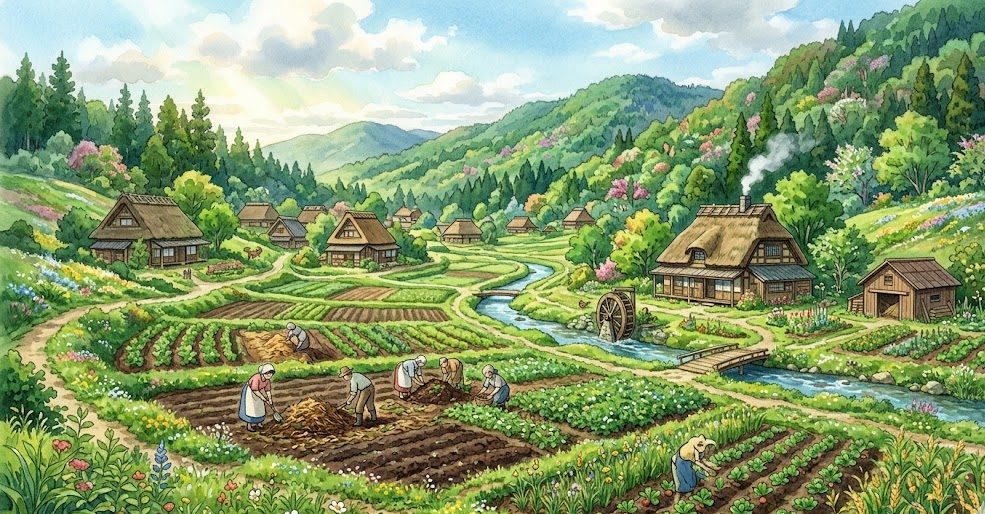
For generations, industrial agriculture treated soil as a static medium—an empty vessel to be injected with synthetic nitrogen, phosphorus, and potassium to force crop growth. Decades of this intensive chemical approach have taken a severe toll. Globally, agricultural lands are facing a quiet crisis: topsoils are becoming depleted, beneficial microbial life is vanishing, and fields are turning increasingly acidic and compacted.
True agricultural sustainability begins with a fundamental realization: soil is not dead dirt; it is a Living Earth. It is a complex, dynamic ecosystem teeming with billions of bacteria, fungi, protozoa, and earthworms. Restoring and healing soil fertility naturally requires moving away from quick-fix chemical inputs and embracing organic techniques that rebuild the earth’s natural biological infrastructure from the ground up.
Understanding the Living Earth: The Wood-Wide Web and Microbes
Before implementing restoration techniques, it is essential to understand what makes soil fertile. True fertility is driven by the Soil Food Web. In a single teaspoon of healthy, organic soil, there are more living organisms than there are people on planet Earth.
- Mycorrhizal Fungi: These specialized fungi form a symbiotic relationship with plant roots, creating an underground network often called the “Wood-Wide Web.” They expand the root surface area up to 1,000 times, sourcing water and locking in vital micronutrients that plants cannot reach alone.
- Beneficial Bacteria: Microscopic bacteria break down organic matter and convert atmospheric nitrogen into a stable, plant-accessible form, acting as nature’s built-in fertilizer factories.
- Humus Builders: Microbes convert decaying leaves and roots into humus—a highly stable, nutrient-dense organic compound that gives fertile soil its rich, dark color and sweet, earthy scent.
When chemicals are applied excessively, this biological engine is destroyed. Healing the soil means restoring these microscopic populations.
Step-by-Step Organic Techniques to Restore Soil Fertility
Healing depleted farmland or garden soil requires a deliberate, multi-layered organic strategy. The following techniques work together to kickstart natural fertility:
1. The Power of High-Quality Thermal Compost
Compost is the ultimate remedy for damaged soil. Unlike chemical fertilizers that only feed the plant, compost feeds the soil ecosystem.
- Inoculating the Soil: Adding well-aged, microbe-rich compost reintroduces vital bacterial and fungal strains to dead fields.
- Structural Repair: Organic compost contains humic acids that bind loose sand particles together to hold water, while simultaneously loosening heavy clay to allow plant roots to breathe.
2. Green Manuring and Bio-Drilling
Green manures are specific crops grown not for harvest, but to be chopped down and integrated directly back into the earth.
- Nitrogen Fixation: Planting legumes such as alfalfa, clover, or hairy vetch pulls nitrogen directly out of the air and stores it in root nodules. When terminated, this nitrogen is released naturally into the topsoil.
- Bio-Drilling with Daikon Radishes: Planting deep-rooting forage radishes acts as a natural plow. The roots drill down up to six feet, breaking up deep underground clay pans. As the radishes decay in winter, they leave deep, open channels for air, water, and future plant roots.
3. Implementing No-Dig and Sheet Mulching (Lasagna Gardening)
Plowing destroys the delicate fungal networks built by the Soil Food Web. Transitioning to no-dig or minimal-tillage frameworks preserves this underground architecture.
- Sheet Mulching: For heavily degraded areas, building layers of carbon-rich materials (cardboard, dry leaves, straw) and nitrogen-rich materials (green clippings, compost) directly over the soil surface creates a slow-release, nutrient-rich barrier that naturally suppresses weeds while feeding deep-dwelling earthworms.
+-----------------------------------------------------------------------+
|                    THE NATURAL SOIL HEALING CYCLE                     |
+-----------------------------------------------------------------------+
|                                                                       |
|   [ STEP 1: REST ]   ---> Stop Tillage & Chemical Applications         |
|                             (Preserves existing fungal networks)      |
|                                                                       |
|   [ STEP 2: FEED ]   ---> Apply Thermal Compost & Organic Mulches     |
|                             (Reintroduces active microbial life)      |
|                                                                       |
|   [ STEP 3: BUILD ]  ---> Plant Deep-Rooted Legumes & Cover Crops     |
|                             (Fixes nitrogen & creates root pathways)  |
|                                                                       |
+-----------------------------------------------------------------------+
Advanced Organic Inputs for Rapid Soil Rehabilitation
When dealing with highly degraded, barren, or chemically damaged soils, standard compost may need an extra boost. Modern organic farmers utilize targeted, natural biostimulants to accelerate the healing process:
1. Humic and Fulvic Acids
Extracted from ancient, oxidized organic deposits, humic and fulvic acids act as powerful natural chelators. They unlock minerals like phosphorus and iron that are tightly bound up in the soil, making them instantly available to growing plants.
2. Biochar Inoculation
Biochar is highly porous, pure carbon created by burning agricultural waste in an oxygen-free environment. Because it is completely stable, it does not decompose. When mixed with liquid compost tea, biochar acts as a permanent, microscopic coral reef inside the soil—providing housing for beneficial microbes and retaining moisture indefinitely.
3. Liquid Compost Teas and Kelp Extracts
Spraying actively aerated compost tea (AACT) directly onto fields introduces billions of active microbes instantly. Combined with cold-processed kelp meal, which contains over 60 trace minerals and natural growth hormones, this liquid treatment rapidly wakes up dormant, tired soils.
Organic vs. Chemical Dynamics: A Long-Term Performance Review
Switching from chemical dependencies to a living, organic soil model radically transforms the economic and physical balance of an agricultural asset:
| Performance Metric | Chemical-Dependent Soil | Living Earth (Organic Model) |
|---|---|---|
| Nutrient Delivery System | Soluble salts; easily leaches away into groundwater during rains. | Biological release; tied to organic matter, meaning zero runoff. |
| Water Retention Capacity | Poor; soil dries rapidly, requiring constant, costly irrigation. | Exceptional; organic humic matter holds up to 20x its weight in water. |
| Pest and Disease Pressure | High; weak plants require constant synthetic chemical protection. | Low; strong plant immunity driven by systemic fungal networks. |
| Long-Term Profitability | Decreases; requires increasing chemical inputs to get the same yield. | Increases; input costs plummet as the ecosystem self-sustains. |
Export to Sheets
Conclusion: Honoring the Living Earth
Restoring fertility to our global soils is not an overnight task; it is a journey of transition from chemical exploitation to biological stewardship. By understanding that the ground beneath our feet is a vibrant, living organism, and by employing targeted techniques like cover cropping, thermal composting, and zero-tillage, we can actively reverse decades of land degradation.
For organic farmers, eco-entrepreneurs, and conscious growers, nurturing a Living Earth ensures more than just high-yielding, residue-free harvests today. It builds a robust, climate-resilient, and self-sustaining agricultural inheritance for the generations of tomorrow.