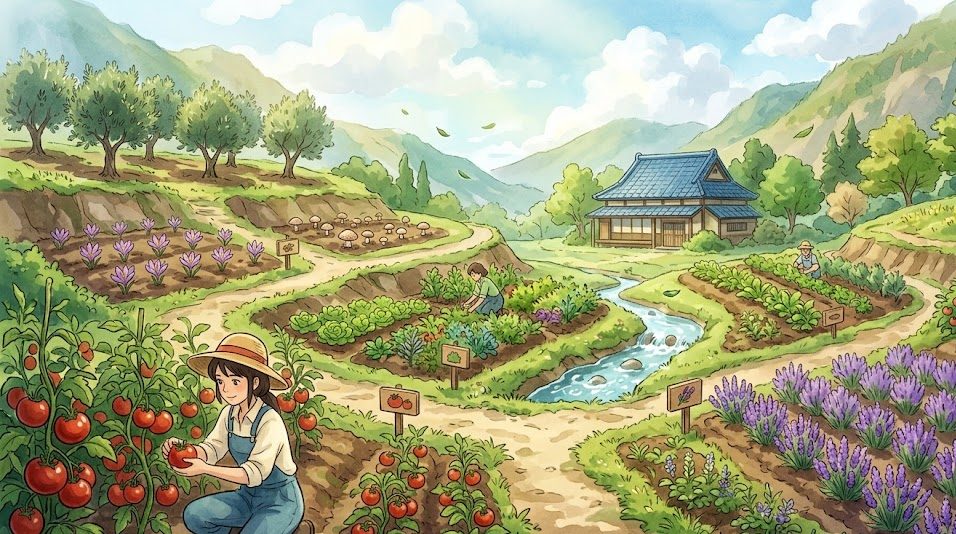
In the modern agricultural landscape, the age-old philosophy of “bigger is better” is rapidly shifting toward a new mantra: “smarter is better.” For farmers and landowners looking to move beyond the narrow margins of traditional commodity crops like wheat or corn, the goal is clear—maximize profit per square foot.
High-value crops allow you to generate significant revenue on smaller parcels of land by focusing on quality, specialty markets, and timing. If you are ready to pivot toward higher profitability, here are the top 5 crops that offer the best return on investment for savvy growers.
1. Gourmet Mushrooms (Shiitake, Oyster, Lion’s Mane)
Mushrooms are perhaps the ultimate “high-density” crop. Because they grow vertically in stacked trays or specialized grow bags inside climate-controlled environments, you can produce massive yields in a footprint that would be negligible for field crops.
- Why it’s profitable: Mushrooms have a lightning-fast harvest cycle (often just a few weeks from inoculation to harvest). Gourmet varieties like Lion’s Mane or Oyster mushrooms are sought after by high-end restaurants, health food stores, and farmers’ markets.
- The Strategy: Focus on indoor cultivation to control humidity and temperature. By eliminating weather risks and pests, you ensure a year-round, consistent supply, which allows you to command premium wholesale prices.
2. Microgreens
If mushrooms are the king of high density, microgreens are the king of high turnover. These “seedling” vegetables are harvested just days after germination.
- Why it’s profitable: They require very little space—a single rack can produce hundreds of dollars worth of product every two weeks. Because they have a rapid growth cycle, your capital is returned almost immediately.
- The Strategy: Target local upscale restaurants and boutique grocers. Chefs love microgreens for their aesthetic appeal and intense flavor. Since these are often sold by the ounce rather than the pound, the price-per-square-foot is exceptionally high.
3. Garlic (Gourmet and Heirloom Varieties)
While garlic is a common household item, there is a massive difference between mass-produced, bland garlic and gourmet, organic heirloom varieties.
- Why it’s profitable: Garlic is relatively easy to store and transport, meaning it doesn’t have the high-spoilage risk of leafy greens. Heirloom bulbs like Music or German Red have a loyal following and can be sold for double or triple the price of standard store-bought garlic.
- The Strategy: Focus on unique varieties that are not easily found in supermarkets. By positioning your harvest as a “gourmet specialty,” you can sell directly to consumers at markets or online through specialty food platforms.
4. Lavender
Lavender is a powerhouse crop that bridges the gap between agriculture and value-added retail. It is aesthetically beautiful, drought-tolerant, and highly versatile.
- Why it’s profitable: You aren’t just selling a raw plant; you are selling a “lifestyle” product. You can monetize lavender in three ways: fresh-cut bouquets, dried bundles, and value-added goods like essential oils, soaps, and sachets.
- The Strategy: Choose varieties that yield the best oil if you plan to process it, or focus on visual appeal if you plan to host “U-Pick” events. Agritourism can significantly increase your profit margins by turning your farm into a destination.
5. Ginseng (The Long-Term Investment)
If you are looking for long-term wealth building, American Ginseng is a traditional high-value crop. It takes years to mature, but the financial payoff for high-quality, wild-simulated roots is legendary.
- Why it’s profitable: It is one of the most valuable medicinal roots on the planet, with a massive export market to Asia. Once established, it requires minimal maintenance beyond monitoring.
- The Strategy: This is a patience-game. By growing “wild-simulated” ginseng—which mimics natural forest conditions—you produce a product that commands a much higher price than commercially farmed, greenhouse-grown roots.
Keys to Scaling Your Profitability
Transitioning to high-value crops is not just about the seed you plant; it is about the business model you build. To truly maximize your acreage, keep these three principles in mind:
- Value-Added Processing: The highest margins are found not in the raw product, but in what you turn it into. Can you turn your lavender into soap? Can you dry your mushrooms? Transforming raw goods increases shelf life and profit.
- Direct-to-Consumer Marketing: By cutting out the middleman and selling directly to the end user (via CSAs, farmers’ markets, or a professional website), you capture the full retail value rather than taking a fraction of the wholesale price.
- Optimize for Rotation: Don’t let your land sit idle. Integrate short-cycle crops (like microgreens) with longer-cycle crops to ensure your cash flow remains steady throughout the year.
Final Thought: Maximum profitability isn’t found in farming more land; it’s found in farming your land more effectively. By selecting high-value niche crops and leveraging direct