For decades, the global focus of farming has been on “yield”—the sheer volume of food we can pull from the earth. But in our race to feed a growing population, we have often treated soil like dirt: a lifeless medium used only to hold plants upright while we pump them full of synthetic chemicals.
The results of this “extractive” mindset are becoming clear. We are seeing massive soil erosion, decreasing nutrient density in our food, and land that becomes more barren with every passing season.
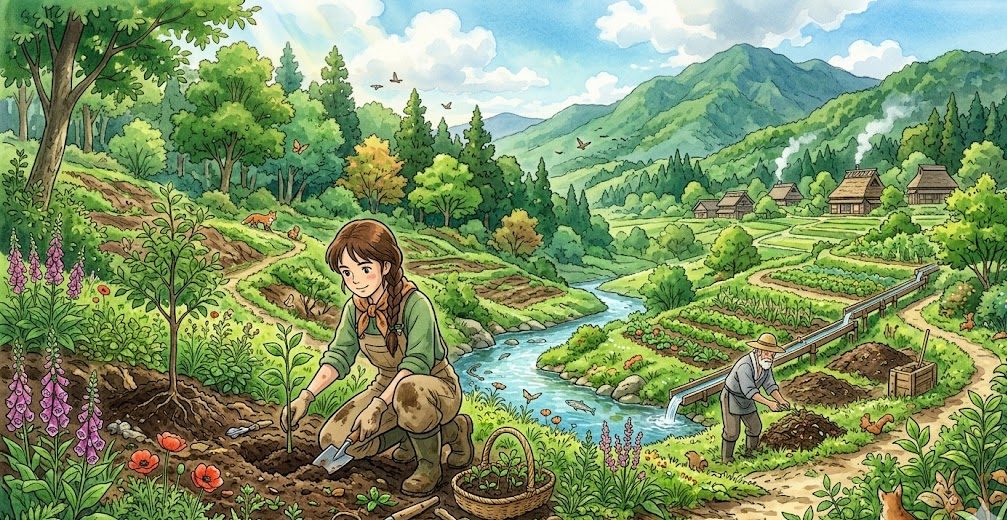
However, a powerful movement is gaining ground. It’s called Regenerative Agriculture. Instead of just “sustaining” a degrading system, this approach focuses on restoration. It is about healing the land, building organic matter, and ensuring long-term health for the soil beneath our feet.
1. The Foundation: Soil as a Living Organism
To understand restoration, we must first change how we view soil. Healthy soil isn’t just a collection of minerals; it is a complex, living ecosystem. A single teaspoon of healthy soil contains more microorganisms than there are people on Earth.
These microbes—bacteria, fungi, and protozoa—are the “engine” of the farm. They break down organic matter, unlock nutrients for plants, and create a “glomalin” (a biological glue) that holds the soil together. When we use heavy tilling and harsh chemicals, we kill this engine. Regenerative farming seeks to put the life back in.
2. Increasing Organic Matter: The Earth’s Natural Sponge
The “Holy Grail” of land restoration is Soil Organic Matter (SOM). This is the decomposed remains of plants, animals, and microbial life.
Why SOM is a Game Changer:
- Water Retention: For every 1% increase in organic matter, an acre of land can hold an additional 20,000 gallons of water. This makes farms incredibly resilient to droughts and prevents flooding during heavy rains.
- Nutrient Cycling: Organic matter acts as a slow-release fertilizer. It holds onto essential nutrients like nitrogen and phosphorus, preventing them from washing away into our rivers and oceans.
- Carbon Sequestration: Soil is one of the world’s largest carbon sinks. By building organic matter, we are literally pulling CO2 out of the atmosphere and “burying” it in the ground where it helps plants grow.
3. The Pillars of Regenerative Restoration
How do we actually restore a field that has been depleted? It follows five core principles that prioritize long-term land health over short-term spikes.
I. Minimize Soil Disturbance (No-Till)
Tilling is the equivalent of a hurricane for the soil’s microbial city. It breaks up fungal networks and releases stored carbon into the air. Regenerative farmers use “No-Till” methods, leaving the soil structure intact so the underground ecosystem can thrive undisturbed.
II. Keep the Soil Covered
Bare soil is vulnerable soil. It bakes in the sun, blows away in the wind, and washes away in the rain. By using cover crops (like clover, rye, or vetch) or leaving crop residues on the surface, farmers create a “skin” for the earth. This keeps the ground cool and feeds the microbes even when the main cash crop isn’t growing.
III. Maximize Plant Diversity
In nature, you never see a thousand-acre forest of only one type of tree. Monocultures (growing only one crop) deplete specific nutrients and attract specific pests. By rotating crops and planting diverse mixtures, farmers break pest cycles and ensure the soil receives a varied “diet” of root exudates.
IV. Maintain Living Roots Year-Round
Plants feed soil microbes by leaking sugars through their roots. When a field sits empty for six months, the microbes starve. Keeping living roots in the ground as long as possible ensures the “underground economy” never shuts down.
V. Integrate Livestock
Nature intended for animals and plants to work together. Managed grazing—where livestock are moved frequently to mimic wild herds—is a powerful restoration tool. Their manure provides natural fertilizer, and their hooves help press seeds and organic matter into the soil, stimulating new growth.
4. The Long-Term Benefits: Beyond the Harvest
Restoring land health isn’t just an environmental “good deed”; it is a sound economic strategy for the future of farming.
| Feature | Industrial Farming (Chemical-Heavy) | Regenerative Farming (Restorative) |
| Input Costs | High (Buying fertilizer/pesticides) | Low (Natural systems provide nutrients) |
| Drought Resistance | Low (Soil dries out quickly) | High (Soil holds massive water) |
| Profitability | Declining due to rising chemical costs | Increasing as soil health improves |
| Food Quality | Lower nutrient density | Higher vitamins and minerals |
5. From “Dirt” to “Soil”: The Restoration Timeline
Restoration is not an overnight process. It takes time to undo decades of degradation.
- Years 1-3: The transition phase. The soil begins to breathe again. Worm populations increase, and water infiltration improves.
- Years 5-10: The “tipping point.” Organic matter levels rise significantly. The farmer notices they need far less fertilizer because the soil is now “feeding itself.”
- Generational Impact: The land becomes an asset that grows in value and productivity, rather than a resource that is being used up.
6. How Consumers Can Drive Change
You don’t have to be a farmer to participate in land restoration. The way we shop determines how the earth is treated.
- Support Organic and Regenerative Labels: Look for “Regenerative Organic Certified” (ROC) products.
- Eat Seasonally and Locally: Local farmers are often more able to implement diverse crop rotations than giant industrial operations.
- Compost at Home: By composting your food scraps, you are participating in the cycle of organic matter. If you have a garden, you are literally restoring your own small patch of Earth.
Final Thoughts: Healing the Earth from the Ground Up
We often look to the stars or high-tech gadgets for solutions to our environmental crises. But the most powerful technology we have is the soil beneath our feet.
Restoring land health is the ultimate “win-win.” It provides us with more nutritious food, protects us against a changing climate, and ensures that the next generation inherits a world that is fertile and full of life.
It is time to stop “mining” the soil and start mentoring it. When we take care of the soil, the soil takes care of us. The journey to a greener future doesn’t start with a giant leap—it starts with a single, healthy clod of earth.