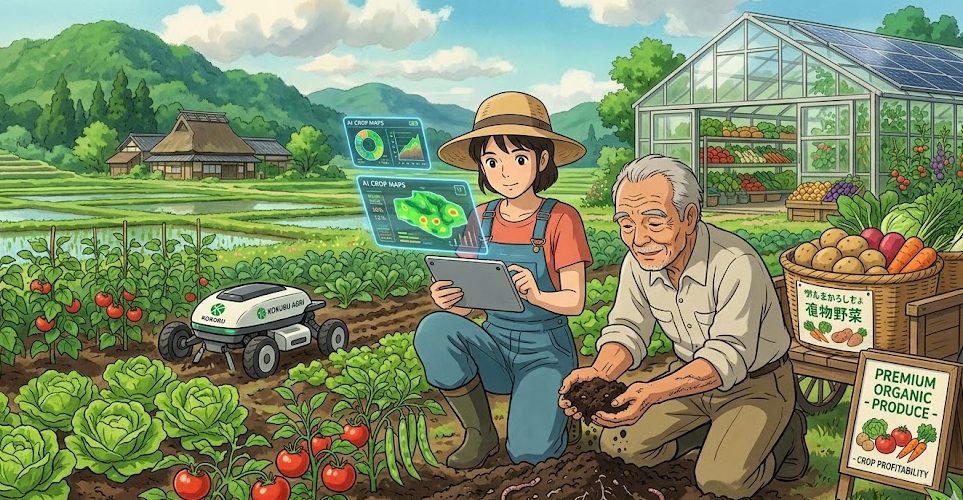
Agriculture is witnessing a technological renaissance. The era of manual guesswork and blanket chemical application is rapidly being replaced by a sophisticated, data-driven, and ecologically conscious approach. For the modern farmer, success is no longer just about working harder—it is about working smarter.
In this masterclass, we explore the trifecta of Modern Farming Mastery: leveraging AI tools for decision-making, adopting natural soil care to ensure longevity, and maximizing profitability through precision management.
1. The AI Revolution in the Field
Artificial Intelligence is often associated with tech hubs and skyscrapers, but its most impactful application today is in the open field. AI is helping farmers solve the “unknowns” of agriculture.
Smart Monitoring and Predictive Analytics
AI-powered apps can now analyze imagery from smartphones or low-cost drones to identify crop stress before it is visible to the human eye.
- Disease Detection: By uploading a photo of a leaf, AI models can instantly identify pathogens or nutrient deficiencies, allowing for “spot treatment” rather than field-wide spraying.
- Predictive Weather Models: AI integrates historical climate data with real-time sensor inputs to provide hyper-local weather forecasts, helping you decide exactly when to irrigate or harvest.
Farm Management Software (FMS)
Modern FMS platforms act as the “brain” of your operation. They track input costs, labor hours, and market prices in real-time. By utilizing these tools, you can identify exactly which crops are eating into your margins and which ones are fueling your growth.
2. Natural Soil Care: The Foundation of Profit
While AI handles the data, soil biology handles the production. No technology can compensate for degraded, “dead” soil. Modern farming recognizes that the most efficient fertilizer is a healthy, self-sustaining soil ecosystem.
The Microbial Engine
Your soil is home to billions of microorganisms. When you use excessive synthetic chemicals, you disrupt this microbiome.
- Bio-Stimulants: Move towards using Jeevamrit or fermented compost extracts. These inputs act as a starter culture, multiplying the beneficial bacteria that break down organic matter into plant-available nutrients.
- Cover Cropping: Never leave the soil bare. During off-seasons, planting cover crops like legumes or rye prevents erosion and naturally fixes nitrogen, reducing your reliance on expensive synthetic fertilizers.
The Power of Mulching
Organic mulching is a low-cost, high-impact strategy. By covering the soil with crop residue or dry leaves, you create a micro-climate for earthworms and fungi. This practice also slashes your water consumption by up to 30% by preventing direct evaporation from the soil surface.
3. Maximizing Crop Profitability
Profitability in agriculture is a balance between maximizing yield and minimizing input costs.
Diversification and High-Value Crops
Stop growing what everyone else is growing. Use AI market analysis tools to track local demand trends. Sometimes, shifting just 20% of your land to high-value organic produce or specialized medicinal crops can double your total farm profit.
The “Cost-Per-Acre” Mindset
Successful farmers treat their land like a business. Every input—seed, fertilizer, fuel, and labor—must be tracked.
- Precision Application: Use drip irrigation to deliver water and nutrients directly to the root zone. This minimizes waste and ensures that your expensive inputs are actually being utilized by the crop.
- Value Addition: Can you process your harvest? Selling raw produce is often the least profitable stage. Drying, packaging, or converting crops into secondary products (like organic oils or powders) can significantly increase your profit margins.
4. The Synergy: Connecting Tech and Nature
The “Modern Farming Masterclass” is not about choosing between tech and nature—it is about the synergy between them.
For example, use AI tools to optimize your irrigation schedules, then apply that water using organic-infused fertigation systems. Use drone imagery to identify pest hotspots, then manage those spots with natural biological predators instead of broad-spectrum pesticides.
This hybrid model reduces your dependence on external, volatile chemical markets and builds a robust, climate-resilient farm that yields consistent profits year after year.
Conclusion: Building Your Legacy
Modern farming is a long-term game. It requires patience to build soil health, courage to adopt new AI tools, and discipline to track your financials. However, the result is a farm that is not only more profitable but also more sustainable and enjoyable to manage.
By integrating digital intelligence with ecological stewardship, you aren’t just farming for today—you are building a productive, high-value asset for the future.
Frequently Asked Questions (FAQ)
Q: Are AI tools too expensive for small-scale farmers? A: Not anymore. Many AI-based agricultural apps are free or low-cost, and they run on standard smartphones. You don’t need expensive hardware; you only need to start capturing data.
Q: Does natural soil care lead to lower yields? A: You may see a temporary fluctuation during the first 1–2 years of transition. However, as soil biology recovers, plant immunity increases, and you will typically see more consistent yields with far lower input costs.
Q: Where should I start? A: Start by digitizing your record-keeping. Once you know exactly where your money is going, you can identify which AI tool or soil improvement project will give you the highest Return on Investment (ROI).