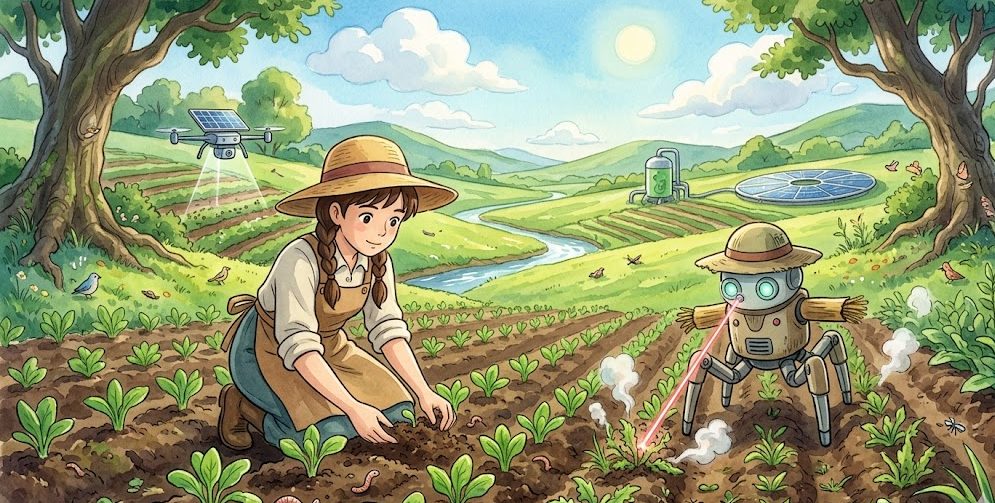
Agriculture is at a major crossroads. As the global population climbs toward 10 billion, the pressure on our food systems has never been greater. We are tasked with a paradox: we must produce more food while simultaneously reducing our environmental footprint. The solution lies in the convergence of ancient wisdom and cutting-edge innovation.
The future of sustainable farming isn’t about choosing between nature and technology; it is about the intelligent synthesis of Artificial Intelligence (AI), the preservation of soil health, and the evolution of weed control. This article explores how these three pillars are transforming the farm of tomorrow.
1. The Role of AI: Precision in Every Field
Artificial Intelligence is no longer a futuristic concept reserved for tech hubs; it is becoming a primary tool for modern farmers. In the context of sustainability, AI acts as an efficiency engine.
Data-Driven Decision Making
Traditional farming often relies on reactive measures—treating a crop only after a problem becomes visible. AI, combined with satellite imagery and drone-mounted sensors, allows for proactive management. AI algorithms can analyze spectral data from fields to detect early signs of water stress, nutrient deficiency, or fungal growth before the human eye can spot them.
By identifying these issues at the microscopic level, farmers can limit interventions to only the specific areas that need them. This reduces the overuse of fertilizers and water, which is the cornerstone of sustainable operations.
2. Soil Health: The Foundation of Profitability
While AI provides the data, the soil provides the yield. Sustainable farming is increasingly moving toward “regenerative” practices, where the goal is to improve the soil’s biological capacity year after year.
The Living Ecosystem
Healthy soil is a complex ecosystem teeming with microbial life. For decades, intensive tilling and chemical-heavy approaches stripped this biological wealth, leading to erosion and nutrient depletion. Modern sustainable farming focuses on:
- No-Till Practices: By minimizing soil disturbance, we preserve the fungal networks (mycorrhizae) that help plants absorb water and nutrients.
- Cover Cropping: Keeping the soil covered year-round—using crops like vetch or rye—prevents erosion, increases organic matter, and naturally suppresses weeds.
- Carbon Sequestration: Healthy soil acts as a massive carbon sink. By transitioning to regenerative models, farmers are not only producing food but also actively fighting climate change.
3. The Revolution in Weed Control
Weed management has historically been the most chemical-intensive aspect of farming. The reliance on herbicides has led to “superweeds” that are resistant to conventional treatments. However, we are entering an era of “intelligent” weed control that removes the need for synthetic chemicals entirely.
Robotics and Computer Vision
New autonomous robots are now equipped with high-resolution cameras and AI models trained to distinguish between a crop and a weed.
- Precision Weeding: These machines can target weeds with mechanical hoes, laser pulses, or high-pressure water jets, pulling or eliminating them without disturbing the surrounding crop or the soil structure.
- The Benefit: By eliminating herbicide use, we protect the soil microbiome and ensure that the surrounding water supply remains free of toxic chemical runoff. This is a massive win for both the farmer’s profit margins (as chemicals are expensive) and the long-term health of the ecosystem.
4. Synergizing AI, Soil, and Weed Management
The true power of these technologies is unlocked when they are integrated. Imagine a field where:
- Soil sensors report nutrient levels to an AI hub.
- AI adjusts the application of natural compost based on those specific needs.
- Autonomous weeders patrol the rows daily, removing competition so the crops can maximize their growth.
This is not a far-off dream; it is an emerging reality. This integrated approach leads to Higher Yields, Lower Input Costs, and Superior Quality Produce.
5. Economic and Social Impact
Adopting these sustainable strategies is not just an environmental choice—it is a smart business move.
- Reducing Overhead: By using AI to optimize inputs and robots to handle weeding, farmers can drastically reduce their spending on fertilizers, pesticides, and manual labor.
- Consumer Demand: Modern consumers are increasingly willing to pay a premium for food grown using sustainable, “chemical-free” practices. By labeling their produce as sustainably grown, farmers can access higher-value markets.
Conclusion: Embracing the Transition
The transition to sustainable farming is a marathon, not a sprint. We are moving from a model of “extraction” to a model of “cultivation.” By leveraging AI to make smarter decisions, prioritizing the health of our soil, and embracing non-toxic weed control, we can build a food system that is truly resilient.
The future of agriculture is not just about producing more; it is about producing better. As a farmer, the first step is to start observing and measuring. Whether it is adding a soil sensor, trying no-till on a small plot, or researching robotic weeding options, every small action counts toward a more sustainable and profitable future.