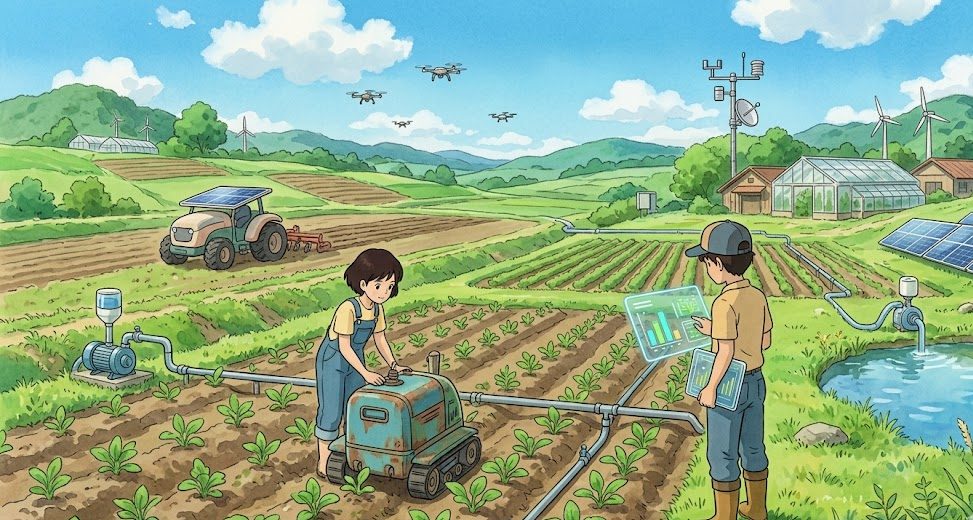
Agriculture is undergoing its most significant transformation in a century. By 2026, the gap between traditional farming and “smart” farming has narrowed, making precision technology accessible to more growers than ever. If you are looking to maximize your harvest while slashing input costs—like fertilizer, water, and labor—integrating the right technology is no longer an option; it is a competitive necessity.
The core philosophy of modern smart farming is simple: move from treating the whole field to treating the specific plant. By using data to inform your decisions, you stop wasting resources on healthy areas and start focusing your efforts exactly where they are needed most.
Here are the top five technologies that are defining high-efficiency agriculture in 2026.
1. IoT Soil & Moisture Sensors: The “Digital Nervous System”
Gone are the days of manual soil testing or guessing when to irrigate. Internet of Things (IoT) sensors are now the standard for real-time monitoring.
- How it works: These small, solar-powered devices are placed throughout your field. They continuously measure soil moisture, temperature, pH levels, and nutrient content, transmitting this data directly to your smartphone or farm management platform.
- The ROI: You eliminate the “over-watering” trap. By receiving real-time alerts only when a specific zone is dry, you can reduce water consumption by up to 50% while ensuring your crops never experience stress. This is the difference between a farm that reacts to drought and one that prevents it.
2. AI-Driven Decision Support Systems (DSS)
In 2026, AI is no longer just “analytics”—it is a field-ready decision partner. AI-powered decision support systems act like an expert agronomist in your pocket.
- How it works: These systems synthesize data from your IoT sensors, satellite imagery, and local weather patterns to offer prescriptive advice. Instead of telling you the soil is dry, the system suggests: “Irrigation needed in Zone B by 4:00 PM to prevent 5% yield loss.”
- The ROI: You save hours of manual analysis. These systems reduce decision-fatigue and help you execute tasks at the precise moment of need, preventing crop failure before it happens.
3. Variable Rate Technology (VRT)
Variable Rate Technology is the hallmark of precision agriculture. It allows your machinery to change the rate of input application “on the fly” as it moves across the field.
- How it works: Using GPS-guided prescription maps, your spreader or sprayer automatically adjusts how much fertilizer, herbicide, or seed is applied to different parts of the field. Fertile zones get standard amounts, while nutrient-depleted zones get a “boost,” and low-productivity zones get less, saving you from wasting expensive inputs.
- The ROI: Input costs for chemicals and fertilizers typically drop by 15%–30% because you are only paying for what the plant actually needs.
4. Drone Scouting & Multispectral Imaging
Walking every row of a large field is inefficient. Drones allow you to “see” what your eyes cannot.
- How it works: Equipped with multispectral cameras, drones capture light wavelengths that reveal plant health (often using indices like NDVI). They can detect water stress, pest infestations, or nutrient deficiencies days before they become visible to the human eye.
- The ROI: Early detection is everything. Spotting a localized pest outbreak allows you to spray only that small patch, rather than the entire crop, saving thousands in chemical costs and preserving the yield of the unaffected areas.
5. Automated Precision Irrigation Systems
Water is your most precious resource, and inefficient distribution is a massive drain on profitability.
- How it works: Modern smart irrigation integrates your IoT sensor data with automated valves. The system delivers the exact amount of water needed to the root zone, potentially utilizing solar-powered pumps for energy independence.
- The ROI: Beyond saving water, precision irrigation ensures uniform crop growth. When every plant receives the same optimal moisture level, you get consistent harvest timing, which significantly streamlines your labor and logistics during the busiest times of the year.
Why Smart Farming is an Economic Winner
The initial investment in these technologies can feel daunting, but in 2026, the “payback period” has shortened significantly due to increased equipment interoperability and service-based models. When you adopt these tools, you are building three layers of profitability:
- Reduced Variable Costs: You spend less on water, fertilizer, and fuel because you aren’t over-applying to “fine” areas.
- Increased Productivity: You resolve stressors early, which directly translates to higher-quality yields and more uniform crops.
- Risk Mitigation: Data provides a buffer against the unpredictability of climate change. You aren’t just farming for today; you are building a resilient operation for the next decade.
Conclusion: Start Small, Think Big
You don’t need to turn your farm into a futuristic laboratory overnight. The most successful modern farmers start by identifying their biggest “pain point”—whether it’s water waste, pest loss, or uneven growth—and investing in the specific tech that solves it.
By turning your farm into a connected, data-driven operation, you aren’t just growing food—you are managing a high-performance business. The future of farming belongs to those who turn data into action.