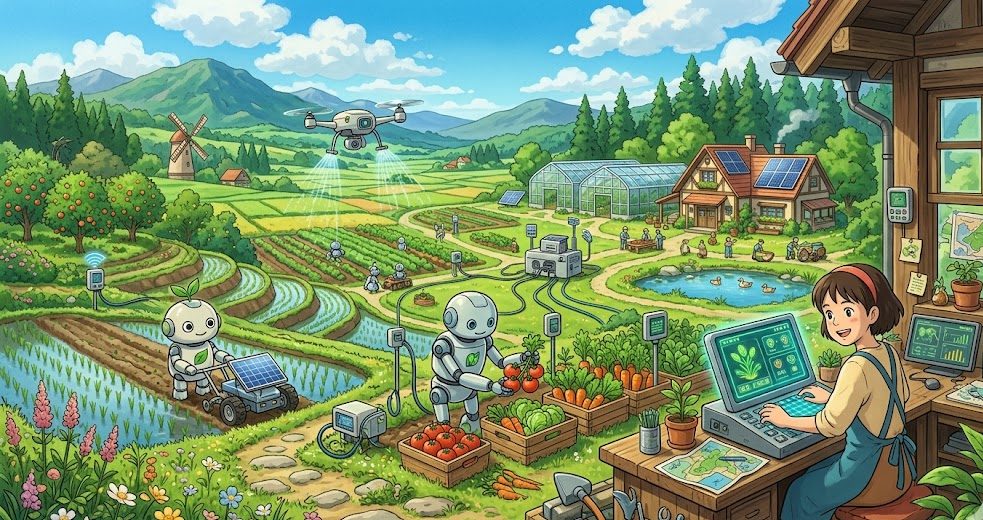
For decades, farming has been a game of intuition, hard work, and unpredictability. Farmers look at the sky, feel the soil, and make their best guess on when to plant, water, and harvest. But as shifting weather patterns become more extreme, input costs skyrocket, and labor shortages intensify, relying on guesswork is no longer enough.
Enter the era of smart agricultural technology.
Today, artificial intelligence (AI) and automated machinery are stepping out of tech labs and moving straight into the fields. This isn’t about replacing the human touch of a farmer; it is about giving growers superpowers. By processing millions of data points in real time, AI helps farmers see the unseen, predict risks weeks in advance, and manage massive tracts of land with microscopic precision.
Whether you operate a sprawling commercial enterprise or a tech-forward family estate, understanding AI automation is the key to building a resilient, future-proof operation.
1. Computer Vision: The New “Eyes” of the Field
Historically, detecting a crop disease required walking the rows and physically inspecting leaves. By the time a human eye noticed a problem, the infection had usually spread across entire acres. Modern smart agricultural technology solves this using computer vision.
How Machine Learning Spots Trouble
High-resolution cameras mounted on drones, tractors, or field posts take thousands of photos daily. Advanced AI algorithms, trained on vast libraries of plant imagery, scan these pictures. The AI can distinguish the exact shape, color, and size of leaf imperfections to identify specific issues, such as apple black rot or wheat rust, with over 90% accuracy.
Targeted Spraying Technology
Instead of blanket-spraying an entire field with expensive chemicals—which wastes money and harms the soil—smart sprayers use computer vision to apply treatments dynamically.
Real-World Impact: As a tractor pulls an AI-enabled sprayer through a field, internal cameras identify weeds among cash crops in milliseconds. The nozzles open and close instantly, spraying only the weed and leaving the surrounding crop untouched. This technique can slash herbicide usage by up to 90%.
2. Autonomous Machinery and Robotic Labor
Finding reliable seasonal labor for planting and harvesting is one of the biggest bottlenecks in modern agriculture. To keep operations running smoothly around the clock, farms are adopting robotic automation.
Self-Driving Tractors
Forget driverless cars on city streets; autonomous tractors are already dominating the fields. Utilizing a mix of GPS guidance systems, radar, and AI obstacle detection, these machines can navigate fields with centimeter-level precision. They operate perfectly in dense fog or pitch-black darkness, mapping out optimized routes that minimize fuel consumption and prevent soil compaction.
Gentle Robotic Harvesters
Harvesting delicate fruits and vegetables has long been considered a uniquely human skill. Today’s AI harvesters utilize soft robotic grippers and spatial AI to judge the exact ripeness of a fruit by its color and density. The robot gently picks the produce without bruising it, allowing for continuous, 24/7 harvesting during peak seasons.
3. AI-Driven Smart Irrigation and Hydration Precision
Water scarcity is no longer a future threat; it is a current reality. Traditional scheduled watering systems often over-saturate certain areas while leaving others bone dry. AI automation turns irrigation into a highly calculated science.
The Connected Micro-Climate
By linking underground Internet of Things (IoT) soil sensors with live satellite weather feeds, AI systems create a dynamic watering blueprint.
[IoT Soil Sensors] + [Satellite Weather Feeds] ➔ [AI Analytics Hub] ➔ [Automated Variable-Rate Irrigation]
Instead of running a generic sprinkler timer, the AI calculates the exact evaporation rate of the day. It instructs automated pumps to deliver variable amounts of water tailored to the precise needs of specific zones, maximizing crop health while conserving precious water resources.
Automated Leak Detection
Water pressure drops can indicate hidden underground line breaks that ruin crops and waste thousands of gallons. Machine learning models analyze water flow anomalies in real time, pinpointing the exact coordinates of a pipeline leak and alerting the farm manager instantly via smartphone.
4. Generative AI Advisories: A Data Scientist in Your Pocket
You don’t need a degree in data analytics to benefit from smart agricultural technology. The rise of localized, voice-activated Generative AI tools means that real-time expert advice is just a question away.
Instant, Localized Insights
Modern farm management software compiles historical records, market trends, and sensor data into interactive AI dashboards. Farmers can simply speak into an app in their native language and ask complex questions:
- “Based on the current humidity and the rain forecast for Thursday, when is the safest window to apply liquid fertilizer?”
- “What is the projected market demand for soybeans in three months compared to corn?”
The AI cross-references local conditions with global agricultural databases, providing an instant, actionable prescription map that eliminates costly human error.
5. Predictive Analytics for Climate Risk Management
Extreme weather events can wipe out an entire season’s profits overnight. While we cannot control the weather, AI predictive modeling gives farmers the runway needed to mitigate disasters.
Deep Learning and Risk Modeling
By analyzing decades of historical climate data alongside live satellite atmospheric tracking, AI models identify subtle patterns that precede major shifts. It can forecast localized frost pockets, flash droughts, or impending pest migrations weeks before they manifest.
With this early warning system, farmers can adjust planting schedules, deploy protective row covers, or harvest crops slightly early, transforming a catastrophic loss into a manageable setback.
Conclusion: Embracing the Smart Farm
Artificial intelligence is no longer a luxury reserved for massive corporate agricultural empires. From automated weeders to simple smartphone apps that analyze soil health, smart agricultural technology is becoming highly accessible and modular. By letting AI handle data processing and routine field monitoring, you can focus on what matters most: strategic planning, sustainability, and growing top-tier crops. The future of farming is digital, and the growers who embrace these automated tools today are the ones who will feed the world tomorrow.
Frequently Asked Questions (FAQs)
1. Do I need an internet connection across my entire farm to use AI tools?
While real-time cloud data processing requires connectivity, many modern agricultural robots and sensors use “Edge AI.” This means the physical machine has built-in processing chips that allow it to navigate, detect weeds, or collect data offline, syncing up with the cloud once it returns to a Wi-Fi-enabled barn.
2. Is smart agricultural technology too expensive for small farms?
While buying an autonomous tractor is a major investment, many entry-level AI tools are highly affordable. Software platforms, drone mapping services, and basic IoT soil sensors are priced for small-to-medium operations. Additionally, tailored equipment financing and agri-tech grants make adoption easier.
3. Will AI eventually eliminate the need for human farm workers?
No. AI is designed to automate repetitive, labor-intensive, and dangerous tasks (like heavy lifting or handling toxic chemical sprays). It changes the labor market by shifting workers into safer, higher-skilled roles like equipment management, tech maintenance, and data-driven strategy.
4. How long does it take to set up an AI farm management system?
Basic software apps and smart sensors can be deployed and used in a single afternoon. However, deep learning models that predict specific crop yields and soil traits become truly accurate after collecting data over one full growing season.
5. Can AI help a farm become organically certified?
Yes! In fact, AI is a major asset for organic growers. Because computer vision-powered robots can mechanically destroy weeds and targeted sprayers reduce reliance on broad-spectrum chemicals, AI helps farms maintain strict organic standards while keeping production high.