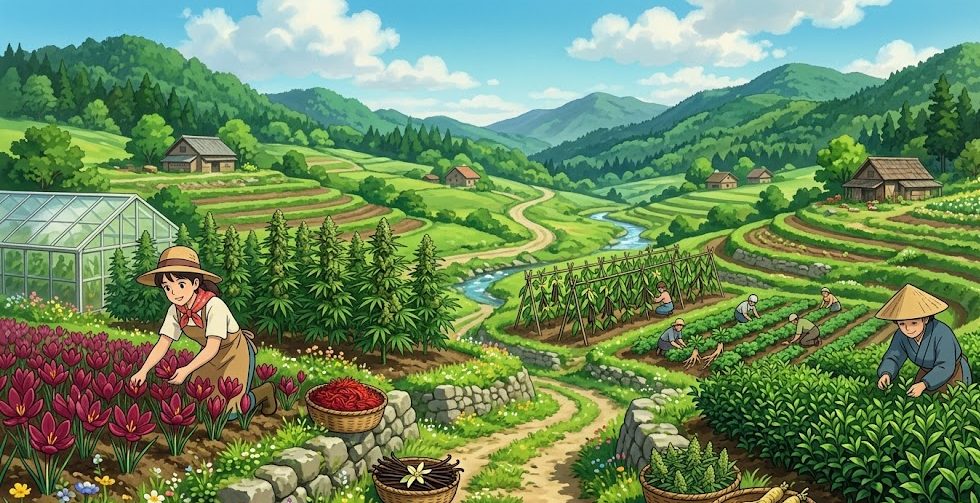
For many farmers, the transition from traditional commodity crops—like corn, wheat, or soybeans—to high-value specialty crops represents a significant opportunity to increase farm revenue (Birthal, n.d.). While commodity crops often rely on massive economies of scale to be profitable, high-value cash crops can generate substantial income even on smaller parcels of land by tapping into niche markets, gourmet culinary trends, and the growing demand for specialty produce (Gao, n.d.).
If you are looking to maximize your profit per acre, it is time to move beyond the staples. Below are five high-value cash crops that are currently trending and consistently proving to be profitable for growers who prioritize quality and market access.
1. Culinary and Medicinal Herbs
Fresh culinary herbs are perhaps one of the most reliable “high-value” crops for small-scale operations (Gao, n.d.). Crops such as basil, rosemary, thyme, chives, and cilantro offer high profit margins because they are in constant demand by restaurants, specialty grocers, and farmers’ markets.
- Why they are profitable: Herbs are lightweight, have a short growth cycle, and can often be harvested multiple times throughout a single season.
- The Profit Edge: Research has shown that crops like basil can yield gross values exceeding $10,000 per acre depending on market conditions (Gao, n.d.). To succeed here, focus on quality and packaging—freshness is the premium factor that keeps chefs returning to your brand.
2. Microgreens
Microgreens—young vegetable greens harvested just after the cotyledon leaves have developed—have exploded in popularity due to their high nutritional density and visual appeal in gourmet cooking.
- Why they are profitable: You can produce these indoors in controlled environments, meaning you aren’t limited by typical outdoor growing seasons. Their “crop-to-harvest” time is incredibly fast (often 7–14 days), allowing for rapid turnover of capital.
- The Profit Edge: Because they are grown vertically in trays, your “acreage” is effectively multiplied. You aren’t just farming the ground; you are farming the cubic space.
3. Gourmet Mushrooms
Specialty mushrooms like Shiitake, Oyster, or Lion’s Mane represent a unique category of high-value agriculture. Unlike traditional crops, they require specialized substrates (like sawdust or straw logs) and controlled humidity/light conditions.
- Why they are profitable: Mushrooms can be grown in low-light, indoor spaces that are otherwise useless for traditional farming. They have a high price-per-pound ratio in both wholesale and direct-to-consumer markets.
- The Profit Edge: You can stack mushroom production racks vertically, making this one of the most space-efficient methods of generating income on a small footprint.
4. Berries (Strawberries, Raspberries, and Blueberries)
Perennial berry crops are a classic “high-value” choice. While they require a larger upfront investment in irrigation and planting (sunk costs), they provide reliable annual income once established (Neill & Morgan, 2021).
- Why they are profitable: Consumers are willing to pay a premium for “locally grown” berries, which are often fresher and have a better shelf life than those shipped long-distance.
- The Profit Edge: High-yield varieties, especially when grown in tunnels or greenhouses, can extend the harvest season, allowing you to capture higher market prices during the “off-season.”
5. Specialty Vegetables (Heirloom Varieties)
Standard supermarket vegetables are often bred for transportability and shelf life, which often comes at the expense of flavor. Heirloom tomatoes, unique pepper varieties, and gourmet lettuce mixes are highly sought after by foodies and chefs.
- Why they are profitable: They offer a differentiation factor. By growing varieties that cannot be found in a typical grocery store, you move out of the “commodity” price trap and into a “premium” pricing tier.
- The Profit Edge: Direct-to-consumer marketing through farm stands or Community Supported Agriculture (CSA) programs allows you to capture the full retail value of your produce rather than selling at wholesale margins (Kim, 2016).
Factors Influencing Your Profitability
It is important to remember that high-value crops are generally high-risk, high-reward (Neill & Morgan, 2021). Unlike corn or soy, which have established, stable global markets, specialty crops depend on specific, often local, demand.
Frontiers
- Market Access: Before you plant, secure your buyers. Whether it’s a contract with a local restaurant or a spot at a popular market, having a defined path to sale is essential (Gao, n.d.).
- Labor Intensity: Most high-value crops require more manual labor for weeding, harvesting, and post-harvest handling (Kanyua, n.d.).
- Capital Investment: Specialized equipment, irrigation systems, and climate-controlled storage often represent significant “sunk costs” that must be factored into your long-term ROI calculations (Neill & Morgan, 2021).
Frequently Asked Questions (FAQs)
Q: Are these crops suitable for beginners? A: Some, like microgreens, are excellent for beginners due to their short cycles. Others, like perennials or mushrooms, have a steeper learning curve regarding infrastructure and environment management.
Q: Do I need a lot of land to make a profit? A: No. That is the beauty of high-value cash crops. Many growers make a full-time living on less than five acres by focusing on intensive, high-yield production methods.
Q: How do I compete with supermarket prices? A: You don’t. You compete on quality, freshness, and local identity. Customers purchasing gourmet produce at a farmers’ market are rarely looking for the cheapest price; they are looking for the best experience.
Q: What is the biggest risk with specialty crops? A: Market volatility and crop loss. Because these crops are often delicate, a single pest infestation or weather event can impact a larger percentage of your revenue compared to commodity crops.
Conclusion
Transitioning to high-value cash crops is a strategic move that requires planning, market research, and a commitment to quality. By focusing on crops like culinary herbs, microgreens, or gourmet mushrooms, you can dramatically increase the profitability of every acre you manage.
Remember, the goal of “high-value” farming is to do more with less—to create a premium product that sustains both your land and your livelihood. Start with one specialty crop, master the production process, and build your market connections before expanding. Your journey to a more profitable farm begins with identifying the niche that works for your climate and your community.